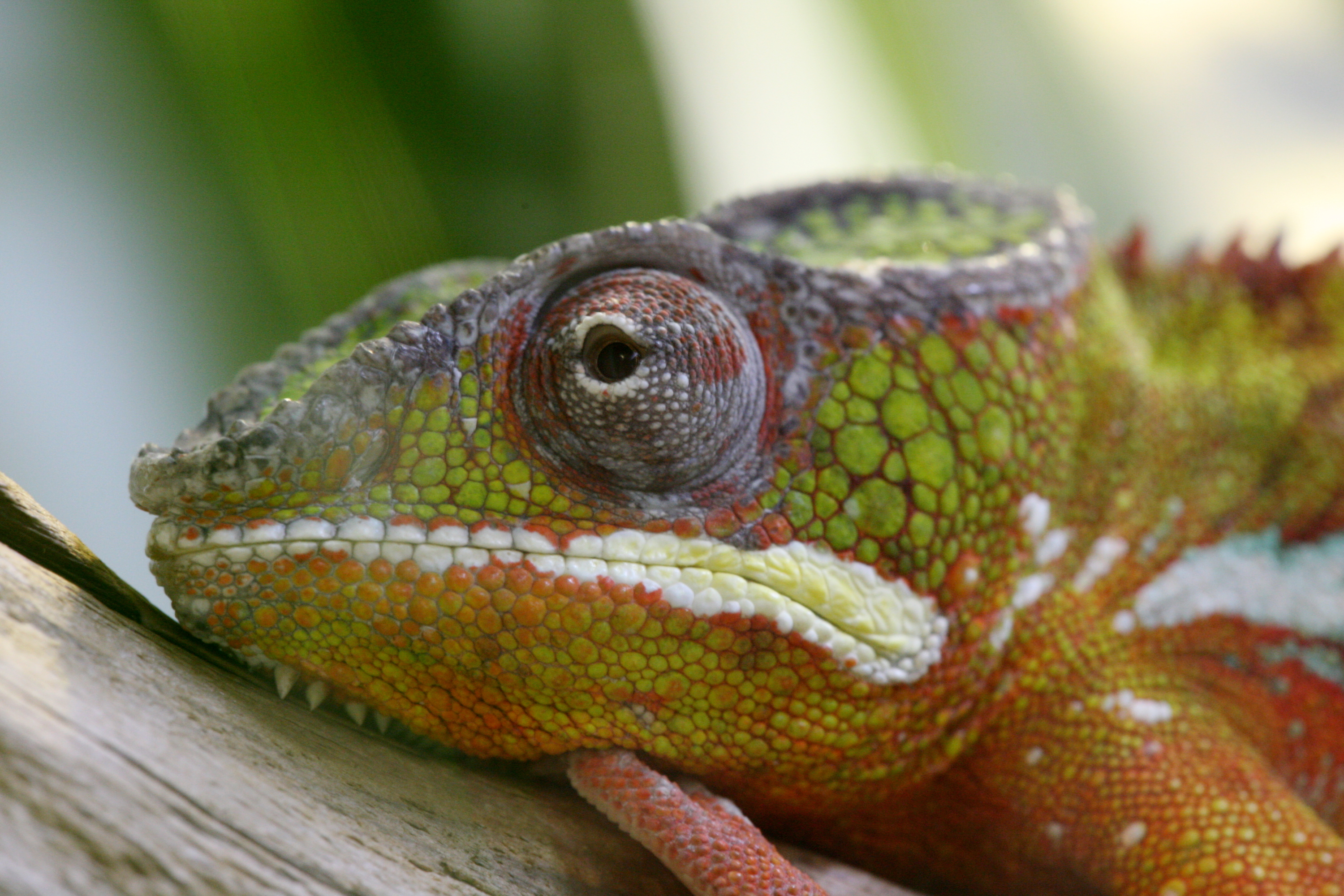
Panther chameleons are brightly colored arboreal lizards from Madagascar, named for their bold reds, blues, and greens that vary by locale. Captive-bred individuals are well-established in the U.S. trade and considered an advanced-care species.
ℹ️
Educational only. KinStation content is reviewed by licensed veterinarians but cannot replace an in-person exam. Always consult a licensed veterinarian or board-certified specialist for diagnosis, treatment, or any decision affecting your pet's health.
🩺 Need expert help with your panther chameleon?
Connect with a specialist near you or ask a licensed vet — never substitute online guidance for hands-on care in an emergency.
Males 14–20 inches total length; females smaller (10–14 inches).
Lifespan
4–7 years
Social needs
solo
Native region
Madagascar (Sub-Saharan Africa)
Origin
Old World
Climate
🌴 Tropical
Family
Chamaeleonidae
Genus
Furcifer
Part of the Chameleons
Chameleons are specialized arboreal and leaf-litter Old-World lizards prized for color change, independently swiveling eyes, projectile tongues, and precise temperature and humidity needs.
From the minimum an animal needs to be kept humanely, up to the ideal setup. Bigger is almost always better — minimums are floors, not targets.
Photo coming soon
Minimum
Adult screen cage
2 × 2 × 4 ft (≈ 24 × 24 × 48 in)
An adult panther chameleon needs a well-ventilated screen enclosure of at least 24 × 24 × 48 inches densely furnished with branches and live foliage for cover and climbing. Provide a 28–32 °C basking spot dropping to ambient room temperature, high-output (5–6 %) UVB, and a dripper or misting system for drinking; chameleons are strictly solitary and stressed by the sight of other chameleons.
Recommended
Planted screen / hybrid enclosure
2 × 2 × 4 ft, heavily planted
A 2 × 2 × 4-foot screen or hybrid enclosure packed with live plants such as ficus and pothos gives essential visual barriers and naturalistic climbing routes. Maintain a clear thermal gradient with a 30–32 °C basking branch, strong UVB, nightly humidity spikes to 70–100 % that dry out by day, and an automated misting system plus dripper for hydration.
David Dixon / CC BY-SA 2.0 (Wikimedia Commons)
Photo coming soon
Ideal
Free-range / planted atrium
Large atrium or free-range plant tree
The best welfare setup is a large planted atrium or a free-range ficus 'tree' in a warm, bright room with abundant perching height, dappled light, and a fogger/mister recreating natural humidity cycles. Provide rich UVB or natural sunlight, varied branch diameters, and live foliage so this active, visually driven species can thermoregulate, hunt, and hide as it would in Madagascar.
Life & growth stages
How this animal changes through its life — each stage often has its own care, diet and space needs.
Photo coming soon
Egg / Neonate
Most reptiles lay leathery- or hard-shelled eggs incubated by ambient warmth, though some snakes and lizards give live birth. Incubation temperature can influence sex and development in many species.
Photo coming soon
Hatchling
Hatchlings emerge as fully formed miniatures of the adult, often using an egg tooth to slit the shell. They are independent from birth but small and vulnerable, and may show brighter or different juvenile patterning.
Photo coming soon
Juvenile
Juveniles grow steadily, shedding their skin periodically as they enlarge. Coloration and proportions shift toward the adult form, and growth rate depends heavily on temperature, diet, and basking/UVB access.
Adult
Adults reach the species' full length and mass and become sexually mature. Many reptiles show sex differences in size, coloration, or features (such as larger heads, hemipenal bulges, or femoral pores), and continue to shed throughout life.
Color & pattern variants
Natural variants occur in the wild; selectively bred (man-made) variants were developed in captivity.
Panther chameleons are arboreal rainforest-edge animals and, like other chameleons, do best in a tall, ventilated screen enclosure rather than a sealed glass tank. A frequently cited target for a single adult is a screen cage around 24×24×48 inches, heavily planted with sturdy live or artificial foliage and a network of climbing branches sized to grip. Vertical space and dense cover let the animal choose its exposure and feel secure.
The setup needs a clear thermal gradient — a focused basking zone grading down to a cooler ambient range with a nighttime drop — plus high-output UVB across the upper enclosure for healthy calcium metabolism. UVB lamps are replaced on a schedule as their output fades. Strong ventilation is repeatedly emphasized for this species because stagnant, perpetually wet air contributes to respiratory and eye infections.
Humidity is supplied through misting and drippers rather than a soggy substrate; panther chameleons drink droplets from leaves and typically ignore standing water bowls. Daytime humidity is moderate, often rising overnight, with the cage allowed to dry between mistings. Live plants help maintain humidity and provide drinking surfaces, and gravid females need a deep diggable laying area.
Substrate
Bare-bottom or paper-towel flooring is safest in a screen cage because it prevents impaction and is easy to keep hygienic; if a planted bioactive base is used, top it with large drainage media and leaf litter so the chameleon cannot ingest loose soil while hunting. Avoid loose particulate or moss substrates within reach of feeding.
Equipment & setup
House in a large, well-ventilated screen enclosure (at least 24x24x48 inches for an adult male) with a basking spot of 85-90F under the canopy and a vertical gradient down to the low 70sF, plus a linear T5 UVB bulb (5.0-6.0) overhead. Provide dense horizontal branches and live foliage (ficus, pothos, schefflera), and deliver hydration via a dripper and automatic misting system or 2-3 long hand-mistings per day rather than a standing bowl.
Diet
Panther chameleons are insectivores. A rotation of feeders — crickets, dubia roach nymphs, silkworms, black soldier fly larvae, and occasional hornworms — provides better nutrition than a single staple insect, and all feeders are gut-loaded before offering. Variety also keeps interest high in an animal that hunts visually and can become bored of a monotonous diet.
Supplementation uses plain calcium at most feedings plus a multivitamin and a D3 component offered on a less frequent, vet-guided schedule. Both deficiency and excess of fat-soluble vitamins can cause disease, so the regimen is kept conservative and consistent rather than improvised. Exact frequencies should be confirmed with an exotics veterinarian, not estimated.
Hydration is part of feeding success: a dehydrated chameleon eats poorly, so misting and dripper systems matter as much as the insects. Common mistakes mirror those of the veiled chameleon — assuming the animal drinks enough, feeding only crickets, and over-relying on fatty feeders.
Behavior & temperament
Panther chameleons are solitary and territorial; adults are housed singly, and even the sight of another chameleon can be stressful. They are primarily display animals that tolerate, rather than enjoy, brief handling for necessary husbandry. Stress is communicated through color and posture: darkening, gaping, and lateral flattening typically indicate the animal wants to be left alone.
Color is this species' headline feature and its language. Bright, high-contrast displays can signal either breeding readiness or agitation depending on context, while calm animals settle into a more relaxed palette that varies by locale (population of origin). Reading the difference between a confident display and a stress display is a learned skill that comes from observing a specific animal over time.
Females signal receptivity and gravidity through color and behavior, and a gravid female will need a laying site whether or not breeding was intended. As with all chameleons, sudden, sustained changes in baseline color or activity are behavioral red flags worth investigating.
Health
Husbandry underlies most panther chameleon health issues: metabolic bone disease (inadequate calcium/UVB), dehydration and renal disease, vitamin A deficiency, ocular problems and respiratory infection (linked to humidity and ventilation extremes), and egg binding in females. These are general patterns, not a diagnostic checklist — any specific concern belongs with a veterinarian.
Prevention is environmental: correct gradient and UVB (replaced on schedule), reliable hydration via misting/dripping, good airflow, and a laying site for females. Knowing the animal's normal appetite, hydration cues, and calm coloration makes early problems easier to catch.
Signs that warrant a reptile-experienced veterinarian include sunken or persistently closed eyes, ocular discharge, weakness or a rubbery jaw, loss of grip, sustained dark stress coloration, and inappetence. Establishing care with an exotics vet before an emergency is strongly advised.
Tips, DIY & hacks
Chameleons rarely drink from bowls, so a DIY dripper made from an ice-water-filled deli cup with a pinhole gives a steady drink onto leaves; run misting outside basking hours so the animal can warm up and dry off. Gut-load and dust feeders (calcium without D3 most feedings, calcium with D3 and a multivitamin lightly per veterinary schedule), and house panther chameleons individually since they are territorial and stress badly in sight of conspecifics.
Origin & history
Furcifer pardalis is endemic to Madagascar, where it occurs in distinct regional populations known as "locales" — Ambilobe, Nosy Be, Ambanja, Sambava, and others — each associated with characteristic male coloration. This locale system has profoundly shaped the pet trade, where animals are often sold and bred by locale to preserve particular color lines.
Once supplied largely through wild collection and export, panther chameleons are now extensively captive-bred in the United States and Europe, improving both availability and the health of available animals. Their spectacular reds, blues, greens, and oranges make them one of the most photographed reptiles in the hobby and a flagship species for Madagascar's herpetofauna.
Anecdotes & owner lore
Community experience and cultural notes — not veterinary advice. Every animal is an individual; treat these as colour, not care instructions.
In the hobby, panther chameleons are practically traded like fine wine by region: keepers will debate the merits of an Ambilobe "red bar blue body" versus a Nosy Be turquoise the way collectors argue vintages. A male coming into full breeding color for the first time is a milestone owners photograph and share, and "firing up" for the camera is half the fun of keeping one.
There's also a persistent myth — that chameleons change color to match their surroundings — that panther keepers enjoy debunking, because their animals do the opposite of hiding: a confident male turns the brightness up. Many owners describe distinct personalities, from mellow individuals that calmly hand-walk onto a plant during cage cleaning to divas that puff, sway, and gape at a passing shadow. The slow, deliberate, rocking "branch-in-the-wind" walk, paired with independently swiveling turret eyes, gives the species an oddly contemplative, almost dinosaur-like charisma that owners find addictive.
Common ailments
Metabolic bone disease (MBD) — common — Prevented by correct UVB (replaced on schedule) and a conservative calcium program; common in animals kept without proper lighting.
Dehydration and kidney disease — common — Panther chameleons drink from droplets; reliable misting/dripper hydration is the main preventive measure.
Dystocia (egg binding) — common — Gravid females need a deep laying site even without a male present.
Eye infection / ocular disease — common — Often tied to inadequate ventilation, vitamin A status, or chronically wet conditions in the enclosure.
Reviewed and signed off by: KinStation Editorial - pre-launch draft (pending DVM review)