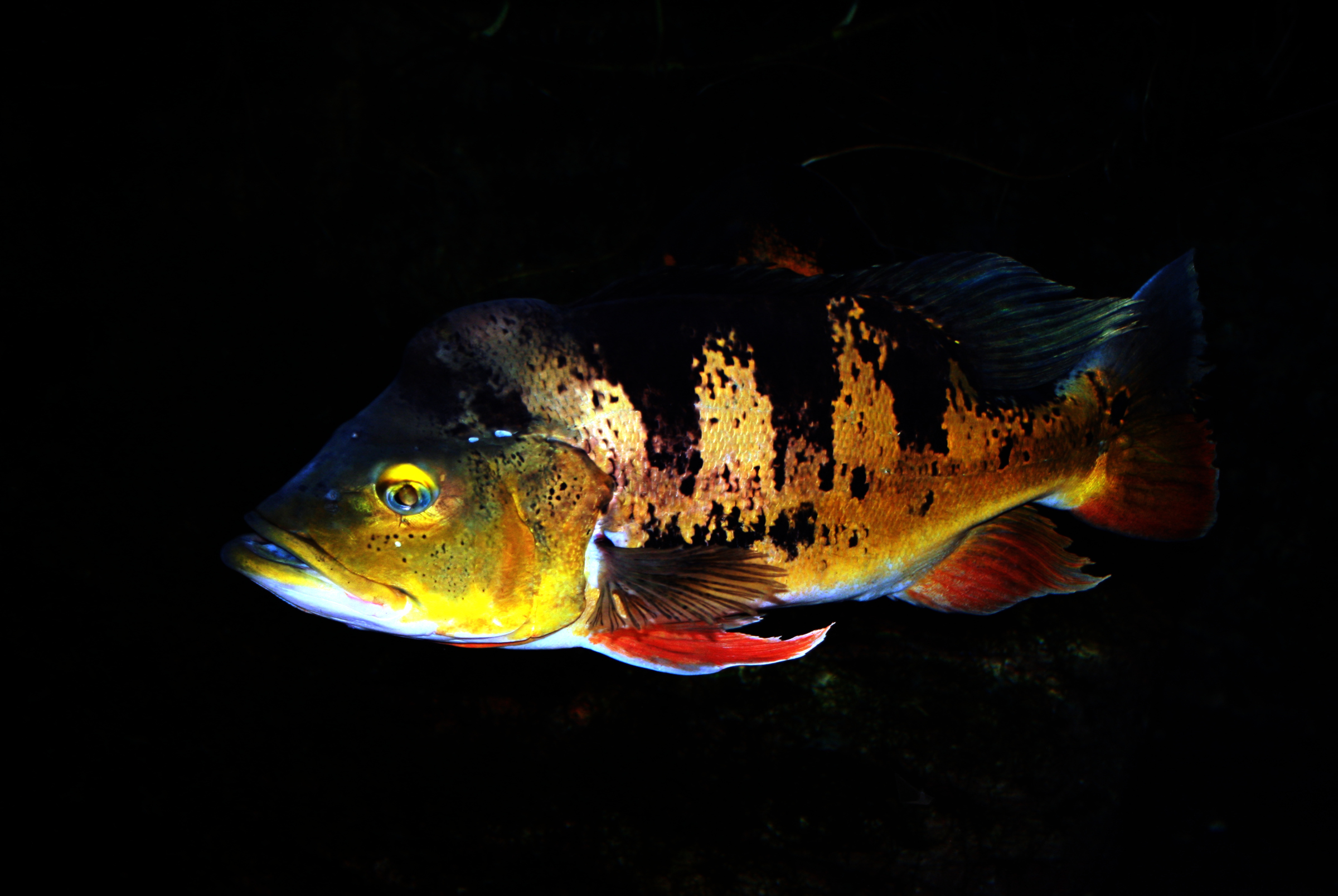
A large, fast-growing, vividly marked South American predatory cichlid prized by anglers and big-tank keepers. It is a hard-hitting piscivore that needs an enormous tank, and as an introduced game fish it is invasive in warm US waters, so it must never be released.
ℹ️
Educational only. KinStation content is reviewed by licensed veterinarians but cannot replace an in-person exam. Always consult a licensed veterinarian or board-certified specialist for diagnosis, treatment, or any decision affecting your pet's health.
🩺 Need expert help with your peacock bass?
Connect with a specialist near you or ask a licensed vet — never substitute online guidance for hands-on care in an emergency.
From the minimum an animal needs to be kept humanely, up to the ideal setup. Bigger is almost always better — minimums are floors, not targets.
Photo coming soon
Minimum
Adult cichlid monster tank
180 gal / 680 L (≥6 ft)
Cichla species reach 40–75 cm depending on species and are aggressive open-water piscivores. 6-ft tank is bare entry; smaller tanks cause stress damage and stunting.
Photo coming soon
Recommended
Large monster-cichlid system
300–500 gal / 1100–1900 L (8 ft+)
8-ft+ tank with massive filtration (4–6× turnover), strong cooling, and feeder-quality varied diet. Single specimen or carefully matched pair — they kill weaker tankmates.
Photo coming soon
Ideal
Indoor pond / public display
1000 gal+ / 3800 L+ pond
Indoor pond or public-aquarium-scale display with sand bottom, driftwood structures, and room to express full adult swimming range. Truly humane peacock-bass keeping.
Life & growth stages
How this animal changes through its life — each stage often has its own care, diet and space needs.
Photo coming soon
Egg
Fish eggs are small, translucent spheres, often laid in clutches on plants, substrate, or in a nest — or carried/brooded by a parent in livebearing and mouth-brooding species. A dark eye spot and the curled embryo become visible inside as development progresses.
Photo coming soon
Fry
Newly hatched fry are tiny and semi-transparent, frequently still carrying a yolk sac that fuels them before they feed freely. They lack full fin structure and adult coloration, staying near cover until they can swim and forage on their own.
Photo coming soon
Juvenile
Juveniles look like miniature adults but with developing fins and muted or different markings; many species shift pattern and color as they mature. Growth is rapid at this stage given clean water and steady feeding.
Adult
Adults show the species' full size, finnage, and mature coloration, and are sexually mature. Many fish develop sex-specific differences in size, color, or fin shape, which can intensify during breeding.
Habitat & enclosure
A single adult needs a very large tank, at least 180 gallons (680 L) and realistically a 6 ft (180 cm) or longer footprint, with even bigger systems for multiples. Warm, soft to neutral water, pH 6.5-7.5, temperature 76-84F (24-29C), with strong filtration and brisk flow to mimic flowing rivers. Provide open swimming room with a few large, immovable rocks or driftwood for territory; this powerful fish needs space more than clutter. A secure lid prevents jumping.
Substrate
Use sand or smooth gravel, or bare-bottom in very large systems for easier cleaning of a messy predator. Avoid sharp decor that could injure a fast-moving fish. Keep the layout open with a few heavy, stable structures rather than fine breakable ornaments.
Equipment & setup
Needs oversized filtration (large sumps or multiple canisters), strong flow, a guarded heater, and a heavy, secure lid to prevent powerful jumps. Robust, immovable hardscape resists being shoved around. No UVB is required; focus on biological filtration, oxygenation, and water volume to support a big, hungry carnivore.
Diet
An apex piscivore. Feed thiaminase-free fish fillets (tilapia, whitefish), shrimp, prawn, earthworms, and large floating or sinking carnivore pellets, which most can be trained to accept. Avoid an exclusive diet of feeder fish, which carry disease and cause vitamin B1 deficiency; vary protein and supplement B1 if needed. Feed growing fish heavily but watch water quality, as this voracious eater produces heavy waste.
Behavior & temperament
Bold, active, and highly predatory, striking explosively at prey and intolerant of other fish in its space; it is best kept singly or only in very large systems with similarly robust, fast tankmates. It is not aggressive toward people but is skittish and powerful and can injure itself dashing into the glass or lid, so a large, calm setup helps. Not a handling fish; net it carefully and respect its size and strength.
Health
Generally hardy and disease-resistant given space and clean water, but prone to ich and bacterial infections under stress, head/snout damage from glass-surfing, and stunting or spinal deformity in undersized tanks. Thiaminase-rich feeder diets cause neurological B1-deficiency signs; rotate foods. Maintain heavy filtration and large water changes to control nitrate from its big appetite. Skittish dashing is the main injury risk, so minimize sudden disturbances.
Tips, DIY & hacks
Never release a peacock bass: Cichla species are established invasive game fish in Florida and parts of Hawaii and Texas and can be regulated or restricted, so check state law before keeping and rehome responsibly. Note that the aquarium-trade name covers several Cichla species and hybrids, so wild-collected or imported stock may not be true C. ocellaris. Wean juveniles onto pellets and varied fillet to avoid feeder-fish disease and B1 deficiency. Plan for a roughly 2-foot fish with a decade-long lifespan and a tank measured in hundreds of gallons.