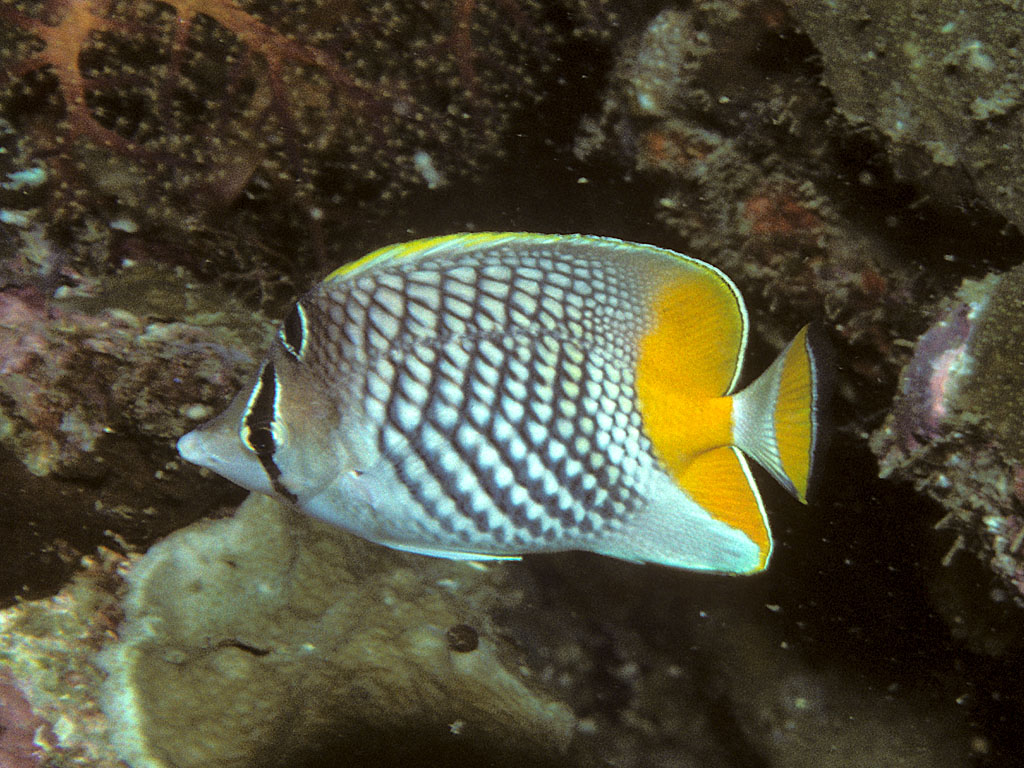
The pearlscale butterflyfish is an elegant species patterned with a crosshatched 'pearl' net of dark-edged scales and a bright orange-yellow tail band. Beautiful but demanding, it needs a mature tank and is not safe with most corals.
ℹ️
Educational only. KinStation content is reviewed by licensed veterinarians but cannot replace an in-person exam. Always consult a licensed veterinarian or board-certified specialist for diagnosis, treatment, or any decision affecting your pet's health.
🩺 Need expert help with your pearlscale butterflyfish?
Connect with a specialist near you or ask a licensed vet — never substitute online guidance for hands-on care in an emergency.
Small-to-medium butterflyfish: reaches about 14-15 cm (5.5-6 in).
Lifespan
5–10 years
Social needs
solo
Native region
Western Pacific (Philippines, Indonesia, Ryukyu Islands)
Origin
Old World
Climate
🌴 Tropical
Water type
🌊 Marine
Family
Chaetodontidae
Genus
Chaetodon
Part of the Butterflyfish
Disc-shaped, ornately patterned reef fish admired for their elegance; many are specialist feeders demanding mature systems and careful diets, and most are not fully reef-safe.
From the minimum an animal needs to be kept humanely, up to the ideal setup. Bigger is almost always better — minimums are floors, not targets.
Photo coming soon
Minimum
Long FOWLR
90 gal / 340 L FOWLR (≥4 ft)
Chaetodon xanthurus is a hardier butterfly but still picks at inverts. 4-ft+ FOWLR with peaceful tankmates, ample rock, and stable params (24–26 °C, sg 1.024).
Photo coming soon
Recommended
Mature FOWLR or SPS reef
125 gal / 470 L
More length lets it cruise. Varied frozen mysis/brine + sponge formulas. Single specimen in most setups; pairs only in very large reefs.
Photo coming soon
Ideal
Large reef-safe display
180 gal+ / 680 L+ display
Spacious SPS-only reef with long swim lanes and mature ecosystem. Most stable long-term butterflyfish keeping.
Life & growth stages
How this animal changes through its life — each stage often has its own care, diet and space needs.
Photo coming soon
Egg
Fish eggs are small, translucent spheres, often laid in clutches on plants, substrate, or in a nest — or carried/brooded by a parent in livebearing and mouth-brooding species. A dark eye spot and the curled embryo become visible inside as development progresses.
Photo coming soon
Fry
Newly hatched fry are tiny and semi-transparent, frequently still carrying a yolk sac that fuels them before they feed freely. They lack full fin structure and adult coloration, staying near cover until they can swim and forage on their own.
Photo coming soon
Juvenile
Juveniles look like miniature adults but with developing fins and muted or different markings; many species shift pattern and color as they mature. Growth is rapid at this stage given clean water and steady feeding.
Adult
Adults show the species' full size, finnage, and mature coloration, and are sexually mature. Many fish develop sex-specific differences in size, color, or fin shape, which can intensify during breeding.
Habitat & enclosure
Found on coral-rich reefs and rubble slopes of the western Pacific. Requires a mature, stable aquarium of at least 280 L (75 gal) with abundant live rock, caves, and grazing surfaces. Reef parameters: 24-27 C (75-80 F), salinity 1.020-1.025 SG, pH 8.1-8.4, very low nitrate. Generally NOT reef-safe — it nips stony and soft coral polyps and other sessile invertebrates.
Substrate
Fine aragonite sand with extensive, well-aged live rock providing crevices to shelter in and natural microfauna to graze. Plenty of cover reduces stress in this naturally cautious fish.
Equipment & setup
High-performance skimmer and biological filtration to keep nitrate low, a heater, moderate flow, and reef-appropriate lighting. A secure lid prevents jumping. No UVB required. A refugium supplying live copepods and amphipods helps support newly introduced specimens.
Diet
Carnivore feeding on small invertebrates and coral polyps in the wild. Often needs coaxing onto prepared foods: offer frozen mysis, enriched brine, finely chopped seafood, and clam/mussel on the half shell, fed multiple small meals daily. A mature tank with live rock 'pods' and microfauna greatly aids acclimation.
Behavior & temperament
Generally peaceful and somewhat shy, appreciating cover and dim acclimation. Best kept one per tank unless the system is very large, where a bonded pair can be tried. Mixes with calm tankmates but may be bullied by aggressive fish. Not handleable; an observation-only display species.
Health
Considered delicate — sensitive to water quality, shipping stress, and poor diet, and prone to hunger strikes if it will not accept aquarium foods. Susceptible to marine ich and bacterial/fin disease; quarantine and observe feeding before purchase. Pristine, stable water and a varied diet are essential to long-term success.
Tips, DIY & hacks
Buy only specimens already eating prepared foods, and pick a mature, peaceful tank for acclimation. Accept that corals and ornamental polyps are at risk — house it in a fish-only-with-live-rock or carefully chosen system. Multiple tiny feedings beat one large meal for keeping butterflyfish in condition.