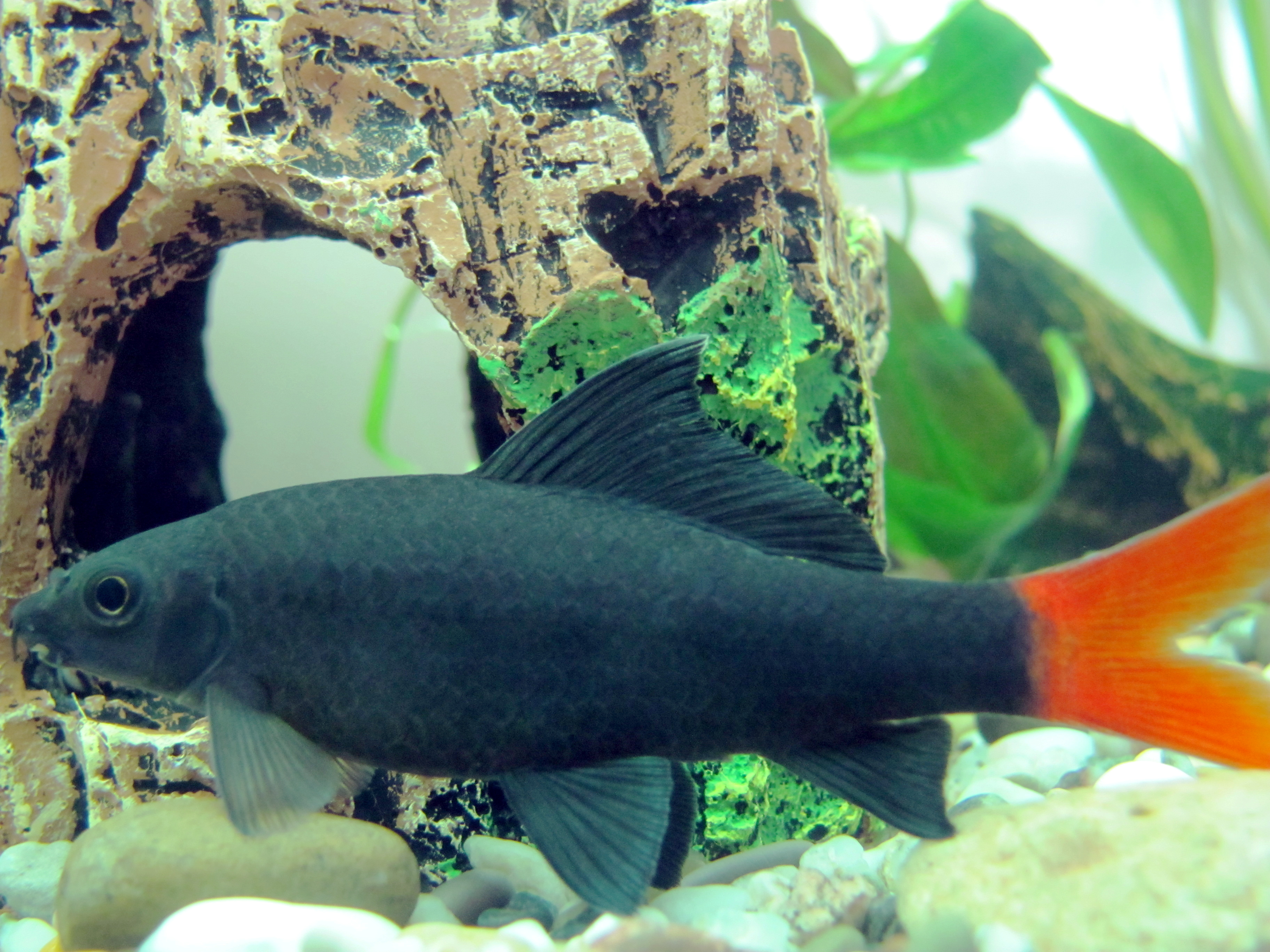
The redtail shark is a striking Thai cyprinid with a velvety jet-black body and a single brilliant red tail. Endangered in the wild and sustained in the hobby by captive breeding, it is a bold, territorial bottom-dweller best kept as the lone 'shark' in a spacious, well-structured aquarium.
ℹ️
Educational only. KinStation content is reviewed by licensed veterinarians but cannot replace an in-person exam. Always consult a licensed veterinarian or board-certified specialist for diagnosis, treatment, or any decision affecting your pet's health.
🩺 Need expert help with your redtail shark?
Connect with a specialist near you or ask a licensed vet — never substitute online guidance for hands-on care in an emergency.
Shark-shaped cyprinids kept for their bold profiles and active foraging; most are territorial and best managed as the standout fish in a robust community.
From the minimum an animal needs to be kept humanely, up to the ideal setup. Bigger is almost always better — minimums are floors, not targets.
Photo coming soon
Minimum
Long territorial tank
55 gal / 200 L (≥4 ft)
Epalzeorhynchos bicolor (critically endangered in wild) reaches 15 cm and is highly territorial. One only, 4-ft+ length, caves, no other shark-shaped fish.
Photo coming soon
Recommended
Long planted community
75 gal / 280 L
6-ft+ footprint with dither schools and structured rockwork. The red tail patrols a defined territory — break sight lines with plants and driftwood.
Photo coming soon
Ideal
Large Asian biotope
125 gal+ / 470 L+ biotope
Long biotope with strong flow, abundant cover, and mixed dither species. Full red-on-black colour and reduced aggression in this scale.
Life & growth stages
How this animal changes through its life — each stage often has its own care, diet and space needs.
Photo coming soon
Egg
Fish eggs are small, translucent spheres, often laid in clutches on plants, substrate, or in a nest — or carried/brooded by a parent in livebearing and mouth-brooding species. A dark eye spot and the curled embryo become visible inside as development progresses.
Photo coming soon
Fry
Newly hatched fry are tiny and semi-transparent, frequently still carrying a yolk sac that fuels them before they feed freely. They lack full fin structure and adult coloration, staying near cover until they can swim and forage on their own.
Photo coming soon
Juvenile
Juveniles look like miniature adults but with developing fins and muted or different markings; many species shift pattern and color as they mature. Growth is rapid at this stage given clean water and steady feeding.
Adult
Adults show the species' full size, finnage, and mature coloration, and are sexually mature. Many fish develop sex-specific differences in size, color, or fin shape, which can intensify during breeding.
Habitat & enclosure
Give a single redtail shark at least a 55-gallon (~210 L) tank with a long footprint to accommodate its active patrolling and territorial nature. Maintain tropical conditions of 72-79°F (22-26°C), pH 6.5-7.5, and soft to moderately hard water with stable parameters and clean, well-oxygenated water.
Originating from the streams and floodplains of the Chao Phraya basin, it appreciates moderate flow and abundant cover. Dense decor — driftwood tangles, caves, and rockwork — breaks line of sight and gives the fish defensible retreats, which is key to managing its temper. Moderate lighting with shaded zones works best.
Substrate
Soft sand or smooth fine gravel protects its barbels and belly as it forages. A dark substrate deepens the contrast of the black body and red tail while helping the fish feel secure.
Equipment & setup
Use efficient filtration delivering moderate current and a heater for the tropical range. A powerhead or filter return can supply gentle flow to mimic its native streams; standard planted/community lighting is fine, complemented by plenty of caves and driftwood for territorial boundaries.
Diet
Omnivorous and easy to feed. Provide a balanced diet of sinking pellets, flakes, and algae wafers, plus blanched vegetables (zucchini, peas, spinach) and occasional live or frozen treats like bloodworms and brine shrimp. It grazes biofilm and algae but is not an efficient dedicated algae eater.
Behavior & temperament
Territorial and semi-aggressive, intolerant of conspecifics and other similar-shaped or bottom-dwelling fish; keep strictly one per tank in most setups. Pair with fast, mid-to-upper-level tankmates such as larger tetras, barbs, danios, and rainbowfish. Avoid loaches, catfish, other freshwater sharks, and shy bottom fish that it will bully.
Health
Hardy when well kept but prone to ich and stress-related fin or skin problems in unstable or dirty water. Most health issues are secondary to aggression-induced stress or poor maintenance, so generous space, hiding spots, and consistent water quality are the best defenses. Quarantine newcomers before introduction.
Tips, DIY & hacks
Introduce the redtail shark last so it doesn't claim the whole tank before tankmates arrive. Rescaping decor when adding fish helps disrupt established territories and curb aggression. Because the species is endangered in the wild, choose captive-bred stock from reputable sources.