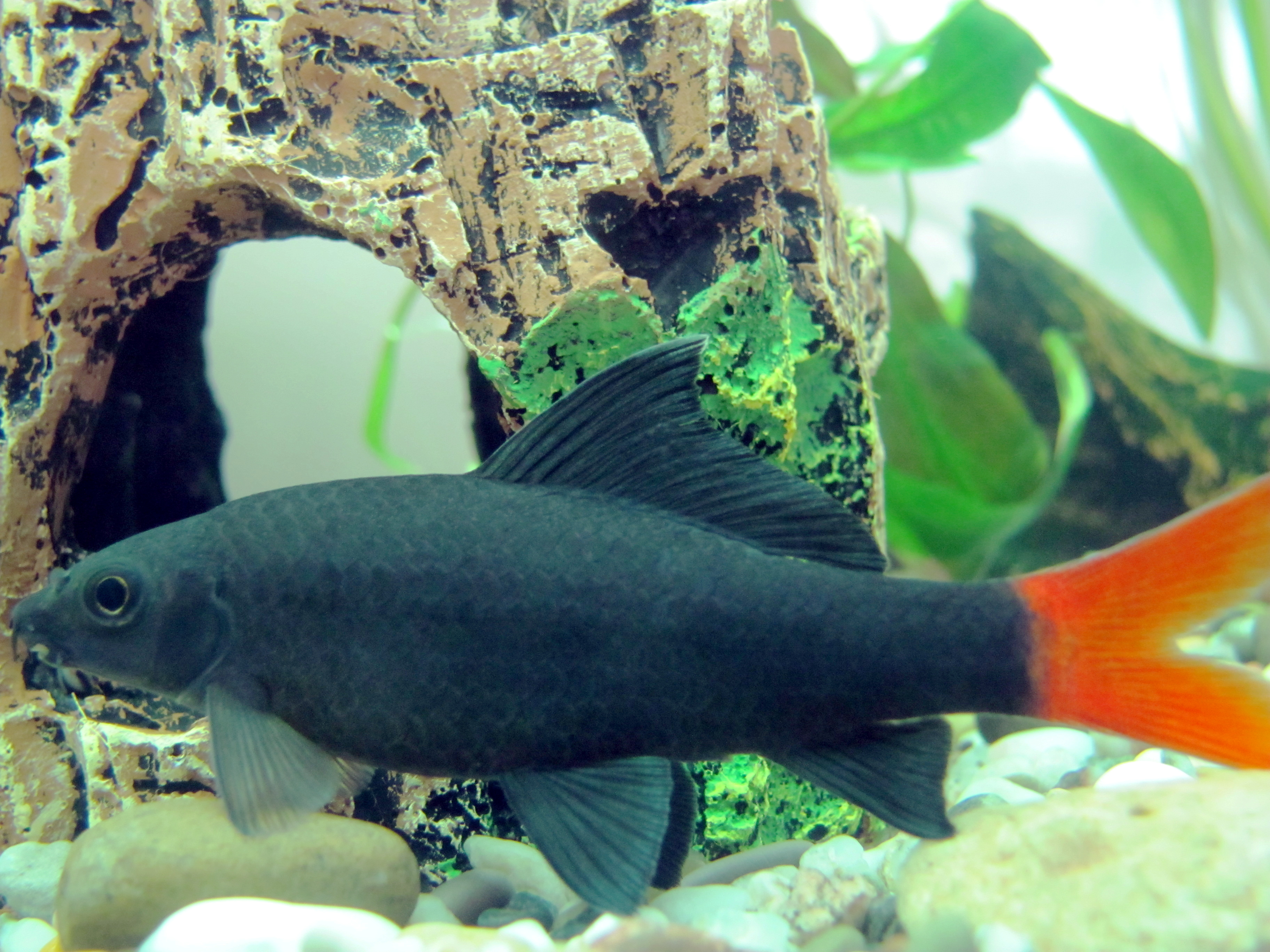
The redtail shark is a striking velvet-black cyprinid with a brilliant red caudal fin. Bold and territorial, it is best kept singly as the lone 'shark' in a community of robust tankmates.
ℹ️
Educational only. KinStation content is reviewed by licensed veterinarians but cannot replace an in-person exam. Always consult a licensed veterinarian or board-certified specialist for diagnosis, treatment, or any decision affecting your pet's health.
🩺 Need expert help with your redtail shark?
Connect with a specialist near you or ask a licensed vet — never substitute online guidance for hands-on care in an emergency.
Medium: jet-black body with a vivid red tail, reaching about 12-15 cm (5-6 in).
Lifespan
5–8 years
Social needs
solo
Native region
Thailand (Chao Phraya basin)
Origin
Old World
Climate
🌴 Tropical
Water type
💧 Freshwater
Family
Cyprinidae
Genus
Epalzeorhynchos
Part of the Freshwater Sharks
Shark-shaped cyprinids kept for their bold profiles and active foraging; most are territorial and best managed as the standout fish in a robust community.
From the minimum an animal needs to be kept humanely, up to the ideal setup. Bigger is almost always better — minimums are floors, not targets.
Photo coming soon
Minimum
Long territorial tank
55 gal / 200 L (≥4 ft)
Epalzeorhynchos bicolor reaches 15 cm and is highly territorial — ONE per tank only. 4-ft+ length, structured caves, no other shark-shaped or red-finned fish.
Photo coming soon
Recommended
Larger long community
75 gal / 280 L
6-ft footprint dilutes aggression. Add dither schools (giant danios, rainbows), driftwood, and broken sight lines. Strong flow mimics river origin.
Photo coming soon
Ideal
Asian river biotope
125 gal+ / 470 L+ biotope
Long planted biotope with strong flow, smooth rocks, and active mid-water schools. Best colour and least aggression at this scale.
Life & growth stages
How this animal changes through its life — each stage often has its own care, diet and space needs.
Photo coming soon
Egg
Fish eggs are small, translucent spheres, often laid in clutches on plants, substrate, or in a nest — or carried/brooded by a parent in livebearing and mouth-brooding species. A dark eye spot and the curled embryo become visible inside as development progresses.
Photo coming soon
Fry
Newly hatched fry are tiny and semi-transparent, frequently still carrying a yolk sac that fuels them before they feed freely. They lack full fin structure and adult coloration, staying near cover until they can swim and forage on their own.
Photo coming soon
Juvenile
Juveniles look like miniature adults but with developing fins and muted or different markings; many species shift pattern and color as they mature. Growth is rapid at this stage given clean water and steady feeding.
Adult
Adults show the species' full size, finnage, and mature coloration, and are sexually mature. Many fish develop sex-specific differences in size, color, or fin shape, which can intensify during breeding.
Habitat & enclosure
Endemic to the Chao Phraya basin of Thailand and Critically Endangered (possibly extinct) in the wild; aquarium stock is captive-bred. Provide at least 110-200 L (30-55 gal) with many caves, driftwood tangles, and visual barriers to break up sightlines and establish a single defendable territory. Water: 22-27 C (72-80 F), pH 6.5-7.5, soft to moderately hard.
Substrate
Soft sand or smooth fine gravel protects the underside as it grazes and forages along the bottom. Dense hardscape — rocks, roots, and caves — is more important than plants for providing territory and refuge.
Equipment & setup
Reliable heater, efficient filtration with moderate flow, and a secure lid (they jump). No UVB or special lighting required, though subdued lighting and plenty of cover encourage natural behavior and color.
Diet
Omnivore with a strong appetite for algae and biofilm. Offer sinking pellets and wafers, supplemented with blanched vegetables (zucchini, spinach, cucumber) and occasional frozen meaty foods. A varied diet maintains the deep red tail coloration.
Behavior & temperament
Semi-aggressive and highly territorial, especially toward similarly shaped or bottom-dwelling fish. Keep one per tank — two redtail or rainbow sharks will fight, often to the death. Combine only with fast, mid-to-upper-water tankmates that can avoid it. Not handleable. Largely solitary by nature except when breeding.
Health
Hardy when water quality is good. Prone to stress-induced fading of color and to ich under poor conditions. Sensitive to nitrate accumulation; perform regular water changes. Quarantine new arrivals and avoid copper overdosing.
Tips, DIY & hacks
Introduce the redtail shark last so existing residents are not seen as territory intruders, and provide more hiding spots than you think you need. Never house with rainbow sharks (E. frenatum) or other redtails. Rescaping the tank can reset territorial aggression.