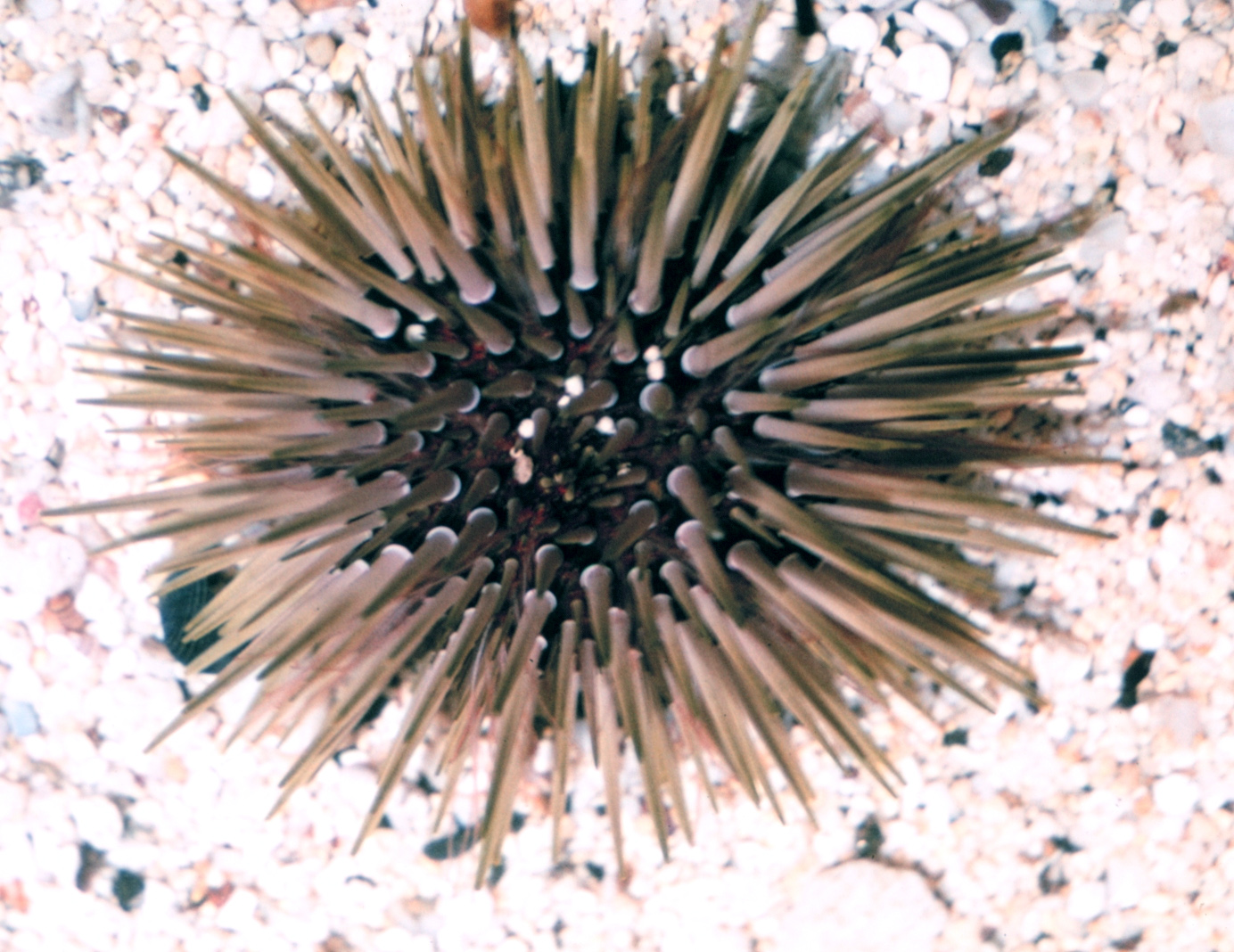
A small, abundant Indo-Pacific urchin that carves burrows into rock with its spines and teeth and shelters there by day, emerging at night to graze algae. Hardy and reef-safe to livestock, but a notable bioeroder — it can grind hollows into live rock and loosen an aquascape over time.
ℹ️
Educational only. KinStation content is reviewed by licensed veterinarians but cannot replace an in-person exam. Always consult a licensed veterinarian or board-certified specialist for diagnosis, treatment, or any decision affecting your pet's health.
🩺 Need expert help with your rock-boring urchin?
Connect with a specialist near you or ask a licensed vet — never substitute online guidance for hands-on care in an emergency.
Oval test about 5 cm (2 in); short, stout spines, often with pale tips or a pale ring at the base.
Lifespan
3–6 years
Social needs
solo
Native region
Indo-Pacific (East Africa and Red Sea to Hawaii)
Origin
Old World
Climate
🌴 Tropical
Water type
🌊 Marine
Family
Echinometridae
Genus
Echinometra
Part of the Sea Urchins
Spiny echinoderm grazers prized as reef clean-up crew for mowing down film, hair and nuisance algae. Most are reef-safe but may dislodge loose corals, and all are highly intolerant of copper and sudden salinity changes.
How this animal changes through its life — each stage often has its own care, diet and space needs.
Photo coming soon
Larva
Most marine invertebrates hatch into microscopic planktonic larvae (such as the zoea of crustaceans or the bipinnaria/veliger of echinoderms and mollusks) that drift and feed in the water column. The larva looks nothing like the adult and undergoes major reorganization.
Photo coming soon
Juvenile
After settling out of the plankton, the juvenile takes on a recognizable miniature of the adult body plan — a tiny shell, a small star, or a translucent shrimp. Crustaceans grow by molting, shedding the exoskeleton to enlarge.
Photo coming soon
Adult
Adults reach full size and reproductive maturity with the species' mature shell, shape, or coloration. Many continue to molt or grow throughout life, and some show sex differences in size or claw/appendage shape.
Color & pattern variants
Natural variants occur in the wild; selectively bred (man-made) variants were developed in captivity.
Natural
representative
Brown / Grey (typical)
The usual form, with short stout brown-to-grey spines, frequently pale-tipped, over an oval test; color varies widely by locality.
Habitat & enclosure
Keep one in an established reef or FOWLR tank of 20 gallons (75 L) or more with solid, well-anchored live rock it can graze and shelter against. Maintain stable marine parameters: temperature 72-80F (22-27C), pH 8.1-8.4, salinity SG 1.024-1.026, alkalinity 8-11 dKH and low nitrate.
It ranges widely across the Indo-Pacific, from East Africa and the Red Sea to Hawaii, where it bores into basaltic and calcareous reef rock. Provide crevices for daytime shelter; it grazes mostly after dark. Moderate flow and any reef lighting are fine.
Substrate
Solid, securely stacked live rock is essential — both as grazing surface and because it will bore into it; avoid relying on it in delicate or precariously balanced aquascapes. Any sand or bare-bottom base works underneath.
Equipment & setup
Standard reef equipment is sufficient: skimmer, live-rock biofiltration, heater and moderate flow. No special lighting is needed for this nocturnal grazer.
Diet
A nocturnal herbivore that grazes film, turf and hair algae from rock surfaces near its burrow. Supplement with nori or algae wafers if tank algae is limited, since it tends to feed close to its retreat rather than roaming widely.
Behavior & temperament
Reclusive and nocturnal, wedging into or excavating a snug rock pocket by day and grazing nearby at night. Peaceful and reef-safe toward fish, corals and inverts, but its burrowing is the catch: by rasping rock with spines and teeth it causes bioerosion that can hollow live rock and gradually destabilize stacked rockwork. Keep one per tank.
Health
Hardy, but as an echinoderm it is highly sensitive to copper, salinity and temperature swings, low oxygen and air exposure — never use copper meds or remove it into the air. Spine loss or sluggishness signals poor water quality or starvation. (Educational only, not a substitute for advice from an aquatic veterinarian.)
Tips, DIY & hacks
Drip-acclimate slowly and never expose it to air. Good cleanup help in a robust rocky tank, but think twice if your rockwork is finely balanced or your rock is soft, since it will carve into it. Provide a natural crevice so it doesn't excavate a critical support.
Reviewed and signed off by: KinStation Editorial — pre-launch draft (pending DVM review) on 2026-06-09