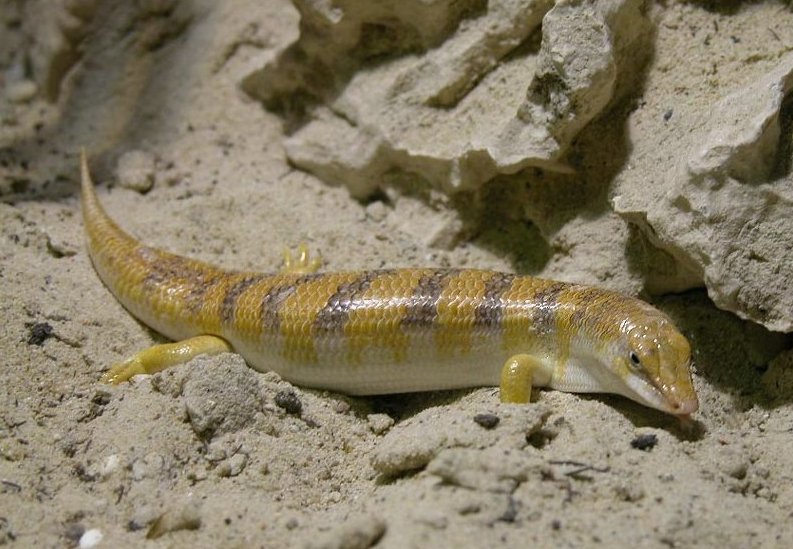
The sandfish skink is a remarkable desert specialist that 'swims' through dry sand using lateral undulations, spending most of its life buried. It is a fascinating display animal but a poor handling pet, as it stresses easily and is rarely seen above the surface.
ℹ️
Educational only. KinStation content is reviewed by licensed veterinarians but cannot replace an in-person exam. Always consult a licensed veterinarian or board-certified specialist for diagnosis, treatment, or any decision affecting your pet's health.
🩺 Need expert help with your sandfish skink?
Connect with a specialist near you or ask a licensed vet — never substitute online guidance for hands-on care in an emergency.
Small, about 6-8 in (15-20 cm) total length with a streamlined wedge-shaped snout.
Lifespan
8–12 years
Social needs
solo
Native region
North Africa and the Arabian Peninsula (Sahara and Middle Eastern deserts)
Origin
Old World
Climate
🏜️ Arid
Family
Scincidae
Genus
Scincus
Part of the Skinks & plated lizards
Smooth- to plate-scaled, often terrestrial and fossorial lizards — generally hardy, diurnal, and good-natured, needing diggable substrate, a basking gradient, and UVB.
From the minimum an animal needs to be kept humanely, up to the ideal setup. Bigger is almost always better — minimums are floors, not targets.
Photo coming soon
Minimum
Deep-sand desert terrarium
36 × 18 × 12 in with ≥ 6 in sand
Scincus scincus needs a 36×18 floor with at least 6 in of fine play sand (they swim through sand). Hot basking 38–42 °C, cool side 25 °C. Low humidity. 5–7% UVB across half the enclosure.
Photo coming soon
Recommended
Larger sand vivarium
48 × 18 × 12 in, deep sand
A 48×18 with 8 in+ of fine sand, surface décor (rocks, hardscape), and a strong thermal gradient. Sandfish are diurnal sand-swimmers — substrate depth is the welfare keystone.
Photo coming soon
Ideal
Naturalistic dune enclosure
60 × 24 × 12 in, deep sand
Large dune-style enclosure with deep fine sand, varied surface texture, scattered cover, and strong basking gradient. Mimics North African / Arabian desert habitat.
Life & growth stages
How this animal changes through its life — each stage often has its own care, diet and space needs.
Photo coming soon
Egg / Neonate
Most reptiles lay leathery- or hard-shelled eggs incubated by ambient warmth, though some snakes and lizards give live birth. Incubation temperature can influence sex and development in many species.
Photo coming soon
Hatchling
Hatchlings emerge as fully formed miniatures of the adult, often using an egg tooth to slit the shell. They are independent from birth but small and vulnerable, and may show brighter or different juvenile patterning.
Photo coming soon
Juvenile
Juveniles grow steadily, shedding their skin periodically as they enlarge. Coloration and proportions shift toward the adult form, and growth rate depends heavily on temperature, diet, and basking/UVB access.
Adult
Adults reach the species' full length and mass and become sexually mature. Many reptiles show sex differences in size, coloration, or features (such as larger heads, hemipenal bulges, or femoral pores), and continue to shed throughout life.
Habitat & enclosure
Provide a wide, shallow-footprint terrarium of at least 24 x 18 in (60 x 45 cm) for one or a small group, prioritizing floor space over height. Maintain a hot, arid desert setup: a surface basking zone of 95-105°F (35-40°C) at one end grading to a cool buried zone in the high 70s-low 80s°F (25-28°C), and let nights drop into the low 70s°F. Keep ambient humidity low (around 20-40%) but provide one slightly damp deeper sand layer so the animal can choose its microclimate.
Substrate
Fine, soft, dry desert sand at least 4-6 in (10-15 cm) deep is essential, as the whole husbandry is built around burrowing. A children's play-sand washed and dried, or a dedicated reptile desert sand, works well. Slightly dampen the lowest layer to provide a humidity gradient while keeping the surface dry.
Equipment & setup
Use an overhead basking lamp to create a hot surface spot, a low-output UVB tube (T5 HO ~5%) for this diurnal desert lizard, and a thermostat-controlled secondary heat source if needed. A deep sand bed, a shallow water dish (or occasional misting of one corner), and accurate thermometers/hygrometer round out the setup. A solid base under the sand spreads heat safely.
Diet
Insectivorous. Offer small gut-loaded crickets, dubia roach nymphs, mealworms, and other appropriately sized insects, which the skink ambushes from just below the sand surface, sensing vibrations. Dust with calcium plus D3 and a multivitamin on a regular rotation. Feed a few times a week; do not overfeed sedentary adults.
Behavior & temperament
Crepuscular/diurnal and almost entirely fossorial, 'sand-swimming' below the surface and surfacing only briefly to bask or feed. Not a handling animal: it is fast, fragile, and stresses when restrained, and frequent handling is discouraged. Generally peaceful and can be kept in compatible same-size groups if space and food are ample.
Health
Most problems stem from improper sand or humidity. Use clean, fine, rounded desert sand of adequate depth to allow safe burrowing; sharp or dusty substrates can cause abrasions and respiratory irritation. Watch for dehydration, metabolic bone disease without adequate calcium/UVB, and stress from being kept too exposed. Wild-imported specimens commonly carry mites and internal parasites.
Tips, DIY & hacks
Build the enclosure around deep, clean sand and resist the urge to handle; enjoy this species as a behavior display. Feed by dropping insects on the surface and watch the skink ambush from below. Source captive-bred animals where possible, and quarantine and deworm wild imports before adding to any collection.