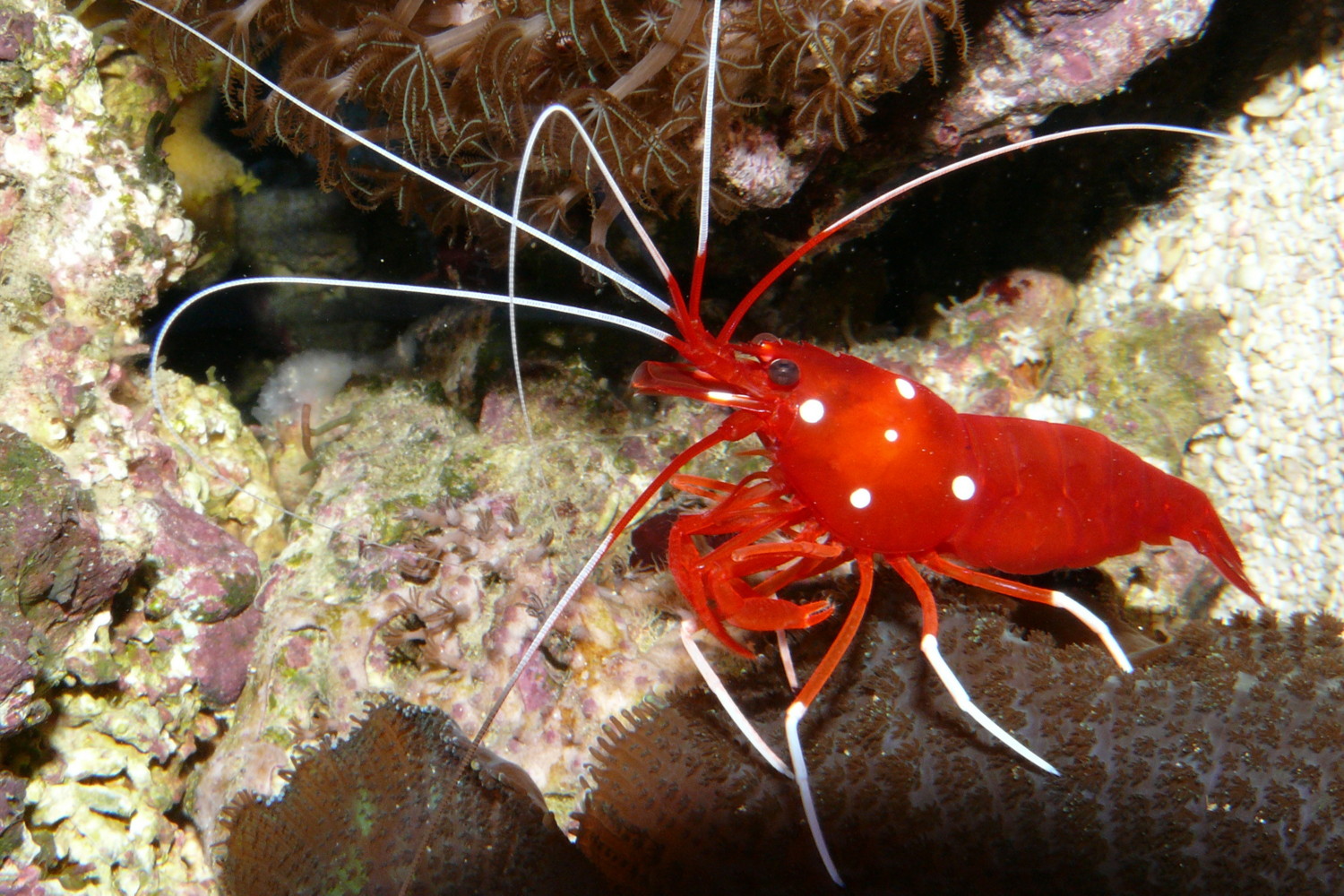
The scarlet or blood red fire shrimp is a striking deep-red Lysmata with white-spotted body and long white antennae, prized as one of the most beautiful reef-safe invertebrates. Slightly shyer than the skunk cleaner, it still operates cleaning stations and is hardy once acclimated to stable marine conditions.
ℹ️
Educational only. KinStation content is reviewed by licensed veterinarians but cannot replace an in-person exam. Always consult a licensed veterinarian or board-certified specialist for diagnosis, treatment, or any decision affecting your pet's health.
🩺 Need expert help with your scarlet cleaner shrimp?
Connect with a specialist near you or ask a licensed vet — never substitute online guidance for hands-on care in an emergency.
About 4-5 cm (1.5-2 in) body length, with long white antennae.
Lifespan
2–5 years
Social needs
pair
Native region
Indo-Pacific reefs (notably around the Philippines, Indonesia, and the Maldives)
Origin
Old World
Climate
🌴 Tropical
Water type
🌊 Marine
Family
Lysmatidae
Genus
Lysmata
Part of the Cleaner Shrimp
Brightly colored marine shrimp, mostly of the genus Lysmata, that set up cleaning stations and pick parasites and dead tissue from fish. Hardy, peaceful, and almost universally reef-safe, they are among the most popular and useful invertebrates in the saltwater hobby.
From the minimum an animal needs to be kept humanely, up to the ideal setup. Bigger is almost always better — minimums are floors, not targets.
Photo coming soon
Minimum
Reef aquarium
20 gal (≈ 76 L) reef
Lysmata debelius ('blood/fire shrimp') is more reclusive than the skunk cleaner — keep singly or as a bonded pair, with rockwork caves. Stable 1.025 salinity, 24–26 °C. Will clean fish but spends most time hiding.
Photo coming soon
Recommended
Established reef aquarium
30+ gal reef, deep rockwork
A 30+ gal reef with deep rockwork caves and overhangs where blood shrimp can establish a cleaning station. Peaceful tankmates; never with aggressive predatory fish.
Photo coming soon
Ideal
Mature reef with caves
55+ gal mature reef, complex rockwork
A mature reef with complex rockwork and stable parameters. Bonded pairs are visible cleaning fish under the right conditions — striking deep red colour.
Life & growth stages
How this animal changes through its life — each stage often has its own care, diet and space needs.
Photo coming soon
Larva
Most marine invertebrates hatch into microscopic planktonic larvae (such as the zoea of crustaceans or the bipinnaria/veliger of echinoderms and mollusks) that drift and feed in the water column. The larva looks nothing like the adult and undergoes major reorganization.
Photo coming soon
Juvenile
After settling out of the plankton, the juvenile takes on a recognizable miniature of the adult body plan — a tiny shell, a small star, or a translucent shrimp. Crustaceans grow by molting, shedding the exoskeleton to enlarge.
Adult
Adults reach full size and reproductive maturity with the species' mature shell, shape, or coloration. Many continue to molt or grow throughout life, and some show sex differences in size or claw/appendage shape.
Habitat & enclosure
Keep in an established reef or fish-only-with-live-rock tank of at least 75 L (20 gal) with abundant rockwork, caves, and shaded overhangs, as this shrimp prefers more cover than the skunk cleaner. Maintain temperature 24-27°C (75-80°F), pH 8.1-8.4, salinity SG 1.024-1.026, dKH 8-12, with low nitrate and rock-stable parameters. Moderate flow and standard reef lighting are fine; subdued lighting and plentiful hiding spots encourage it to come out.
A mature, well-cycled system is essential, as this species reacts badly to swings in salinity, temperature, or copper.
Substrate
Aquascape with plentiful live rock arranged into caves and shaded ledges, which this shy species relies on for security. Fine sand or shallow reef substrate beneath the rock is ideal.
Equipment & setup
Run mature biological filtration with live rock and a sump or canister, a protein skimmer, and a heater for steady tropical temperatures. Moderate-flow powerheads and standard reef lighting suffice; keep the whole system strictly copper-free.
Diet
Omnivorous scavenger and facultative cleaner. It picks dead tissue and parasites from fish at its station and forages for detritus and leftovers between rocks. Feed a varied meaty diet — mysis, brine shrimp, chopped seafood, sinking pellets — and some algae a few times weekly.
Behavior & temperament
Peaceful and reef-safe, but more secretive and territorial toward its own kind than the skunk cleaner; a mated pair coexists, but multiple unpaired adults may squabble. Safe with corals, clams, and most fish, though large predatory fish may eat it. Often hides by day and becomes bolder as it settles in.
Health
Acclimation stress and copper exposure are the leading killers, not infectious disease. Molting issues from poor water chemistry (low iodine/calcium) can occur; the shed shell is often mistaken for a dead shrimp. Provide stable trace elements and never use copper-based medications in its tank.
Tips, DIY & hacks
Drip-acclimate slowly over an hour or more and introduce it with the lights off to reduce stress. Provide a dedicated cave so it feels secure and emerges to clean and feed; keep only a single specimen or a confirmed pair to avoid aggression. Maintain trace iodine for healthy molts.