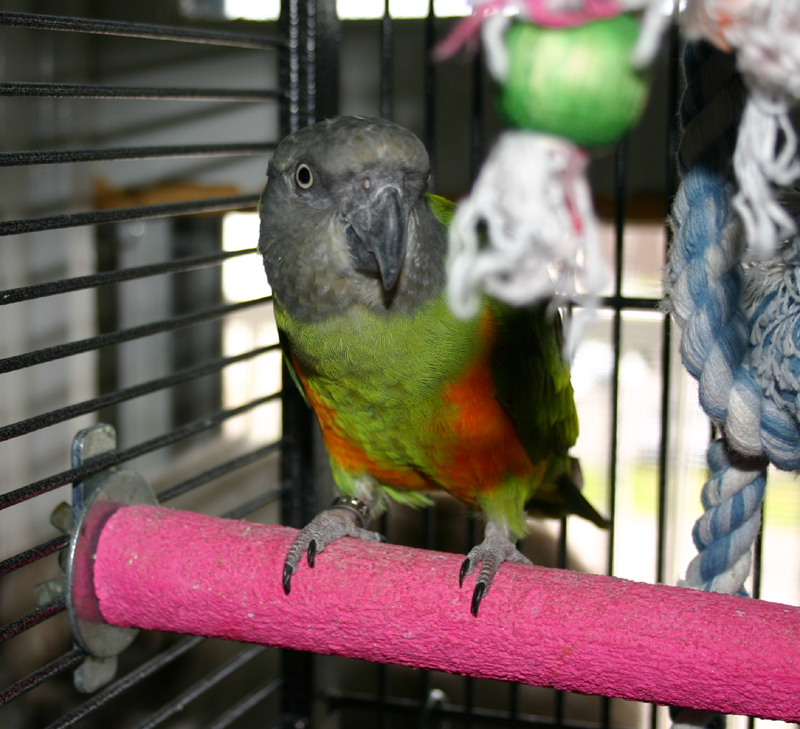
The Senegal parrot is a compact, relatively quiet West African parrot prized as one of the more apartment-friendly medium parrots. Charming and intelligent but often a one-person bird, it suits attentive intermediate keepers wanting a smaller, calmer companion.
ℹ️
Educational only. KinStation content is reviewed by licensed veterinarians but cannot replace an in-person exam. Always consult a licensed veterinarian or board-certified specialist for diagnosis, treatment, or any decision affecting your pet's health.
🩺 Need expert help with your senegal parrot?
Connect with a specialist near you or ask a licensed vet — never substitute online guidance for hands-on care in an emergency.
Small-to-medium — about 9–10 inches head to tail, 120–170 g.
Lifespan
25–50 years
Social needs
solo
Native region
West Africa
Origin
Old World
Climate
🌴 Tropical
Family
Psittacidae
Genus
Poicephalus
Part of the Small & Medium Parrots
Compact New World and African parrots prized as companion birds for their manageable size, character, and (often) quieter temperaments compared with macaws and large amazons. They still require daily interaction, enrichment, and species-appropriate diets.
Poicephalus senegalus -Magic Wings Butterfly Conservatory, South Deerfield, Massachusetts, USA-8a
Rusty Clark from Western, MA · Wikimedia Commons · CC BY 2.0
Habitat & space requirements
From the minimum an animal needs to be kept humanely, up to the ideal setup. Bigger is almost always better — minimums are floors, not targets.
Minimum
Flight cage
24 × 24 × 30 in, ≤ 5/8 in bar spacing
A single Senegal needs a sturdy cage at least 24 in deep and wide with bar spacing of about 5/8 in for safe climbing, set indoors at room temperature with multiple natural perches, chewable wood toys, and foraging puzzles. Senegals bond intensely to one person and need daily out-of-cage time and interaction to stay tame and avoid one-person aggression. This is acceptable only with generous daily handling and flight time outside the cage.
Carolina Gonzalez / CC BY 2.0 (Wikimedia Commons)
Photo coming soon
Recommended
Large flight cage
32 × 24 × 40 in (or larger)
A tall, wide flight cage gives this stocky Poicephalus room to fly, climb, and forage, furnished with varied branch perches, rotating destructible toys, and bathing access. As a quiet but highly intelligent parrot it needs structured daily enrichment and social time with its keeper. This space and stimulation prevent the boredom and feather-plucking common in under-occupied Senegals.
Photo coming soon
Ideal
Aviary / bird room
Walk-in aviary or dedicated bird room
A walk-in aviary or bird-safe room allowing real flight, with natural foliage, foraging stations, chewing branches, and bathing. Senegals are clever and curious, and abundant space plus daily companionship keeps them mentally healthy and physically fit. This is the best welfare outcome and most closely mirrors their natural foraging, flying lifestyle.
Life & growth stages
How this animal changes through its life — each stage often has its own care, diet and space needs.
Photo coming soon
Egg
Birds develop inside a hard-shelled egg incubated by the parent(s). Egg size, shell color, and clutch size vary by species; the embryo develops over days to weeks before hatching.
Photo coming soon
Hatchling / Chick
Hatchlings are either altricial — naked, blind, and dependent on parents (typical of parrots and songbirds) — or precocial — downy, mobile, and self-feeding soon after hatching (typical of poultry and waterfowl). Down gives way to the first feathers.
Photo coming soon
Juvenile / Fledgling
Fledglings grow in their juvenile plumage and begin to fly and feed themselves, though they may still beg from parents at first. Juvenile feathering is often duller than the adult and is replaced as the bird matures.
Adult
Adults attain full body size and mature plumage, and are capable of breeding. Many species show distinct adult coloration, and in sexually dimorphic birds males and females differ in plumage, size, or markings.
(c) Ben Costamagna, some rights reserved (CC BY) via iNaturalist — https://www.inaturalist.org/observations/197550293
Habitat & enclosure
Senegals are stocky, active little parrots that need solid room to climb and play. MINIMUM cage for a single bird is roughly 24 in W × 24 in D × 30 in H with bar spacing about 1/2 to 3/4 inch; width and play space matter more than sheer height. RECOMMENDED is a larger cage (around 30 × 24 × 36 in) plus several hours of daily out-of-cage time in a bird-safe room. IDEAL is a flight cage or aviary several feet in dimension that allows true flight and abundant foraging.
Place the cage in a sociable but not overwhelming part of the home, out of kitchen fumes, direct sun, and drafts, with a calm sleeping area on a consistent light cycle. Provide natural-wood perches of varying diameters, secure hardware, and a sense of a safe retreat within the cage.
Senegals are intelligent and can become nippy or pluck if bored, so provide rotating foraging toys, shreddable wood, puzzle feeders, and bells, plus regular bathing by mist or dish. As with all birds, fumes from PTFE/Teflon cookware, self-cleaning ovens, smoke, scented candles, and aerosols can be rapidly fatal and must be eliminated from the household.
Substrate
Plain newspaper or paper-based pellets on the cage tray are simplest and let you monitor droppings; avoid scented or dusty loose litter. A grate over the tray keeps the bird off discarded food and waste.
Equipment & setup
Provide a sturdy cage with horizontal bars for climbing, natural-branch perches of mixed diameters to keep feet healthy, and plenty of chew toys; Senegals are active climbers who need daily out-of-cage time. Offer a bath dish or misting, full-spectrum lighting indoors, and keep them warm and draft-free. They are quieter than larger parrots but still need substantial mental stimulation.
Diet
Feed a formulated pellet for small-to-medium parrots as the base diet, supplemented daily with a variety of vegetables and leafy greens, limited fruit, and cooked legumes or whole grains. Poicephalus parrots can be prone to weight gain and to vitamin-A deficiency on seed-heavy diets, so keep fatty seeds and nuts to small foraging treats rather than staples.
Provide fresh water at all times. Avoid avocado, chocolate, caffeine, alcohol, onion, garlic, and salty processed foods, all toxic to parrots. Offering vegetables and presenting food in foraging toys supports both nutrition and mental stimulation.
Behavior & temperament
Senegal parrots are notably quiet for a parrot — they chatter, whistle, and can screech when excited, but lack the sustained, piercing volume of conures, macaws, and cockatoos, which is a major reason they are recommended for apartments and noise-sensitive homes. Their talking ability is modest; some learn a handful of words and many sounds, but they are kept more for personality than speech.
Temperament is intelligent, playful, and often comically calm, but Senegals are well known for becoming strongly bonded to one person and can grow territorial or nippy toward others, especially when hormonal. Consistent handling by multiple household members from a young age helps prevent excessive one-person bonding. They are independent enough to entertain themselves with toys yet still need daily interaction. Body-language cues such as pinned eyes, fanned tail, and raised feathers signal excitement or overstimulation that can precede a bite.
Health
Senegal parrots need an avian veterinarian and routine wellness exams with weight tracking, and their potentially long lifespan makes them a multi-decade commitment. As with all birds, they hide illness, so subtle changes deserve prompt attention.
Common concerns include feather-destructive behavior from boredom or stress; psittacosis (a zoonosis); aspergillosis and other respiratory disease; and nutritional disease such as hypovitaminosis A and obesity or fatty liver from seed-heavy diets. Reproductively active hens can develop egg binding.
Seek prompt avian-veterinary care for a fluffed, quiet bird, tail-bobbing or open-mouth breathing, eye or nasal discharge, sudden weight loss, feather damage, or a hen straining to lay. A Senegal that seems even slightly unwell warrants a same-day call to an avian vet, since small parrots can decline quickly.
Tips, DIY & hacks
These clever Poicephalus thrive on foraging—hide food in paper cups, cardboard, or DIY puzzle toys to satisfy their problem-solving drive and prevent boredom-related plucking. Feed a pelleted base with vegetables and limited seed/nuts, as they're prone to obesity and fatty liver on high-fat seed diets. They can be one-person, nippy birds, so consistent gentle handling and target training pay off.
Origin & history
The Senegal parrot is native to a broad swath of West Africa, where it inhabits woodland and savanna and is one of the most common members of the genus Poicephalus. Its compact size, quiet voice, and engaging personality made it a popular cage bird, and for years many were wild-caught for export before captive breeding became the norm; today responsible ownership means a captive-bred bird, and the species is listed on CITES like other parrots.
In aviculture the Senegal is regarded as an excellent 'starter' medium parrot for people who want big-parrot intelligence and character without the noise and space demands of a macaw or large cockatoo. Several closely related Poicephalus species — such as Meyer's and the red-bellied parrot — share its reputation for being relatively quiet and manageable, and the group as a whole has a devoted following among keepers seeking calmer companion parrots.
Anecdotes & owner lore
Community experience and cultural notes — not veterinary advice. Every animal is an individual; treat these as colour, not care instructions.
Senegal parrot owners often describe their birds as 'the quiet big-parrot personality in a pint-sized package' — a Senegal will deliver the intelligence, mischief, and devotion of a much larger parrot at a fraction of the volume, which has earned the species a loyal following among apartment dwellers and people who simply cannot live with a screaming macaw. They are famous for their expressive, almost cartoonish eyes, whose iris color shifts from dark in babies to a striking pale yellow in adults, giving older birds a perpetually surprised, attentive look.
Keepers trade fond stories of Senegals that develop a single 'chosen human' and shadow them devotedly, of birds that hang upside down and 'play dead' for attention, and of the species' tendency to be utterly silent and still when a hawk or other threat is spotted outdoors — a reminder of the wild prey animal beneath the charm. The recurring theme in Senegal lore is contrast: a small, calm, even shy-seeming bird that turns out to be a clever, opinionated, intensely loyal companion once it decides you are its person.
Common ailments
Psittacosis (avian chlamydiosis) — rare — Zoonotic — tell your physician about bird contact if you develop respiratory illness.
Hypovitaminosis A (vitamin A deficiency) — common
Feather-destructive behavior (feather plucking) — common
Reviewed and signed off by: KinStation Editorial — pre-launch draft (pending DVM review)