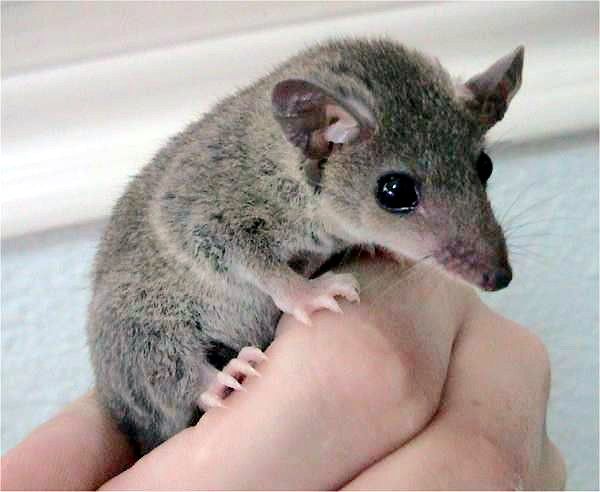
The short-tailed opossum is a tiny, pouchless South American marsupial kept as an exotic pocket pet and widely used in research. Strictly solitary and nocturnal, it can become hand-tame but is best for owners who accept a low-handling, escape-savvy little insectivore.
ℹ️
Educational only. KinStation content is reviewed by licensed veterinarians but cannot replace an in-person exam. Always consult a licensed veterinarian or board-certified specialist for diagnosis, treatment, or any decision affecting your pet's health.
🩺 Need expert help with your short-tailed opossum?
Connect with a specialist near you or ask a licensed vet — never substitute online guidance for hands-on care in an emergency.
Mouse-to-hamster sized: body 10-15 cm plus a short 4-9 cm tail; 60-150 g
Lifespan
4–8 years
Social needs
solo
Native region
South America (Bolivia, Brazil, Paraguay, Argentina)
Origin
New World
Climate
🌴 Tropical
Family
Didelphidae
Genus
Monodelphis
Part of the Opossums
New World marsupials — nocturnal, solitary scavengers ranging from cat-sized Virginia opossums to tiny pocket-pet short-tailed species, with care needs and legality that vary sharply by species.
From the minimum an animal needs to be kept humanely, up to the ideal setup. Bigger is almost always better — minimums are floors, not targets.
Photo coming soon
Minimum
Tall arboreal vivarium (solitary)
30 × 18 × 24 in, branches + nest box + wheel
A 30 × 18 × 24 in (≈ 75 × 45 × 60 cm) tall arboreal vivarium with climbing branches, a nest box, a large solid wheel, and a warm side. House strictly solitary — they fight to the death outside breeding.
Photo coming soon
Recommended
Larger arboreal setup
36 × 24 × 30 in, branches, varied levels
A 36 × 24 × 30 in enclosure with multi-level climbing, deep substrate, and varied hides. Provide a temperature gradient with a warm side around 25–28 °C.
Photo coming soon
Ideal
Naturalistic bioactive vivarium
≥ 4 × 2 × 3 ft, planted, bioactive
A large planted bioactive vivarium with live plants, climbing structure, dense cover, and varied substrate. Closest to South American leaf-litter habitat — a specialist exotic, do thorough research first.
Life & growth stages
How this animal changes through its life — each stage often has its own care, diet and space needs.
Photo coming soon
Newborn
Newborn mammals are nursed on their mother's milk. Many are born helpless — blind, deaf, and sparsely furred (altricial, as in dogs, cats, and rodents) — while others stand and follow within hours (precocial, as in hoofed livestock).
Photo coming soon
Juvenile
After weaning, juveniles grow quickly and become increasingly active, playful, and independent. Adult coat, proportions, and (in many species) the permanent teeth come in as they approach full size.
Photo coming soon
Adult
Adults reach full body size and sexual maturity, with the species' mature coat and build. Sexual dimorphism — differences in size, mane, horns, or markings — is pronounced in some mammals and subtle in others.
Senior
Senior animals show aging signs such as graying fur, reduced activity, and a greater need for veterinary monitoring of joints, teeth, and organ function. Lifespan and the onset of old age vary widely by species and size.
Habitat & enclosure
A single STO does well in a tall glass aquarium (minimum ~75 L / 20 gallon) with a secure mesh lid, or a small-bar cage they cannot squeeze through. Provide climbing branches, ledges, an exercise wheel (solid, no rungs), and several hide/nest boxes, as they are arboreal and love to climb and burrow into a cozy den. House strictly one per enclosure — they are solitary and will fight, sometimes fatally, except briefly for breeding.
Substrate
Aspen shavings, paper-based bedding, or a deep mix that allows light burrowing; provide shredded paper or fleece in nest boxes. Avoid cedar and pine (aromatic oils). Spot-clean frequently as they can be musky.
Equipment & setup
Secure escape-proof enclosure with fine mesh lid, solid-surface exercise wheel, multiple hides/nest boxes, climbing branches, low-wattage heat source or warm room to maintain temperature, shallow water dish or bottle, and insect-feeding supplies (calcium/D3 dusting powder, gut-loading food).
Diet
STOs are primarily insectivorous omnivores. Base the diet on live and prepared insects (crickets, mealworms, dubia roaches, waxworms as treats), supplemented with a quality insectivore or low-iron exotic diet, small amounts of cooked egg, lean meat, and limited fruit/veg. Gut-load and dust insects with calcium/vitamin D3. They are prone to obesity, so keep treats limited.
Behavior & temperament
Nocturnal, energetic, and curious, they spend nights climbing, running the wheel, and foraging. Hand-raised or patiently tamed individuals can be held and may ride in a pocket, but they are quick and can leap, so handle low and over a contained surface. They use the semi-prehensile tail to carry nesting material. Solitary by nature; cohabitation causes stress and aggression.
Health
Generally hardy with a good 4-8 year lifespan. Watch for obesity, dental and skin issues, and stress from improper temperature (keep ~24-29 C; they can become torpid if too cold). They lack a true pouch — young cling to the mother's belly. Use an exotics vet familiar with marsupials. Sensitive to high dietary iron, so avoid iron-rich processed foods.
Tips, DIY & hacks
Maintain a warm, stable temperature to prevent cold torpor. Tame slowly with mealworm bribes and over a sink or bin to catch escapes. Keep one per cage to avoid fights. Provide a wheel and rotating climbing layout to burn their nocturnal energy and prevent obesity.