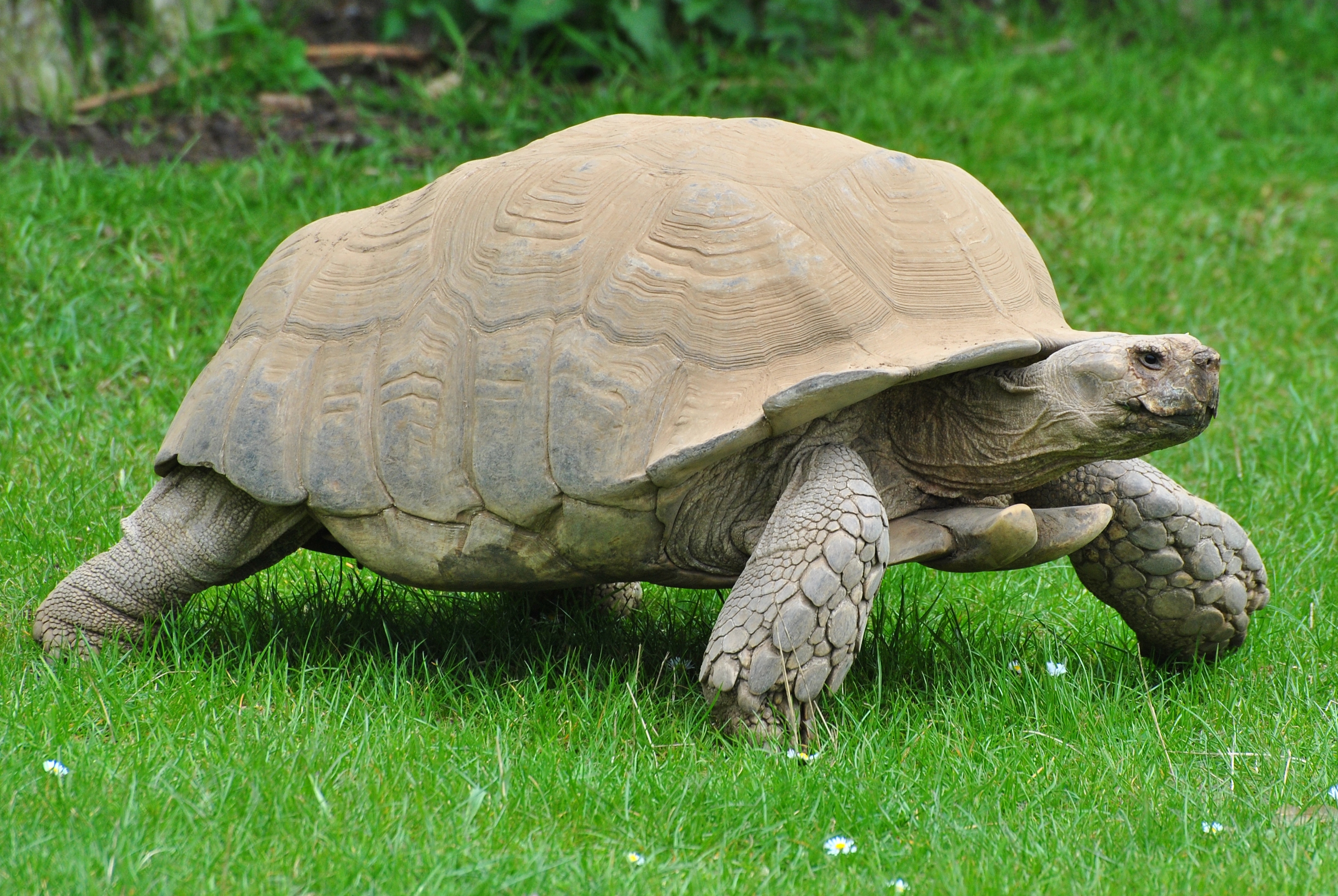
Sulcata tortoises are the third-largest tortoise species in the world, native to the Sahel region of Africa. Sold as small juveniles, they reach 70–100+ pounds and can outlive their original owners — they are widely surrendered when adults outgrow expectations.
ℹ️
Educational only. KinStation content is reviewed by licensed veterinarians but cannot replace an in-person exam. Always consult a licensed veterinarian or board-certified specialist for diagnosis, treatment, or any decision affecting your pet's health.
🩺 Need expert help with your sulcata tortoise?
Connect with a specialist near you or ask a licensed vet — never substitute online guidance for hands-on care in an emergency.
Tortoises are land-dwelling chelonians with high domed shells, elephantine legs, and long lifespans. Most are herbivorous grazers needing UVB lighting, calcium-rich low-protein diets, spacious enclosures, and (for temperate species) controlled brumation.
From the minimum an animal needs to be kept humanely, up to the ideal setup. Bigger is almost always better — minimums are floors, not targets.
Photo coming soon
Minimum
Heated outdoor pen + shelter
≈ 10 × 10 ft pen per adult
Sulcatas reach 70–100+ lb, so even a welfare floor is a roughly 10 × 10 ft secure outdoor pen with a heated, insulated shelter they can fully enter and turn around in. Provide grazing grass, a wallow, deep substrate for burrowing, basking at 35–38 °C (≈95–100 °F), UVB, and protection below ~13 °C; this is a space-intensive, advanced species unsuited to any indoor tank or table long-term.
Photo coming soon
Recommended
Large yard + heated barn
Several hundred sq ft + heated house
A responsible keeper dedicates a large grassed yard of several hundred square feet with a heated, insulated tortoise house or shed, dig-proof and escape-proof fencing, mounds, hides, and a wallow. Grazing on grass and weeds, a 35–38 °C basking zone, UVB, and dry warmth in cold weather are essential for these powerful, burrowing grazers that live 70+ years.
Photo coming soon
Ideal
Acre-scale grazing range
Large fenced acreage + barn
The best welfare outcome is acreage of natural grazing in a warm or climate-controlled climate, with a spacious heated barn, mud wallows, sturdy hides, basking areas, and room to walk and dig for miles as they would in arid Africa. Natural sun, grass forage, and unrestricted movement keep the shell smooth, the gut healthy, and the behaviour natural for this giant, long-lived tortoise.
Life & growth stages
How this animal changes through its life — each stage often has its own care, diet and space needs.
Photo coming soon
Egg / Neonate
Most reptiles lay leathery- or hard-shelled eggs incubated by ambient warmth, though some snakes and lizards give live birth. Incubation temperature can influence sex and development in many species.
Photo coming soon
Hatchling
Hatchlings emerge as fully formed miniatures of the adult, often using an egg tooth to slit the shell. They are independent from birth but small and vulnerable, and may show brighter or different juvenile patterning.
Photo coming soon
Juvenile
Juveniles grow steadily, shedding their skin periodically as they enlarge. Coloration and proportions shift toward the adult form, and growth rate depends heavily on temperature, diet, and basking/UVB access.
Adult
Adults reach the species' full length and mass and become sexually mature. Many reptiles show sex differences in size, coloration, or features (such as larger heads, hemipenal bulges, or femoral pores), and continue to shed throughout life.
Color & pattern variants
Natural variants occur in the wild; selectively bred (man-made) variants were developed in captivity.
Sulcata tortoises are giants in waiting. A hatchling that fits in a palm grows into an animal that can weigh as much as a large dog, so the only realistic long-term housing for an adult is a securely fenced outdoor yard in a climate that supports tortoise activity for much of the year, paired with a heated indoor or barn-style shelter for cold weather. Indoor-only keeping is not viable for an adult.
They are prodigious burrowers. In the wild, sulcatas dig extensive tunnels — reportedly up to around 10 feet deep and far longer — to escape heat and cold, and a captive animal with suitable ground will dig. This behavior is accommodated (and the property is protected from it) rather than prevented, because burrowing is important for thermoregulation and stress reduction. Fencing is buried or hardscaped at the base because a determined sulcata will tunnel under or simply push through a flimsy barrier.
The substrate and microclimate are kept dry and well-drained; chronically wet conditions promote shell rot. Sulcatas do not tolerate sustained cold, so the heated night shelter is essential where temperatures drop. A basking area, shade, and clean water complete a setup that, at adult size, is closer to livestock husbandry than typical pet keeping.
Substrate
Use a deep, diggable substrate like a coir/topsoil-and-play-sand blend or cypress mulch that holds a humid burrow microclimate while keeping the surface dry; avoid loose silica sand and calci-sand, which cause impaction. Adults are best kept outdoors on grass and natural soil where climate allows.
Equipment & setup
These animals get huge (70-100+ lb) and need a large outdoor enclosure with a sturdy heated shelter, a basking spot of 95-100F, and ambient 80-90F. Provide high-output UVB (T5 HO 10-12%) for indoor or sheltered animals, plus a shallow water dish; they need warm, dry conditions and protection from temps below ~50F.
Diet
Sulcatas are strict grazing herbivores built for a high-fiber, low-protein, low-sugar diet. Grasses and grass hays form the bulk of what they eat, supplemented with edible weeds (such as dandelion and plantain) and dark leafy greens. The emphasis on coarse, fibrous forage reflects an animal evolved to crop dry grasses across the African Sahel.
Fruit, high-protein foods, and many commercial pellets are avoided because rich, sugary, or protein-heavy diets are strongly associated with rapid shell pyramiding and renal disease in this species. Calcium is provided (for example via cuttlebone) to support the substantial shell. Fresh water is always available, and routine soaking helps keep juveniles hydrated.
The classic mistakes are feeding like a generalist herbivore (too much produce, fruit, or protein) and underestimating how much grazing area a healthy adult needs. Specific supplementation should be confirmed with a reptile veterinarian rather than guessed.
Behavior & temperament
Sulcatas are solitary and territorial. Males in particular fight, ramming each other with the forked gular projection under the chin, sometimes causing injury, so adults are generally not housed together without ample space and careful management. They are active during warm daylight hours and spend much of their time grazing, walking, and digging.
Despite the placid-tortoise stereotype, sulcatas are powerful, persistent, and surprisingly fast and strong. A large adult can push through fencing, tip patio furniture, and excavate burrows that undermine structures — their strength is routinely underestimated by people picturing a slow, manageable pet. They are also food-motivated and can be quite interactive at mealtime.
Because they are long-lived and grow steadily, their behavioral needs (space to roam and dig, exposure to sun) only expand with time. Planning for the adult, not the cute hatchling, is the central behavioral reality of the species.
Health
Common sulcata health issues include shell pyramiding (the raised, lumpy scute growth associated with low humidity during growth and improper diet), shell rot from wet conditions, respiratory infection, bladder stones, and parasites. These are general patterns to address with a veterinarian, not a self-treatment guide.
Prevention is largely about getting the big husbandry levers right: a high-fiber grazing diet, dry and well-drained living areas, appropriate warmth with a heated shelter, hydration and soaking, and enough space for natural behavior. Annual fecal exams and wellness checks with a reptile-experienced veterinarian are advised, especially as the animal grows.
Signs that warrant veterinary attention include a runny nose or labored breathing, lethargy, straining, blood in the urine, soft or damaged shell areas, and refusal to eat in an otherwise warm, active animal. Given their eventual size, lining up a vet (and a transport plan) in advance is part of responsible ownership.
Tips, DIY & hacks
Feed a high-fiber, grass/hay-based diet (grasses, weeds, Mazuri tortoise diet) and avoid fruit and excess protein, which cause pyramiding and kidney disease. They are powerful escape-artist diggers and burrowers, so bury fencing and use a heated insulated 'pig hut' or shed as a DIY night shelter.
Origin & history
Centrochelys sulcata is the largest mainland tortoise and the third-largest tortoise species in the world (after the Galápagos and Aldabra giants), native to the arid Sahel belt along the southern edge of the Sahara. It is superbly adapted to heat and drought, surviving the worst conditions in deep burrows.
In the pet trade, sulcatas are sold cheaply and abundantly as tiny hatchlings, which is the root of a chronic welfare problem: buyers underestimate the adult's size, lifespan, and space needs, and rescues are perpetually full of surrendered or escaped adults. There are no notable color morphs — the species' "history" in captivity is mostly the story of well-meaning owners outmatched by a hatchling that grows into a hundred-pound digging machine.
Anecdotes & owner lore
Community experience and cultural notes — not veterinary advice. Every animal is an individual; treat these as colour, not care instructions.
Sulcatas have become the poster child for "cute hatchling, enormous regret." Tortoise rescues across the warmer U.S. states are overflowing with surrendered adults, and keepers swap stories of sulcatas that bulldozed through a wooden fence, excavated a burrow under a shed, or simply walked off down the street — there are recurring local-news segments about neighbors banding together to wrangle a wayward tortoise that's gone for a stroll.
The strength is the running joke and the running problem. Owners describe their tortoise rearranging the patio, shoving open gates, and tipping over anything in the way during a determined march toward a favorite weed patch. At the same time, devoted keepers adore them: a contented sulcata grazing across a sunny yard, or pressing its face to the glass at feeding time, has a goofy, gentle-giant charm. The phrase that follows the species everywhere is some version of "they get BIG" — a warning earned by decades of palm-sized babies turning into landscaping-grade adults that can outlive their original owner.
Common ailments
Respiratory infection — common — Often follows exposure to cold; a heated shelter is essential in cool climates.
Shell pyramiding — very common — Extremely common in sulcatas raised too dry or on rich diets; prevention focuses on a high-fiber diet and appropriate growth-stage humidity.
Shell rot — common — Linked to chronically damp living conditions; sulcatas need dry, well-drained substrate.
Bladder stones (uroliths) — common — Hydration (water access plus routine soaking) and a correct diet reduce risk.
Reviewed and signed off by: KinStation Editorial - pre-launch draft (pending DVM review)