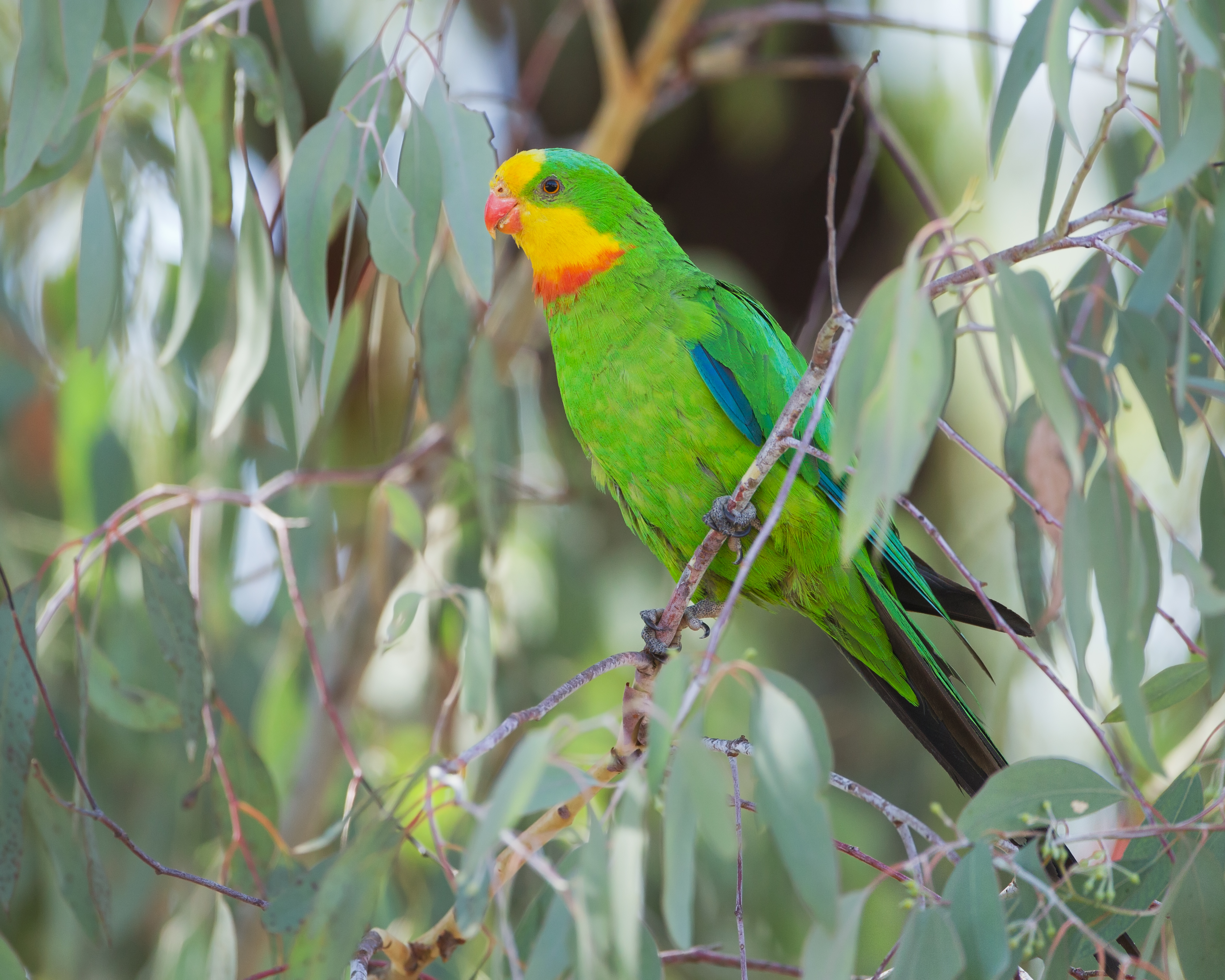
The superb parrot is a slim, elegant grass parrot of inland south-eastern Australia, bright green with the male sporting a yellow face and a scarlet throat band. A graceful, strong flier and a gentle aviary bird, it is Vulnerable in the wild but well established and popular in aviculture. It is listed on CITES Appendix II; Australia bans commercial export of native wildlife, so legitimate pet stock is captive-bred outside Australia.
ℹ️
Educational only. KinStation content is reviewed by licensed veterinarians but cannot replace an in-person exam. Always consult a licensed veterinarian or board-certified specialist for diagnosis, treatment, or any decision affecting your pet's health.
🩺 Need expert help with your superb parrot?
Connect with a specialist near you or ask a licensed vet — never substitute online guidance for hands-on care in an emergency.
Slender, long-tailed parrot ~40 cm long; ~130-160 g
Lifespan
15–25 years
Social needs
pair
Native region
Inland south-eastern Australia (riverine woodlands of the Murray-Darling Basin in New South Wales and Victoria, especial
Origin
Old World
Climate
🍂 Temperate
Family
Psittaculidae
Genus
Polytelis
Part of the Australian grass parrots
Slender, ground-foraging Australian parrots (Polytelis, Neophema, Psephotus and allies) of grasslands and open woodland; mostly gentle, quiet aviary birds that graze on seeding grasses and need length to fly.
From the minimum an animal needs to be kept humanely, up to the ideal setup. Bigger is almost always better — minimums are floors, not targets.
Photo coming soon
Minimum
Long flight cage
60 × 24 × 36 in, bar spacing 1/2–5/8 in
Slim Australian long-tailed parrot — horizontal flight matters most. Provide varied natural perches, foraging, and a quiet draft-free room. Superb parrots are sweet-natured but sensitive to cold and damp.
Photo coming soon
Recommended
Indoor flight or large flight cage
8 × 3 × 6 ft indoor flight or 72 × 36 × 48 in cage
Real flying length with rope perches, foraging stations, bathing, and several hours of supervised out-of-cage flight daily. Compatible in mixed Australian-parakeet aviaries.
Photo coming soon
Ideal
Outdoor aviary
12 × 4 × 7 ft outdoor aviary with shelter
A long planted outdoor aviary with a draft-free shelter section, varied perches, and foraging substrate. Superb parrots are strong flyers in the wild — aviary length is what makes them thrive.
Life & growth stages
How this animal changes through its life — each stage often has its own care, diet and space needs.
Photo coming soon
Egg
Birds develop inside a hard-shelled egg incubated by the parent(s). Egg size, shell color, and clutch size vary by species; the embryo develops over days to weeks before hatching.
Photo coming soon
Hatchling / Chick
Hatchlings are either altricial — naked, blind, and dependent on parents (typical of parrots and songbirds) — or precocial — downy, mobile, and self-feeding soon after hatching (typical of poultry and waterfowl). Down gives way to the first feathers.
Photo coming soon
Juvenile / Fledgling
Fledglings grow in their juvenile plumage and begin to fly and feed themselves, though they may still beg from parents at first. Juvenile feathering is often duller than the adult and is replaced as the bird matures.
Adult
Adults attain full body size and mature plumage, and are capable of breeding. Many species show distinct adult coloration, and in sexually dimorphic birds males and females differ in plumage, size, or markings.
(c) bidgeeboots, some rights reserved (CC BY-NC) via iNaturalist — https://www.inaturalist.org/observations/325389900
Color & pattern variants
Natural variants occur in the wild; selectively bred (man-made) variants were developed in captivity.
Selectively bred (man-made)
representative
Blue
A recessive mutation removing the yellow/red pigments so the bird becomes blue-and-white; the male's face turns white where it would be yellow. Established but less common in aviculture.
representative
Lutino
A mutation eliminating melanin to give a yellow bird with red eyes; the male retains a reddish throat marking.
Habitat & enclosure
Superb parrots are fast, agile fliers built for long flights and need length over height: a planted or suspended aviary at least 3.5-4.5 m (12-15 ft) long is ideal, with a sheltered, dry, draft-free section. They are cold-hardy once acclimatized to temperate climates but should be protected from frost, wet, and extreme heat. Cage housing alone is inadequate for long-term welfare; if cage-kept they require extensive daily flight time. Keep one pair per aviary as males can be territorial in the breeding season.
Substrate
In planted or flight aviaries use a deep, well-drained sand/gravel or natural-earth floor that can be kept dry and raked; standing damp encourages parasites and fungal disease. For any indoor/cage holding, line trays with plain paper for easy cleaning and droppings monitoring.
Equipment & setup
A long aviary with a roofed, draft-free shelter; natural-branch perches of varied diameter set to allow clear flight lines; seed/soft-food dishes and clean water plus a bathing source; cuttlebone and mineral block; foraging and browse (eucalyptus, willow). A vertical nest log/box (~20 x 20 x 60 cm) with a deep litter base is added for breeding pairs. UVB lighting benefits any indoor-housed birds.
Diet
Feed a balanced grass-parrot/small-parrot seed mix (canary, millets, panicum, plus some sunflower/safflower in moderation) supplemented heavily with sprouted seed, fresh greens (chickweed, dandelion, silverbeet, seeding grasses), vegetables, and some fruit. A small-parrot pellet can form part of the diet. Provide soft food and extra protein (egg food, sprouts) when rearing young. Cuttlebone and mineral grit/calcium should be available. Avoid avocado and other toxic foods.
Behavior & temperament
Gentle, quiet, and non-aggressive by parrot standards, with a pleasant chattering voice rather than harsh screeching, making them well suited to suburban aviaries. They are not typically kept as cuddly hand-tame pets but tame aviary birds become confiding. Males perform graceful display flights. Outside breeding they are social and can be relatively peaceful, but during breeding a pair should have its own aviary. They are active and benefit from foraging enrichment and browse.
Health
Generally healthy and undemanding. Like many Australian grass parrots they can be susceptible to intestinal worms and other parasites in earth-floored aviaries, so regular worming and fecal checks are recommended. Watch for fungal infections in damp conditions, and ensure good drainage and dry shelter. Provide UVB or natural sunlight for vitamin D/calcium. PBFD and other psittacine viruses warrant quarantine of new birds.
Tips, DIY & hacks
Provide as much flight length as possible; these birds are at their best on the wing. Offer plenty of seeding grasses and fresh browse to mimic their natural grazing diet. Worm regularly if kept over earth. House one pair per aviary during breeding to prevent male territorial aggression. Their soft voices make them excellent for keepers wanting an attractive, peaceful aviary species.