Cloud forests are cool, perpetually misty tropical montane forests that occur in a narrow altitude band where persistent low cloud bathes the canopy. Their trees are festooned with mosses, ferns, orchids, and bromeliads that harvest water directly from fog, supporting a wealth of endemic species found nowhere else.
Geography
They occupy mid-elevation mountain slopes — often roughly 1,500–3,000 m — in the tropics, including the Andes, Central American cordilleras, the East African highlands, and parts of Southeast Asia. Because each cloud belt sits at a different height on isolated peaks, cloud forests are naturally fragmented 'sky islands' rich in localized endemics.
Climate
Cool and saturated: temperatures are mild to chilly (often 10–20 °C), humidity is near-constant, and frequent fog adds 'horizontal precipitation' captured by leaves and epiphytes. The persistent moisture and reduced sunlight create a lush, dripping, moss-laden environment quite unlike the hot lowland rainforest below.
Flora & fauna
Epiphytes dominate — orchids, bromeliads, mosses, liverworts, and filmy ferns drape every branch. Stunted, gnarled 'elfin' trees grow near the summit. Iconic animals include the resplendent quetzal, hummingbirds, colorful tree frogs and glass frogs, salamanders, and many endemic insects and snails. Some chameleons and montane amphibians in the pet trade trace to such highland forests.
Conservation
Cloud forests are exceptionally vulnerable to climate change, which lifts the cloud base and dries the canopy, plus deforestation for agriculture and cattle. Their high endemism means local loss can mean global extinction. Protection focuses on watershed reserves, reforestation, and limiting upslope land conversion.
Panther chameleons are brightly colored arboreal lizards from Madagascar, named for their bold reds, blues, and greens that vary by locale. Captive-bred individuals are well-established in the U.S. trade and considered an advanced-care species.
Veiled chameleons are tall-casqued arboreal lizards from the Arabian Peninsula. They are the most commonly bred chameleon in the U.S. pet trade and are considered an advanced beginner among chameleons — still highly sensitive to husbandry mistakes.
The bearded pygmy chameleon is a tiny, leaf-litter-dwelling chameleon from Tanzania that mimics a dead leaf and thrives in a cool, humid, heavily planted terrarium. It is rewarding but short-lived and best suited to a dedicated keeper rather than a beginner.
The Vietnamese mossy frog is a master of camouflage, its green, black, and rust bumpy skin perfectly mimicking moss and lichen. It is a hardy, cool-running semi-aquatic frog that does well in small groups in a planted paludarium.
The fire salamander is a striking black salamander boldly marked with yellow (sometimes orange or red) that secretes toxic skin alkaloids as defense. Long-lived and hardy in cool, humid conditions, it is a classic terrestrial caudate for keepers who can keep it cool.
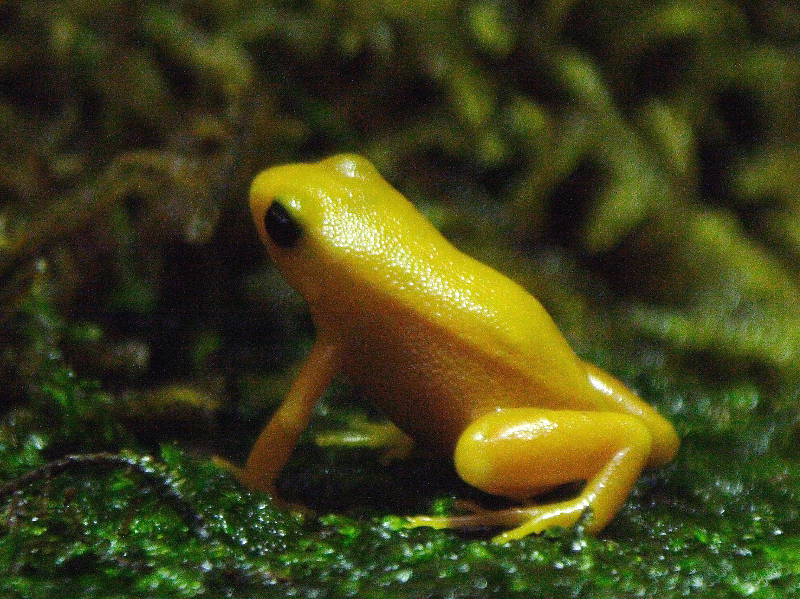
A tiny, brilliant orange-to-yellow terrestrial frog from a few small wetlands in central-eastern Madagascar, often called an 'Old World dart frog' for its convergent aposematic coloring and toxin-sequestering biology (it is not a true dendrobatid). It is a popular, social, captive-bred display species. The wild population is threatened: it was long listed as Critically Endangered and, following a 2020 reassessment with better range data, is now classified as Endangered on the IUCN Red List. It is also listed on CITES Appendix II, so responsible keepers buy only captive-bred stock.
The most beginner-friendly orchid, the moth orchid produces arching sprays of long-lasting flat blooms and can be coaxed to rebloom from the same spike. It grows in bark, not soil, because it is an epiphyte.
Topped by a long-lasting rosette of vivid red, orange, or yellow bracts, the guzmania is an easy epiphytic bromeliad. The colorful 'flower' is actually showy bracts that persist for months.
Delicate, lacy fronds of tiny fan-shaped leaflets on wiry black stems give the maidenhair fern its airy beauty — and its reputation as a diva that crisps at the first hint of dry air or a missed watering.
Unlike feathery ferns, the bird's nest fern forms a rosette of broad, undivided, apple-green fronds that unfurl from a fuzzy central 'nest.' An easygoing epiphyte, it is one of the more forgiving ferns for indoor growing.
An epiphytic fern that grows on trees rather than in soil, the staghorn produces two kinds of fronds: flat, shield-like 'basal' fronds that hug its mount and antler-shaped fertile fronds that arch outward. It is famously grown mounted on a board or in moss.