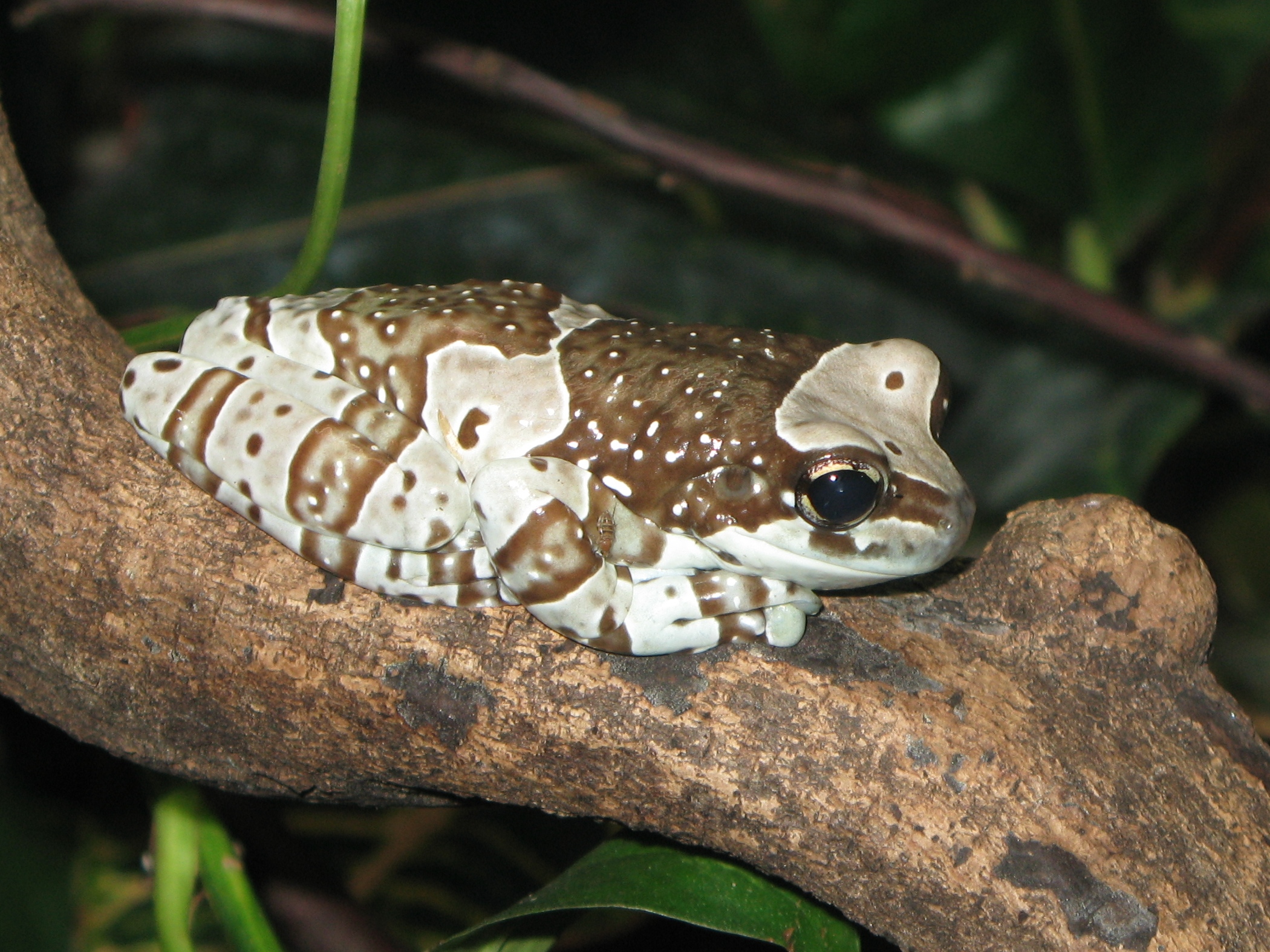
A large, arboreal tree frog with striking gold cross-shaped eyes and a banded brown-and-gray body that becomes bluish in adults. Named for the milky, sticky defensive secretion it exudes when stressed, it is a hardy, charismatic display frog.
ℹ️
Educational only. KinStation content is reviewed by licensed veterinarians but cannot replace an in-person exam. Always consult a licensed veterinarian or board-certified specialist for diagnosis, treatment, or any decision affecting your pet's health.
🩺 Need expert help with your amazon milk frog?
Connect with a specialist near you or ask a licensed vet — never substitute online guidance for hands-on care in an emergency.
Large tree frog; females 9-10 cm (3.5-4 in), males a bit smaller around 6-7 cm.
Lifespan
8–12 years
Social needs
group
Native region
Amazon Basin rainforest canopy of northern South America (Brazil, Peru, Colombia, Venezuela, the Guianas)
Origin
New World
Climate
🌴 Tropical
Family
Hylidae
Genus
Trachycephalus
Part of the Tree Frogs
Arboreal frogs adapted to climbing with expanded toe pads, kept in tall, planted, humid terrariums. Most are nocturnal display animals that should be handled minimally and only with clean, wet hands to protect their sensitive, absorptive skin.
From the minimum an animal needs to be kept humanely, up to the ideal setup. Bigger is almost always better — minimums are floors, not targets.
Photo coming soon
Minimum
Tall arboreal vivarium
18 × 18 × 24 in (ExoTerra) for one adult
Trachycephalus resinifictrix is a large, heavy-bodied arboreal — needs sturdy branches at multiple heights. 18×18×24 tall vivarium with coco fibre / sphagnum, broad-leaf plants, 70–85% humidity at 75–82 °F. Provide a large shallow water dish big enough to sit in.
Photo coming soon
Recommended
Larger planted arboreal
24 × 24 × 36 in for a pair
Pairs need substantial height for territory and calling perches. Multiple horizontal branches at varied diameters, broad leaves (Pothos, Monstera), large water bowl. Low-output UVB on top encourages natural behaviour.
Photo coming soon
Ideal
Planted bioactive arboreal
24 × 24 × 36 in+ bioactive
Planted bioactive vivarium with deep substrate, drainage layer, live plants, branch network, and a moving water feature. Milk frogs call loudly during the wet season — owners should expect nighttime racket.
Life & growth stages
How this animal changes through its life — each stage often has its own care, diet and space needs.
Photo coming soon
Egg
Amphibian eggs are soft, jelly-coated spheres laid in or near water — in floating clutches, strings, or foam nests depending on the species. The dark embryo is visible within the clear gel as it develops.
Photo coming soon
Tadpole / Larva
The aquatic larva (a tadpole in frogs/toads, a gilled larva in salamanders and newts) breathes through gills and feeds and grows in water. Frog/toad tadpoles are limbless at first, then sprout hind then front legs as metamorphosis nears.
Photo coming soon
Juvenile (froglet / eft)
At metamorphosis the animal develops legs and lungs and typically leaves the water as a froglet or, in many newts, a terrestrial eft. It resembles a small adult but is not yet sexually mature and its coloration may still be changing.
Adult
Adults reach full size and breeding condition, with the species' mature skin coloration and pattern. Many amphibians return to water to breed and can show seasonal or sex-specific changes such as nuptial coloration or crests.
(c) Guillaume Delaitre, some rights reserved (CC BY) via iNaturalist — https://www.inaturalist.org/observations/112552086
Habitat & enclosure
Provide a tall, planted arboreal terrarium with ample vertical climbing space; a 45x45x60 cm (18x18x24 in) enclosure suits one to two adults, with larger vivaria for groups. Keep humidity 60-80% with daily misting and good ventilation, and temps of 24-28C (75-82F) day, dropping a few degrees at night. As a canopy-dwelling, water-hole-breeding species it needs a sizable shallow water dish or feature plus sturdy branches, cork tubes, and broad-leaved plants for perching.
Substrate
A moisture-retaining bioactive mix of coco fiber, soil, sphagnum, and leaf litter over a drainage layer works well and supports a clean-up crew. The substrate should hold humidity without staying waterlogged. Provide a thick leaf-litter layer and a large water dish that is cleaned frequently, since these frogs defecate in their water.
Equipment & setup
Tall glass terrarium with screen top for ventilation; LED plant light on a timer; low-wattage heat source if the room runs cool (with a thermostat); daily misting or an automated mister; large shallow water dish. Low-level UVB (2-5%) is beneficial though not strictly required with good D3 supplementation. Use a digital thermo-hygrometer to track conditions.
Diet
A voracious insectivore. Feed appropriately sized crickets, dubia roaches, and hornworms as staples, with the occasional waxworm as a treat and earthworms for variety. Dust feeders with calcium/D3 and a multivitamin on a rotating schedule. Feed adults every 2-3 days, juveniles daily; these frogs become obese easily, so do not overfeed. Provide clean, dechlorinated water at all times.
Behavior & temperament
Nocturnal and arboreal, spending the day tucked in tree hollows or among foliage and becoming active and vocal at night; males give a loud, resonant call. Generally calm and one of the more handleable tree frogs, but handling should still be minimized and done only with clean, wet, powder-free gloved hands to protect their sensitive skin. When threatened they secrete a sticky white 'milk' that can irritate, so wash hands after any contact. They do well in small groups.
Health
Hardy but prone to obesity from overfeeding and to bacterial skin/eye infections in dirty, poorly ventilated setups. Watch for metabolic bone disease from poor supplementation and for impaction if kept on loose particulate substrate with messy feeding. Maintain clean water and good airflow. Quarantine new frogs and use an exotics vet for eye cloudiness, bloat, or skin lesions.
Tips, DIY & hacks
Provide vertical cork tubes and a deep water feature to mimic the flooded tree-hole sites where they breed; a rain chamber can trigger reproduction. Keep the water scrupulously clean because they soil it. Handle rarely and only with clean wet gloves. House in same-size groups to avoid one frog outcompeting smaller cage-mates at feeding time.