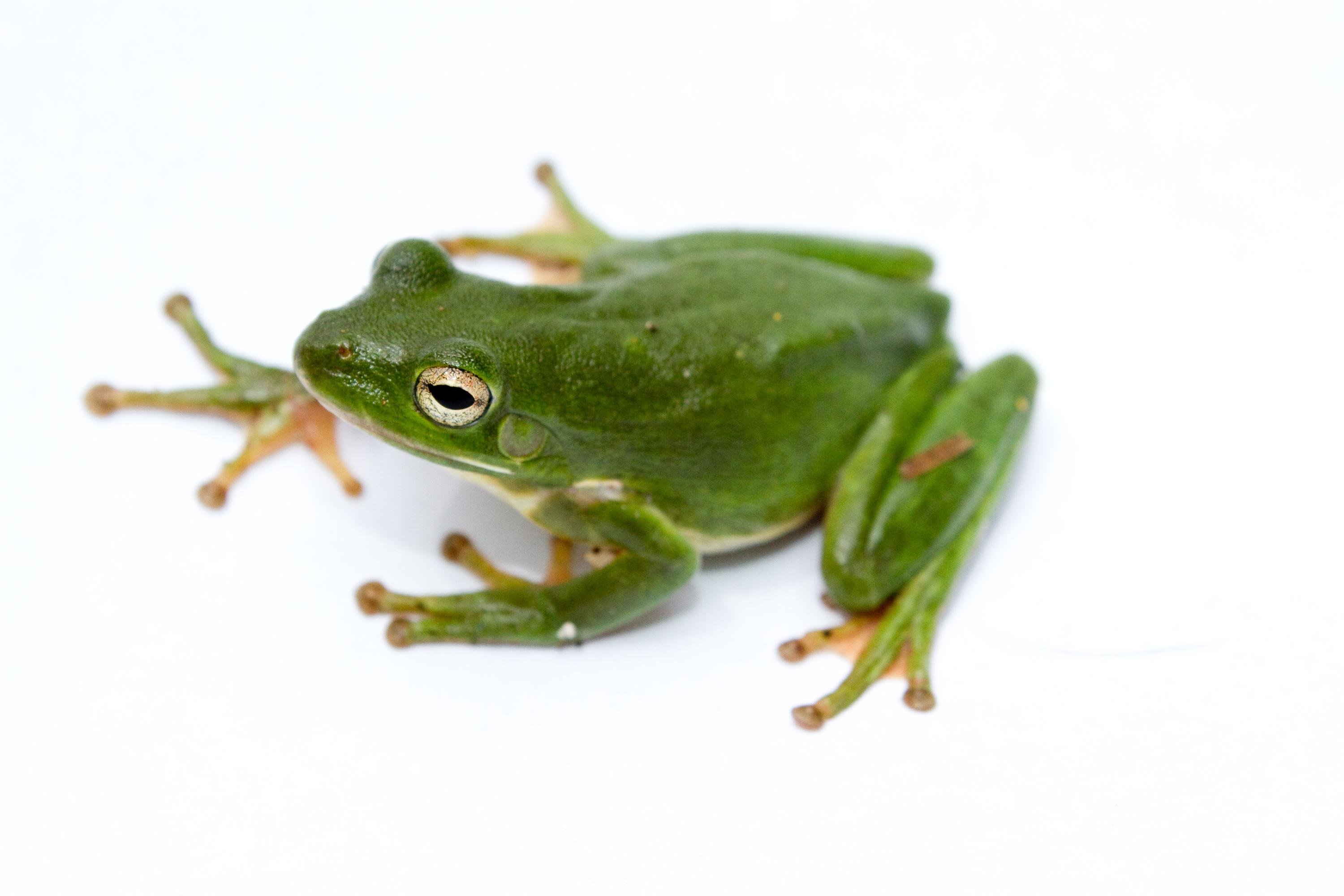
American green tree frogs are small, vivid green arboreal amphibians native to the southeastern United States. They are visually appealing display animals, best observed rather than handled.
ℹ️
Educational only. KinStation content is reviewed by licensed veterinarians but cannot replace an in-person exam. Always consult a licensed veterinarian or board-certified specialist for diagnosis, treatment, or any decision affecting your pet's health.
🩺 Need expert help with your american green tree frog?
Connect with a specialist near you or ask a licensed vet — never substitute online guidance for hands-on care in an emergency.
Arboreal frogs adapted to climbing with expanded toe pads, kept in tall, planted, humid terrariums. Most are nocturnal display animals that should be handled minimally and only with clean, wet hands to protect their sensitive, absorptive skin.
🔊 What does a american green tree frog sound like?
Hyla cinerea call audio
Fredlyfish4 · Wikimedia Commons · CC BY-SA 3.0
🎬 Video
Hyla cinerea call video
Fredlyfish4 · Wikimedia Commons · CC BY-SA 3.0
Habitat & space requirements
From the minimum an animal needs to be kept humanely, up to the ideal setup. Bigger is almost always better — minimums are floors, not targets.
Photo coming soon
Minimum
Tall group terrarium
18 × 18 × 24 in (≈ 29 gal vertical)
Being arboreal and gregarious, green tree frogs need height and company, so an 18 × 18 × 24 in vertical terrarium is the floor for two to three frogs with sturdy branches, broad-leaved plants, and a shallow water dish. Keep at 22–28 °C daytime with a cooler night drop (around 18–20 °C), 60–80% humidity, and low UVB, misting daily to support shedding and calling.
Photo coming soon
Recommended
Planted vertical vivarium
18 × 18 × 36 in for 3–4
An 18 × 18 × 36 in planted vivarium gives three to four frogs ample vertical climbing routes, dense foliage, cork, and a clean water feature, with an automatic mister maintaining 60–80% humidity. Provide a 22–28 °C gradient and low-level UVB plus a cooler night cycle so the colony can perch, hunt, and chorus naturally.
Photo coming soon
Ideal
Bioactive arboreal vivarium
24 × 24 × 36 in+ bioactive
A 24 × 24 × 36 in or taller bioactive vivarium with a drainage layer, live tropical plants, tall branches, and a filtered water section houses a comfortable group with room to leap. Misting systems hold 60–80% humidity, while gentle UVB and a 22–28 °C gradient with night cooling drive natural canopy behaviour and breeding choruses, the best welfare setup.
Life & growth stages
How this animal changes through its life — each stage often has its own care, diet and space needs.
Photo coming soon
Egg
Amphibian eggs are soft, jelly-coated spheres laid in or near water — in floating clutches, strings, or foam nests depending on the species. The dark embryo is visible within the clear gel as it develops.
Photo coming soon
Tadpole / Larva
The aquatic larva (a tadpole in frogs/toads, a gilled larva in salamanders and newts) breathes through gills and feeds and grows in water. Frog/toad tadpoles are limbless at first, then sprout hind then front legs as metamorphosis nears.
Photo coming soon
Juvenile (froglet / eft)
At metamorphosis the animal develops legs and lungs and typically leaves the water as a froglet or, in many newts, a terrestrial eft. It resembles a small adult but is not yet sexually mature and its coloration may still be changing.
Adult
Adults reach full size and breeding condition, with the species' mature skin coloration and pattern. Many amphibians return to water to breed and can show seasonal or sex-specific changes such as nuptial coloration or crests.
Habitat & enclosure
American green tree frogs are small, arboreal amphibians best kept in a vertically oriented, planted vivarium with live or artificial plants, climbing branches, and broad leaves to perch on. A soft, moisture-retaining substrate (such as coco fiber, sphagnum moss, or a bioactive mix) and a shallow dish of dechlorinated water support the humidity and hydration these frogs need.
Maintain comfortable, moderate ambient temperatures with a slight nighttime drop and a humid (but not waterlogged) environment. A low-output UVB source on a regular cycle is recommended, since UVB supports the vitamin D3 pathway and calcium metabolism that prevent metabolic bone disease.
Water quality is critical because amphibian skin is highly permeable: only dechlorinated, amphibian-safe water should ever contact them, and the enclosure should be kept clean. Some states regulate collection of native amphibians, so source captive-bred animals and check local laws.
Substrate
Use a moisture-retaining substrate such as coconut fiber, sphagnum moss, or a bioactive soil mix that holds humidity without staying waterlogged. Add a shallow, easily-cleaned water dish of dechlorinated water large enough for soaking.
Equipment & setup
House these arboreal frogs in a tall enclosure at 72-80F daytime with a slight night drop, using a low-wattage heat source if the room is cool, and maintain 50-70% humidity via misting. Provide plenty of vertical branches, cork bark, and broad-leaf plants for climbing, plus low-level (2.0-5.0) UVB lighting on a day-night cycle.
Diet
Green tree frogs are insectivores fed a variety of appropriately sized live insects — commonly crickets and small roaches, with items like black soldier fly larvae adding variety and the occasional wax worm offered sparingly as a richer treat. Variety helps balance nutrition over time.
Feeder insects should be dusted with a calcium supplement (and a multivitamin on an appropriate schedule for amphibians) to support bone health and prevent metabolic bone disease; the specifics are best guided by an amphibian-experienced veterinarian rather than guessed. Gut-loading the feeders before offering them improves their nutritional value.
Avoid wild-caught insects, which can carry pesticides and parasites. Provide a shallow dish of dechlorinated water at all times, as frogs absorb water (and, unfortunately, contaminants) through their skin.
Behavior & temperament
Green tree frogs are nocturnal and arboreal, spending the day tucked against leaves or glass and becoming active to hunt after dark. They are generally tolerant of being kept in compatible groups, though males call loudly, particularly in breeding condition — a charming or disruptive trait depending on the household.
They are display animals, not handling pets. Their permeable skin readily absorbs oils, soaps, lotions, and salts from human hands, so handling should be minimal and, when necessary, done with clean, wet (dechlorinated) hands or a soft container. This is a welfare issue as much as a behavioural preference.
Watching their colour shift — from bright lime to duller brown depending on temperature, humidity, and mood — is part of the appeal, and a settled frog in good conditions will perch contentedly in the open at night.
Health
Care should be anchored to a reptile/amphibian-experienced veterinarian, and because frogs are subtle, owner observation of skin colour and texture, body condition, appetite, and behaviour is the main early-warning system. Clean conditions and dechlorinated water are the most important preventive measures.
Documented amphibian concerns include chytrid fungal infection (a serious disease of amphibians worldwide), bacterial 'red-leg' (reddening of the legs and underside, with swelling and lethargy), parasites, and metabolic bone disease where calcium or UVB is inadequate. These require veterinary diagnosis and care.
Signs that warrant prompt evaluation include lethargy, abnormal skin colour or lesions, bloating, reddened limbs, and persistent inappetence. Because amphibians decline quietly and their skin is so sensitive, prompt professional input is preferable to home experimentation.
Tips, DIY & hacks
Mist in the evening to mimic their nocturnal activity and trigger feeding, and dust crickets and other insects with calcium and a multivitamin. PVC pipe sections and bamboo make cheap vertical perches and hides; quarantine wild-caught individuals and watch for the loud 'quack' call from males, which signals breeding readiness.
Origin & history
The American green tree frog (Hyla cinerea) is native to the southeastern United States, where it is a common, vocal resident of wetlands, marsh edges, and backyards; it is the official state amphibian of Georgia and Louisiana. Its bright colour, manageable size, and hardiness made it a familiar entry-level display amphibian.
Animals in the trade are a mix of captive-bred and wild-sourced, and because some states regulate the collection of native amphibians, responsible keepers favour captive-bred frogs and check local wildlife regulations before acquiring them.
Anecdotes & owner lore
Community experience and cultural notes — not veterinary advice. Every animal is an individual; treat these as colour, not care instructions.
Across the American South, the green tree frog is the sound of a summer night — a nasal, repetitive 'quonk… quonk' chorus from the marsh edge that residents associate with warm, humid evenings, and an old folk nickname casts the frog as a 'rain frog' whose calling foretells a storm. Many a Southerner's first frog encounter is one stuck to a porch window, hunting moths drawn to the light.
Keepers love the species' mood-ring colour changes and its habit of plastering itself flat against the glass in odd, comical poses. The recurring piece of advice newcomers receive is hands-off appreciation: these are frogs to watch glowing green under a night light, not to handle, and that restraint is itself part of the hobby's culture of respecting delicate amphibian skin.
Common ailments
Metabolic bone disease (MBD) — common — Prevented with dusted/gut-loaded feeders and low-output UVB; calcium and vitamin D3 balance is the key.
Parasitic infection — common
Chytrid fungus (chytridiomycosis) — rare — Green tree frogs are relatively resistant post-metamorphosis, but biosecurity still matters in a collection.
Red-leg syndrome (bacterial septicemia) — rare
Reviewed and signed off by: KinStation Editorial - pre-launch draft (pending DVM review)