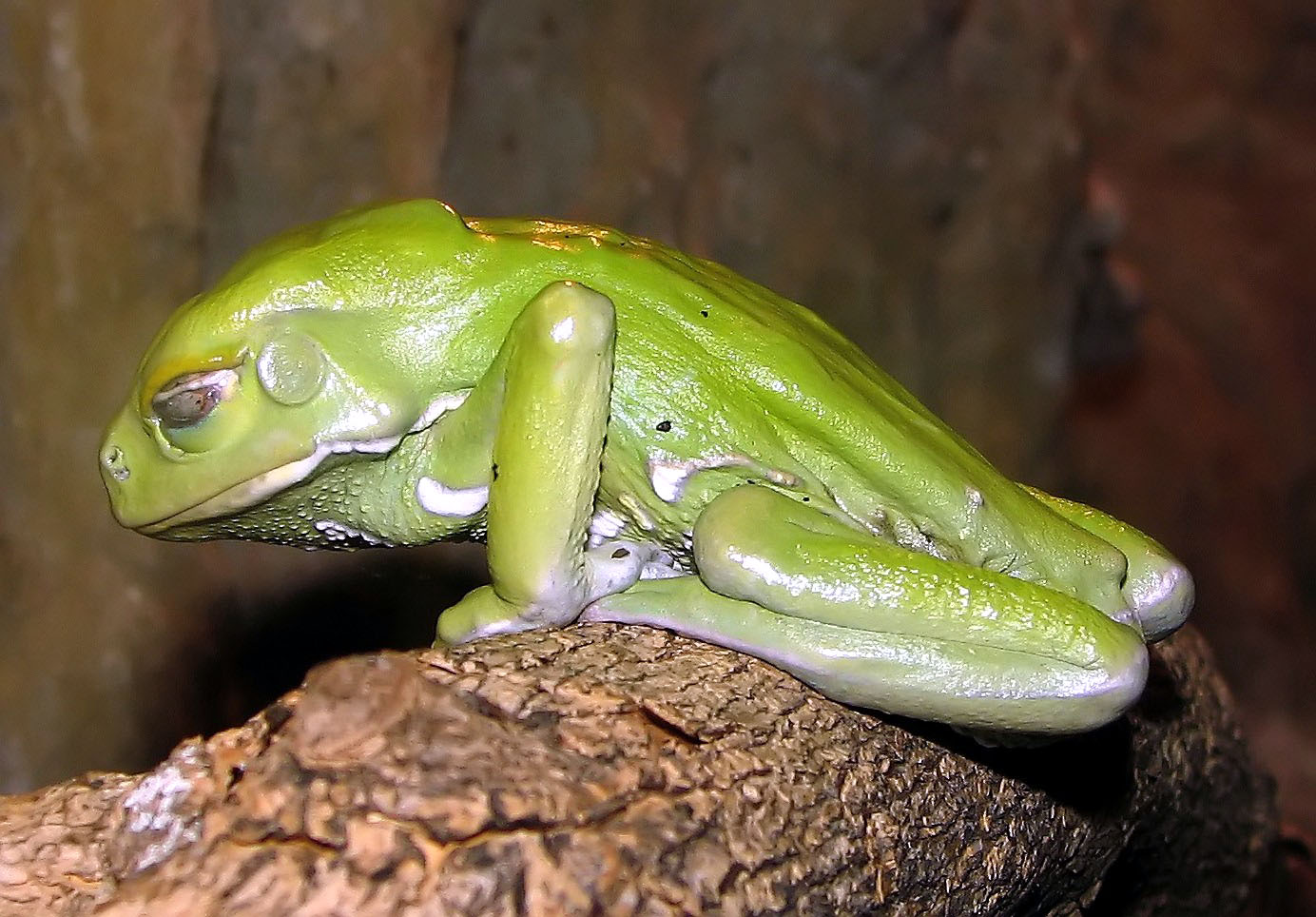
A slow, deliberate, lizard-like leaf frog from the dry Gran Chaco that walks hand-over-hand rather than hopping and waterproofs its skin with a waxy lipid secretion. Its uniquely arid, high-light husbandry makes it a striking but advanced-level species.
ℹ️
Educational only. KinStation content is reviewed by licensed veterinarians but cannot replace an in-person exam. Always consult a licensed veterinarian or board-certified specialist for diagnosis, treatment, or any decision affecting your pet's health.
🩺 Need expert help with your waxy monkey tree frog?
Connect with a specialist near you or ask a licensed vet — never substitute online guidance for hands-on care in an emergency.
Medium-large leaf frog; about 7-10 cm (2.8-4 in), females larger than males.
Lifespan
8–12 years
Social needs
group
Native region
Gran Chaco dry forest and scrub of central South America (Argentina, Bolivia, Paraguay, Brazil)
Origin
New World
Climate
⛅ Subtropical
Family
Phyllomedusidae
Genus
Phyllomedusa
Part of the Tree Frogs
Arboreal frogs adapted to climbing with expanded toe pads, kept in tall, planted, humid terrariums. Most are nocturnal display animals that should be handled minimally and only with clean, wet hands to protect their sensitive, absorptive skin.
From the minimum an animal needs to be kept humanely, up to the ideal setup. Bigger is almost always better — minimums are floors, not targets.
Photo coming soon
Minimum
Tall arboreal vivarium
18 × 18 × 24 in for one adult
Phyllomedusa sauvagii is a slow-moving arid arboreal — DIFFERENT from typical tree frogs. 18×18×24 tall vivarium with coco fibre, leaf litter, sturdy branches, low humidity (50–70%), warmer day temps (78–90 °F basking) and cooler nights. UVB strongly recommended.
Photo coming soon
Recommended
Larger arid arboreal
24 × 18 × 24 in for a pair
Wider arid vivarium with branch network at varied diameters, broad-leaf plants tolerant of low humidity (Sansevieria, Pothos), basking spot under UVB, shallow water dish. Distinctive monkey-like grip — branches must be sturdy.
Photo coming soon
Ideal
Planted arid arboreal
24 × 24 × 36 in bioactive arid
Tall planted bioactive arid vivarium with drainage, sandy/loam substrate, robust branches, UVB across the top, and a shallow water area. Supports natural slow climbing and basking — these frogs walk like primates rather than hop.
Life & growth stages
How this animal changes through its life — each stage often has its own care, diet and space needs.
Photo coming soon
Egg
Amphibian eggs are soft, jelly-coated spheres laid in or near water — in floating clutches, strings, or foam nests depending on the species. The dark embryo is visible within the clear gel as it develops.
Photo coming soon
Tadpole / Larva
The aquatic larva (a tadpole in frogs/toads, a gilled larva in salamanders and newts) breathes through gills and feeds and grows in water. Frog/toad tadpoles are limbless at first, then sprout hind then front legs as metamorphosis nears.
Photo coming soon
Juvenile (froglet / eft)
At metamorphosis the animal develops legs and lungs and typically leaves the water as a froglet or, in many newts, a terrestrial eft. It resembles a small adult but is not yet sexually mature and its coloration may still be changing.
Adult
Adults reach full size and breeding condition, with the species' mature skin coloration and pattern. Many amphibians return to water to breed and can show seasonal or sex-specific changes such as nuptial coloration or crests.
(c) JuanMa PerezIglesias, some rights reserved (CC BY-NC) via iNaturalist — https://www.inaturalist.org/observations/82327893
Habitat & enclosure
Unlike most tree frogs, this is a hot, bright, well-ventilated arid-canopy species. Use a tall, screen-ventilated terrarium of at least 45x45x60 cm (18x18x24 in) for one to two frogs, heavily ventilated to prevent stagnant humidity. Keep warm daytime temps of 27-32C (80-90F) with a basking gradient, dropping at night, and moderate humidity (50-70%) achieved by a light evening misting that dries out, not constant dampness. Provide many sturdy horizontal branches and broad leaves for perching, plus a shallow water dish.
Substrate
A well-draining, drier substrate such as a coco fiber/sand/soil blend or simple paper towel for quarantine; avoid the constantly wet bioactive soils used for rainforest frogs. The setup should dry between mistings. A shallow water dish provides hydration; deep moisture-retaining litter is not appropriate for this xeric species.
Equipment & setup
Tall, heavily ventilated (screen-sided) terrarium; a basking heat source on a thermostat to create a 27-32C gradient; a quality UVB lamp (this diurnally-exposed frog genuinely benefits from moderate-to-high UVB, around 5-7%); LED plant/grow light; a light automated or hand mister for brief evening humidity; digital thermo-hygrometer; shallow water dish. Airflow management is as important as heat.
Diet
An insectivore that eats appropriately sized crickets, dubia roaches, and the occasional hornworm or silkworm. Dust feeders with calcium/D3 and a multivitamin, with attention to vitamin A and D3 given its high-UVB lifestyle. Feed adults 2-3 times weekly, juveniles more often. Offer prey in the evening when the frog becomes active, and provide clean water though these frogs rarely soak.
Behavior & temperament
Nocturnal and remarkably slow and deliberate, gripping branches and walking opposable-toed like a chameleon, which earns it the 'monkey' name. By day it sits exposed in bright light, limbs tucked, coated in waxy secretion that it wipes over its body to prevent water loss; it also excretes uric acid like a reptile to conserve water. Calm and not defensive, but handling should be minimal and gloved to protect the skin and its waxy coating. Best kept in small groups.
Health
Advanced because it fails in typical humid tree-frog setups; it needs heat, strong ventilation, and high UVB or it develops respiratory infections, MBD, and skin disease. Conversely, excessive humidity and poor airflow quickly cause fatal bacterial infections. Provide proper UVB and a thermal gradient. Watch for dehydration, weight loss, and cloudy eyes; use an exotics vet experienced with arid amphibians. Quarantine new arrivals.
Tips, DIY & hacks
Treat it more like an arid reptile than a rainforest frog: prioritize heat, UVB, and ventilation, and let the enclosure dry between mistings. Provide ample horizontal branches for its slow climbing gait. A rain chamber can trigger breeding. Handle rarely and with clean gloves so you do not strip the protective waxy coating. Do not co-house with humidity-loving species whose conditions would kill it.