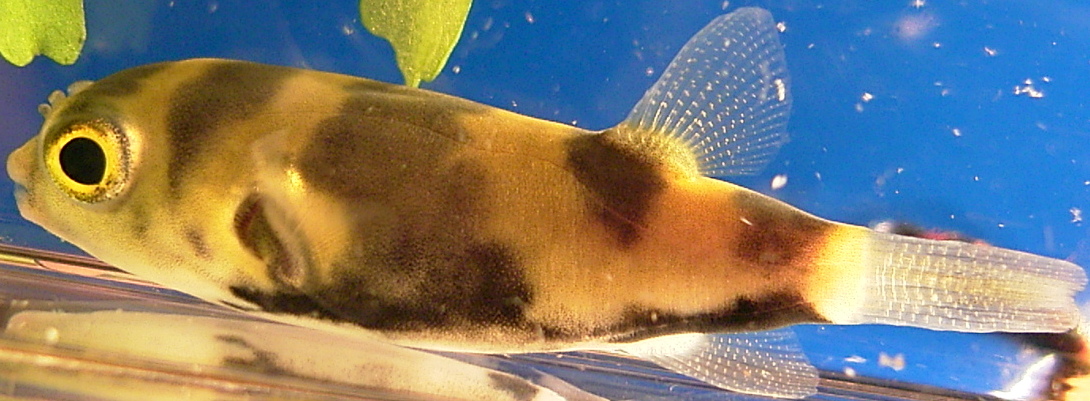
The Amazon puffer is a small, lively, fully freshwater pufferfish with bold black bars over a yellow-green body and the curious, expressive personality the family is loved for. Unusually for puffers it is social and active — best kept in groups — making it one of the few genuinely community-friendly puffers, though its constantly growing teeth demand a hard-shelled diet.
ℹ️
Educational only. KinStation content is reviewed by licensed veterinarians but cannot replace an in-person exam. Always consult a licensed veterinarian or board-certified specialist for diagnosis, treatment, or any decision affecting your pet's health.
🩺 Need expert help with your amazon puffer?
Connect with a specialist near you or ask a licensed vet — never substitute online guidance for hands-on care in an emergency.
Charismatic, intelligent fish with beak-like teeth and expressive faces — most need meaty, hard-shelled prey to keep their teeth worn down, and many are nippy specialists rather than community fish.
From the minimum an animal needs to be kept humanely, up to the ideal setup. Bigger is almost always better — minimums are floors, not targets.
Photo coming soon
Minimum
Small shoal tank
55 gal / 208 L long tank
Colomesus asellus is the only truly social, schooling, freshwater puffer — keep 4+. A 55-gallon long is the practical minimum for a small group. Soft slightly acidic water, strong filtration, moderate flow, and snail-rich diet to wear down teeth.
Photo coming soon
Recommended
Planted shoal tank
75 gal / 284 L long, planted
Heavily planted 75-gal long with driftwood, sand substrate, and a school of 6+. Amazon puffers are active swimmers and curious — they need swim length. Be ready to trim teeth manually if hard prey isn't enough.
Photo coming soon
Ideal
Amazon biotope shoal
100+ gal / 379 L+ biotope
Large Amazon-style biotope with leaf litter, soft acidic water, dim lighting, and a shoal of 8+. Mid-tank activity is constant; tankmates need to be peaceful and fast — fin nipping is common.
Life & growth stages
How this animal changes through its life — each stage often has its own care, diet and space needs.
Photo coming soon
Egg
Fish eggs are small, translucent spheres, often laid in clutches on plants, substrate, or in a nest — or carried/brooded by a parent in livebearing and mouth-brooding species. A dark eye spot and the curled embryo become visible inside as development progresses.
Photo coming soon
Fry
Newly hatched fry are tiny and semi-transparent, frequently still carrying a yolk sac that fuels them before they feed freely. They lack full fin structure and adult coloration, staying near cover until they can swim and forage on their own.
Photo coming soon
Juvenile
Juveniles look like miniature adults but with developing fins and muted or different markings; many species shift pattern and color as they mature. Growth is rapid at this stage given clean water and steady feeding.
Adult
Adults show the species' full size, finnage, and mature coloration, and are sexually mature. Many fish develop sex-specific differences in size, color, or fin shape, which can intensify during breeding.
Habitat & enclosure
Keep a small shoal in at least a 30-gallon (~115 L) tank with a long footprint, as these are fast, restless swimmers that need open lanes. Maintain tropical conditions of 72-80°F (22-27°C), pH 6.0-7.5, and soft to moderately hard water; this species is strictly freshwater, not brackish, despite the brackish needs of many relatives.
They originate from flowing Amazonian rivers, so they enjoy moderate current, good oxygenation, and clean water. Provide plants, driftwood, and rockwork to break sightlines and offer enrichment, with moderate lighting to suit their active, daytime habits.
Substrate
Fine sand or smooth gravel works well; sand suits their foraging and is gentle if they nose along the bottom for snails. A natural, well-planted scape with open swimming space keeps these active fish comfortable.
Equipment & setup
Use efficient filtration that provides moderate flow and strong oxygenation to mimic their river habitat, plus a heater for the tropical range. Standard community lighting is fine; a separate 'snail farm' tank or culture is practically essential equipment for supplying live snails to keep their teeth in check.
Diet
Carnivorous and reliant on hard-shelled prey to wear down continuously growing teeth. Feed snails (ramshorn, pond, bladder), small crustaceans, krill, clam, mussel, and bloodworms; live or frozen snails are the most important staple. Without enough crunchy foods their teeth overgrow, eventually preventing eating, so keep a steady supply of shelled prey.
Behavior & temperament
Active, curious, and social — best kept in groups of three or more, which is rare among puffers. Less aggressive than most relatives but still a potential fin-nipper, so mix with fast, non-flowing-finned tankmates and avoid slow or long-finned fish, shrimp, and snail tankmates (which become food). Within a group they shoal and interact actively, displaying lots of engaging behavior.
Health
Common issues include overgrown teeth from a too-soft diet, internal parasites (especially in wild-caught fish, often warranting deworming), and ich; puffers are scaleless and sensitive to medications, so dose copper and other treatments cautiously. They are also sensitive to poor water quality and ammonia spikes, so stable, well-filtered conditions are important.
Tips, DIY & hacks
Keep a breeding colony of pest snails going elsewhere so you always have hard-shelled food on hand. Deworm wild-caught puffers and watch the front teeth — if they overgrow, a careful trim under sedation by a vet may be needed. Drip-acclimate new arrivals and avoid keeping them with any prized snails or shrimp.