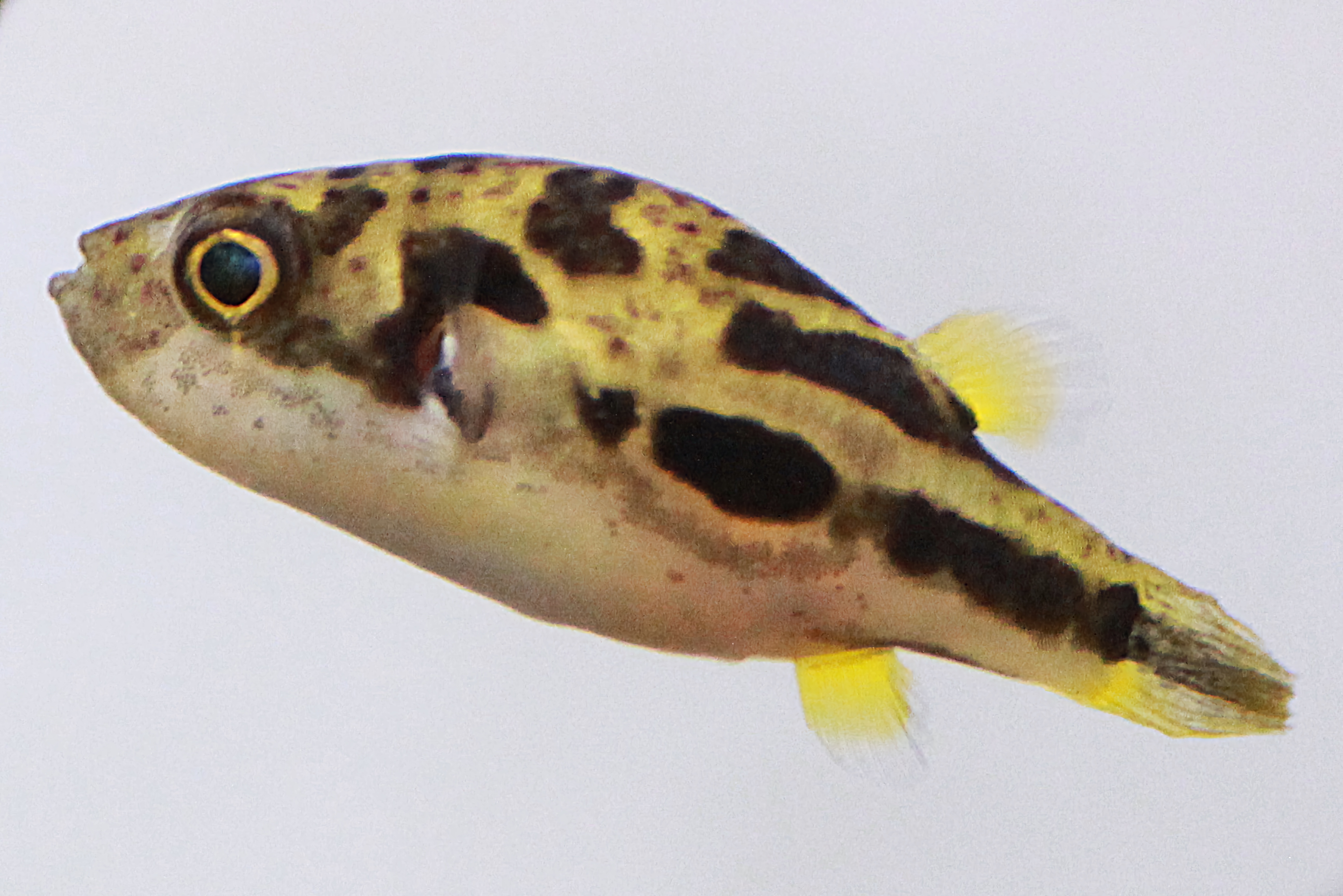
Pea puffers (or dwarf puffers) are tiny, intelligent freshwater pufferfish endemic to the rivers of Kerala, India. They are charming display fish best kept in species-only tanks with snail-based enrichment.
ℹ️
Educational only. KinStation content is reviewed by licensed veterinarians but cannot replace an in-person exam. Always consult a licensed veterinarian or board-certified specialist for diagnosis, treatment, or any decision affecting your pet's health.
🩺 Need expert help with your pea puffer?
Connect with a specialist near you or ask a licensed vet — never substitute online guidance for hands-on care in an emergency.
Charismatic, intelligent fish with beak-like teeth and expressive faces — most need meaty, hard-shelled prey to keep their teeth worn down, and many are nippy specialists rather than community fish.
From the minimum an animal needs to be kept humanely, up to the ideal setup. Bigger is almost always better — minimums are floors, not targets.
Photo coming soon
Minimum
Planted nano group tank
10 gal (≈ 20 × 10 × 12 in)
Pea puffers are tiny but intelligent and territorial, so a 10-gallon densely planted tank is the humane floor for a small group, typically one male to two or three females to diffuse aggression. Heavily plant with broken sightlines, gentle filtration, and warm (24–27 °C) water; they need live or frozen meaty foods and cannot be kept in bare bowls or alone in tight quarters.
Photo coming soon
Recommended
Densely planted puffer tank
15–20 gal (≈ 24 × 12 × 12 in)
A 15–20 gallon long, thickly planted tank gives a harem of pea puffers more space to establish territories, hunt, and retreat, sharply reducing the bullying common in cramped setups. Provide dense planting, driftwood, moss, and warm (24–27 °C) stable water with gentle flow, plus a varied diet of snails and live or frozen foods to satisfy their active foraging instincts.
Photo coming soon
Ideal
Species biotope aquarium
20+ gal long (≈ 30 × 12 × 12 in)
A 20-gallon-plus heavily planted species-only biotope lets a natural group of pea puffers establish stable territories with abundant cover, leaf litter, and snail-cultured live food. Warm (24–27 °C), well-filtered soft water with thick vegetation and broken lines of sight brings out their curious, hunting behavior and minimizes the territorial stress that plagues smaller tanks — the best welfare outcome for this nano species.
Life & growth stages
How this animal changes through its life — each stage often has its own care, diet and space needs.
Photo coming soon
Egg
Fish eggs are small, translucent spheres, often laid in clutches on plants, substrate, or in a nest — or carried/brooded by a parent in livebearing and mouth-brooding species. A dark eye spot and the curled embryo become visible inside as development progresses.
Photo coming soon
Fry
Newly hatched fry are tiny and semi-transparent, frequently still carrying a yolk sac that fuels them before they feed freely. They lack full fin structure and adult coloration, staying near cover until they can swim and forage on their own.
Photo coming soon
Juvenile
Juveniles look like miniature adults but with developing fins and muted or different markings; many species shift pattern and color as they mature. Growth is rapid at this stage given clean water and steady feeding.
Adult
Adults show the species' full size, finnage, and mature coloration, and are sexually mature. Many fish develop sex-specific differences in size, color, or fin shape, which can intensify during breeding.
Habitat & enclosure
Pea puffers are tiny — roughly an inch — but their care is anything but simple, which is why experienced keepers rate them as advanced despite the small footprint. A planted aquarium of about 10–20 gallons suits a small group, and group composition matters: a common approach is one male with two or three females to spread out the male's aggression. Crucially, unlike many pufferfish, the pea puffer is a true freshwater species and is not kept in brackish water.
Heavy planting and décor are functional, not decorative: they break up sightlines so that aggressive or dominant individuals can't constantly harass the others. Temperatures sit in a tropical range with a near-neutral pH and soft to moderately hard water. Mature, fully cycled water is essential because puffers are sensitive to nitrogenous waste; a not-quite-established tank is a frequent cause of trouble.
Gentle filtration, stable parameters, and lots of cover make for calmer, healthier puffers. The overall setup mirrors the slow, vegetated freshwater rivers of their native range, where dense plant growth provides both hunting grounds and refuge.
Substrate
Fine sand or small smooth gravel is fine; the substrate is less important than dense planting and visual cover. A dark substrate helps display their colors and reduces stress.
Equipment & setup
A heavily planted tank (5 gallons for one, 10+ for a small group) with gentle filtration (sponge filter) and stable tropical temperature 74-80F suits these tiny, sensitive fish. Lots of plants, moss, and decor are needed to break sightlines and reduce aggression.
Diet
Pea puffers are carnivores that are notorious for refusing dry foods — flakes and pellets are usually ignored. Their diet is built on frozen and live foods: blackworms, bloodworms, mysis shrimp, and brine shrimp, offered in small portions appropriate to their tiny size. This live/frozen requirement is a major reason they are not a beginner fish.
Small live snails serve a special dual purpose: they are both food and dental maintenance. Like other puffers, pea puffers have beak-like teeth that grow continuously, and crunching hard-shelled prey such as snails helps wear the beak down. Many keepers maintain a snail-breeding tank to keep a steady supply. Without hard prey, the beak can overgrow, and advanced keepers occasionally have a vet trim an overgrown beak under sedation.
The main feeding challenges are the need for live/frozen variety, ensuring every individual in a group actually gets fed (dominant puffers can monopolize food), and providing enough hard-shelled prey for beak wear. Portion control matters too, since puffers can overeat and the small tanks they live in are easily fouled.
Behavior & temperament
Pea puffers punch far above their weight in attitude. They are active, intensely curious, and aggressive for their size, with the endearing habit of swiveling their eyes independently and "watching" their keeper. That curiosity and personality are a big part of their appeal — but the aggression means they are best kept species-only.
Even small, peaceful-seeming tankmates are at risk: pea puffers are notorious fin-nippers and will harass slower or long-finned fish, and shrimp may be eaten. Within a group, a single male can bully females, which is why the recommended ratio skews female and why heavy planting to break sightlines is so important. Keepers watch for individuals being chased away from food or hiding constantly, signs that the social balance is off.
Despite the feistiness, their tiny size, bold behavior, and obvious intelligence make them beloved nano-tank residents. Much of the fun is observational: watching them hunt snails, patrol their planted jungle, and react to activity outside the glass.
Health
Common pea puffer health concerns include internal parasites (especially in wild-caught animals, which make up much of the trade), bacterial infections tied to poor water quality, and beak overgrowth from a lack of hard-shelled prey. These are general patterns to discuss with an aquatic veterinarian rather than self-treat.
Prevention combines water management and diet: a fully mature, cycled tank with stable, clean parameters; a varied live/frozen diet; and regular access to small snails or other hard prey for beak wear. Because so many pea puffers are wild-caught, careful observation during the first weeks — for parasites and feeding response — is worthwhile, and quarantine is sensible.
Signs that warrant attention include a visibly overgrown beak, a sunken or pinched belly (possible internal parasites), bloating, lethargy, loss of appetite, and clamped fins. For an overgrown beak or suspected parasites, an aquatic-experienced veterinarian can advise; beak trimming in particular is a veterinary procedure, not a home one.
Tips, DIY & hacks
Pea puffers need live or frozen meaty foods such as bloodworms, blackworms, and especially small snails to wear down their beaks; they will not eat dry pellets. Culture ramshorn or bladder snails as a free ongoing food source, and keep them species-only or risk fin-nipping of tankmates.
Origin & history
Carinotetraodon travancoricus is a dwarf pufferfish endemic to the rivers, lakes, and backwaters of the Western Ghats in Kerala (and parts of southern India), one of the smallest pufferfish in the world. It is unusual in the puffer world for being a strictly freshwater species, which made it an instant hit when it became widely available in the aquarium trade.
Most pea puffers in the hobby are still wild-caught, and concern over collection pressure on a range-restricted species has prompted interest in captive breeding, which hobbyists do achieve. There are no real color morphs; the appeal is the natural package — a thumbnail-sized, big-eyed, opinionated puffer with a personality vastly larger than its body.
Anecdotes & owner lore
Community experience and cultural notes — not veterinary advice. Every animal is an individual; treat these as colour, not care instructions.
Pea puffers are the nano-tank world's pocket-sized celebrities: a fish the size of a garden pea that behaves like it owns the building. Keepers are endlessly charmed by the independently swiveling eyes — a pea puffer will lock one eye on a snail and the other on your coffee cup — and by the way they seem to genuinely watch and react to people, swimming up to "greet" a familiar face at the glass. They're often described as having more personality per cubic inch than any other aquarium fish.
The snail-hunting is a beloved spectacle. Owners deliberately breed pest snails just to feed them to the puffers, and watching a one-inch fish stalk, pounce on, and crunch a snail out of its shell never gets old. The flip side is the species' reputation as a tiny tyrant — fin-nipping, food-hogging, and utterly unsuited to a peaceful community tank — which has earned it affectionate nicknames and a cult following among keepers who'll happily run a whole dedicated tank for a handful of pea-sized fish with the attitude of something ten times the size.
Common ailments
Bacterial infection — common — Small, sensitive fish in small tanks are vulnerable to water-quality-driven infection.
Beak (tooth) overgrowth — common — Specific to puffers; prevented by routinely offering small snails or other hard prey.
Internal parasites — common — Frequently present in wild-caught pea puffers, which dominate the trade; watch newcomers closely.
Reviewed and signed off by: KinStation Editorial - pre-launch draft (pending DVM review)