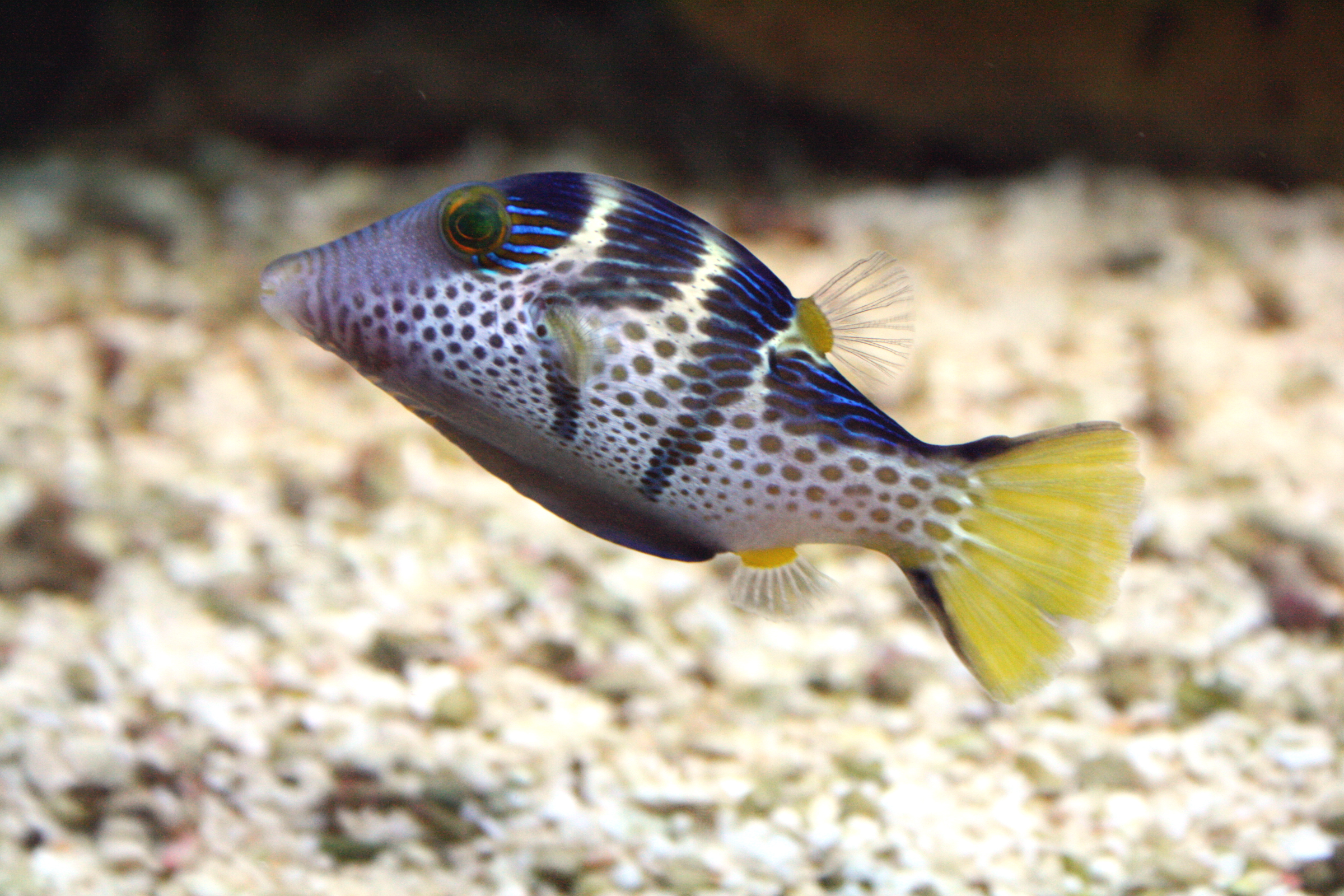
A small, hardy sharpnose puffer marked with four dark saddles and a fine pattern of orange-brown spots. Personable and beginner-friendly for a puffer, but only conditionally reef-safe — it may nip corals, clams, and ornamental invertebrates.
ℹ️
Educational only. KinStation content is reviewed by licensed veterinarians but cannot replace an in-person exam. Always consult a licensed veterinarian or board-certified specialist for diagnosis, treatment, or any decision affecting your pet's health.
🩺 Need expert help with your valentini puffer?
Connect with a specialist near you or ask a licensed vet — never substitute online guidance for hands-on care in an emergency.
Charismatic, intelligent fish with beak-like teeth and expressive faces — most need meaty, hard-shelled prey to keep their teeth worn down, and many are nippy specialists rather than community fish.
From the minimum an animal needs to be kept humanely, up to the ideal setup. Bigger is almost always better — minimums are floors, not targets.
Photo coming soon
Minimum
Mature reef with caves
30 gal / 110 L reef
Canthigaster valentini is a saltwater 'sharpnose' nano puffer (~10 cm). Mature reef with caves and varied diet (crab, shrimp-in-shell, snails). Will nip corals/inverts.
Photo coming soon
Recommended
FOWLR or invert-tolerant reef
55 gal / 200 L+
Larger reef with abundant rockwork and varied diet. Single specimen; they are mildly aggressive. Hard-shell diet wears down growing teeth.
Photo coming soon
Ideal
Large FOWLR display
75 gal+ / 280 L+ display
Spacious reef with abundant invertebrate prey and varied hard-shell diet. Curious personalities — valentini learns to recognise keepers.
Life & growth stages
How this animal changes through its life — each stage often has its own care, diet and space needs.
Photo coming soon
Egg
Fish eggs are small, translucent spheres, often laid in clutches on plants, substrate, or in a nest — or carried/brooded by a parent in livebearing and mouth-brooding species. A dark eye spot and the curled embryo become visible inside as development progresses.
Photo coming soon
Fry
Newly hatched fry are tiny and semi-transparent, frequently still carrying a yolk sac that fuels them before they feed freely. They lack full fin structure and adult coloration, staying near cover until they can swim and forage on their own.
Photo coming soon
Juvenile
Juveniles look like miniature adults but with developing fins and muted or different markings; many species shift pattern and color as they mature. Growth is rapid at this stage given clean water and steady feeding.
Adult
Adults show the species' full size, finnage, and mature coloration, and are sexually mature. Many fish develop sex-specific differences in size, color, or fin shape, which can intensify during breeding.
Habitat & enclosure
House a single Valentini puffer in a fully cycled marine aquarium of at least 30 gallons (110 L); a 4 ft footprint and 55+ gallons is more comfortable and reduces boredom. Provide plenty of live rock with caves and crevices for the fish to graze, explore, and sleep in, plus open swimming space in the lower-to-mid water column. A secure lid helps, though this species jumps less than firefish.
Maintain stable tropical reef conditions: temperature 72-78 F (22-26 C), pH 8.1-8.4, salinity 1.020-1.026 specific gravity (1.023-1.025 ideal), and moderate water flow. As a scaleless, sensitive fish it needs excellent, stable water quality with low nitrate, so over-filtration and consistent parameters matter.
Substrate
A bed of fine to medium aragonite sand suits this bottom-grazing fish and supports denitrification. Build the aquascape from plenty of live rock with caves and overhangs for sleeping, foraging, and security.
Equipment & setup
Run efficient filtration plus a protein skimmer to keep nitrate low for this messy, scaleless eater, along with a reliable heater and moderate flow from one or two powerheads. Standard reef or marine lighting is fine; live rock provides the biological filtration and grazing surfaces this puffer relies on.
Diet
Valentini puffers are carnivores that benefit from hard-shelled prey to help wear down their continuously growing beak-like teeth. Offer a varied meaty diet of mysis shrimp, krill, chopped clam, mussel, cockle, squid, and the occasional snail or small hermit crab; many also pick at algae and sponge on live rock. Feed small portions one to two times daily and remove uneaten food.
A monotonous soft diet can lead to overgrown teeth that may require manual trimming, so include hard-shelled items regularly. Variety prevents nutritional deficiencies and keeps this curious fish engaged.
Behavior & temperament
This is one of the most peaceful puffers, generally docile toward fish tankmates and best kept as the only puffer in the tank. It is only conditionally reef-safe: it usually ignores most corals but may nip LPS polyps, clam mantles, tubeworms, shrimp, snails, and hermit crabs, so it is risky in a prized reef. It is famously mimicked by the filefish Paraluteres prionurus, which copies its coloration for protection.
Keep it with semi-aggressive but non-bullying tankmates that won't outcompete it for food or pick at its fins. Provide rockwork to graze and hunt over; enrichment comes from foraging on live rock and hunting hard-shelled prey. Avoid very timid tankmates it could harass and very aggressive ones that stress it.
Health
Like all puffers it is scaleless and highly sensitive to copper-based medications and many standard treatments, so dose cautiously and treat water quality first. Common issues include overgrown teeth from a soft diet, marine ich (Cryptocaryon) and velvet (Amyloodinium), and internal parasites in wild-caught stock.
Puffers also carry tetrodotoxin and should never be handled roughly or allowed to inflate with air out of water. Quarantine new arrivals, drip-acclimate slowly, keep nitrate low, and maintain pristine, stable water to prevent most problems.
Tips, DIY & hacks
Drip-acclimate slowly and quarantine in a copper-free system, since puffers tolerate copper poorly. Offer hard-shelled snails or clam-on-the-half-shell regularly to keep the beak worn down, and never net a puffer through air where it can gulp and inflate — guide it into a container underwater instead.