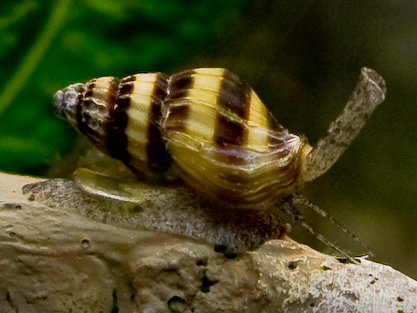
The assassin snail is a strikingly banded yellow-and-brown freshwater snail famous as a natural control for pest snail outbreaks. A predatory carnivore, it hunts and eats smaller snails such as ramshorns, bladder and trumpet snails, making it a popular biological pest-management tool. Unlike most aquarium snails it reproduces slowly and lays single eggs, so it rarely overruns a tank. It is peaceful toward fish and shrimp but should not be trusted with valuable dwarf-shrimp colonies.
ℹ️
Educational only. KinStation content is reviewed by licensed veterinarians but cannot replace an in-person exam. Always consult a licensed veterinarian or board-certified specialist for diagnosis, treatment, or any decision affecting your pet's health.
🩺 Need expert help with your assassin snail?
Connect with a specialist near you or ask a licensed vet — never substitute online guidance for hands-on care in an emergency.
Algae-grazing and detritus-cleaning aquarium snails — from tiny ramshorns and nerites to large mystery, rabbit and trapdoor snails. Hardy invertebrate cleanup crew for planted and community freshwater tanks, most needing mineral-rich water for strong shells.
From the minimum an animal needs to be kept humanely, up to the ideal setup. Bigger is almost always better — minimums are floors, not targets.
Photo coming soon
Minimum
Nano FW tank with pest snails
5+ gal cycled with pest-snail supply
Assassin snails (Clea helena) eat other snails — only viable in a cycled tank that has a pest-snail population to sustain them. Temperature 22–27 °C, neutral-to-hard water, sand or fine gravel substrate.
Photo coming soon
Recommended
Planted community tank
10–20 gal planted with snail population
Planted community tank with ongoing pest-snail supply or supplemental protein (frozen bloodworms). Fine sand substrate — they burrow when resting. Compatible with most peaceful fish.
Photo coming soon
Ideal
Planted aquascape with breeding group
20+ gal planted aquascape
Planted tank stable enough to support an ongoing breeding colony of assassins and their prey snails. Hard water (GH 8–15) supports good shell formation.
Life & growth stages
How this animal changes through its life — each stage often has its own care, diet and space needs.
Photo coming soon
Larva
Most marine invertebrates hatch into microscopic planktonic larvae (such as the zoea of crustaceans or the bipinnaria/veliger of echinoderms and mollusks) that drift and feed in the water column. The larva looks nothing like the adult and undergoes major reorganization.
Photo coming soon
Juvenile
After settling out of the plankton, the juvenile takes on a recognizable miniature of the adult body plan — a tiny shell, a small star, or a translucent shrimp. Crustaceans grow by molting, shedding the exoskeleton to enlarge.
Adult
Adults reach full size and reproductive maturity with the species' mature shell, shape, or coloration. Many continue to molt or grow throughout life, and some show sex differences in size or claw/appendage shape.
Habitat & enclosure
Keep in a cycled freshwater tank of 40 L (10 gal) or more, sized to the prey/cleanup load you need. Provide 21-27 C (70-80 F), pH 7.0-8.0 and moderately hard water (GH 8-15); they prefer neutral-to-alkaline, calcium-rich water for shell health and do poorly in soft, acidic conditions. Gentle to moderate flow suits them, and standard community lighting is fine.
They appreciate a sand or fine-gravel bed they can burrow into to ambush prey, plus driftwood and plants for cover.
Substrate
Fine sand or smooth fine gravel is ideal, allowing them to burrow and lie in wait for prey. Avoid sharp substrates that can damage the foot.
Equipment & setup
A standard heated, filtered freshwater aquarium meets all needs; no skimmer or special lighting required. Maintain calcium hardness via crushed coral or cuttlebone if your water is soft, and avoid any copper-containing equipment or medication.
Diet
Carnivorous predator and scavenger. It actively hunts smaller snails — bladder, ramshorn, trumpet and small mystery snails — using its proboscis, and will also take carrion, frozen bloodworms, brine shrimp and high-protein sinking foods. If prey snails run out, feed meaty foods directly so the colony stays nourished. It does not eat algae or live plants.
Behavior & temperament
Peaceful toward fish, dwarf shrimp adults and other large invertebrates, but predatory toward smaller snails and a threat to baby shrimp and shrimplets. Reef-irrelevant (freshwater only). Slow, deliberate burrower; keep a small group for breeding, but expect it to clear out a pest-snail population over weeks. Not suitable in a tank where you want pest snails as food for other animals.
Health
Hardy when water is hard and alkaline; shell erosion and pitting signal soft, calcium-poor water. Ensure a steady food supply once pest snails are gone, as starvation is the main long-term risk. Sensitive to copper and snail-killing medications — these are lethal, so never use chemical snail treatments in the same tank.
Tips, DIY & hacks
Add a few assassins to clear a pest-snail outbreak naturally instead of chemical snail killers, which harm all invertebrates. They breed slowly — a male and female lay single square eggs on hard surfaces — so seed a small group if you want them to persist. Drip-acclimate new snails, and keep them out of prized shrimp breeding tanks where they may pick off shrimplets.