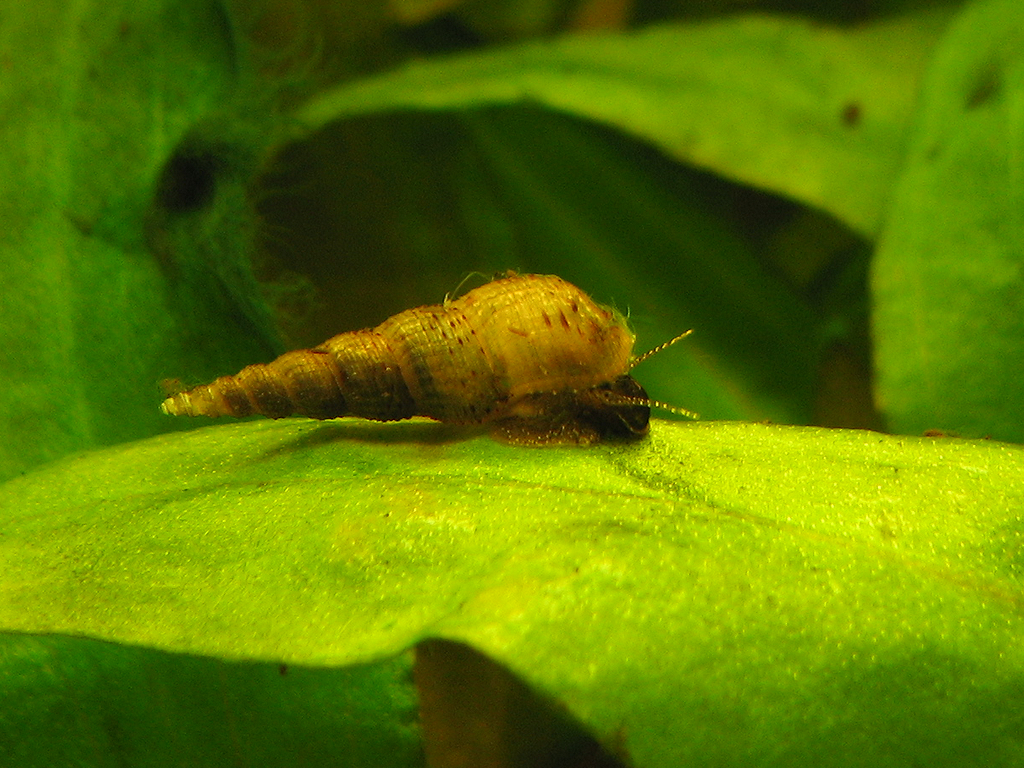
The Malaysian trumpet snail is a small, elongated cone-shelled freshwater snail prized as a substrate-aerating cleanup crew. Largely nocturnal, it burrows through sand by day and emerges at night to graze detritus and leftover food, preventing dead spots and anaerobic pockets in the substrate. It reproduces parthenogenetically (livebearing clones), so colonies build quickly — useful but potentially overwhelming. Note it is regulated or considered invasive in some regions.
ℹ️
Educational only. KinStation content is reviewed by licensed veterinarians but cannot replace an in-person exam. Always consult a licensed veterinarian or board-certified specialist for diagnosis, treatment, or any decision affecting your pet's health.
🩺 Need expert help with your malaysian trumpet snail?
Connect with a specialist near you or ask a licensed vet — never substitute online guidance for hands-on care in an emergency.
Elongated conical shell up to about 2-3 cm (1 in); usually smaller.
Lifespan
1–2 years
Social needs
group
Native region
Africa and Southern Asia (now widely introduced)
Origin
Old World
Climate
🌴 Tropical
Water type
💧 Freshwater
Family
Thiaridae
Genus
Melanoides
Part of the Freshwater snails
Algae-grazing and detritus-cleaning aquarium snails — from tiny ramshorns and nerites to large mystery, rabbit and trapdoor snails. Hardy invertebrate cleanup crew for planted and community freshwater tanks, most needing mineral-rich water for strong shells.
From the minimum an animal needs to be kept humanely, up to the ideal setup. Bigger is almost always better — minimums are floors, not targets.
Photo coming soon
Minimum
Cycled FW with sand
5+ gal cycled with sand substrate
Malaysian trumpet snails (Melanoides tuberculata) live in the substrate — sand or fine gravel needed so they can burrow. They aerate the substrate and prevent anaerobic pockets.
Photo coming soon
Recommended
Planted tank with sand bed
10–20 gal planted with sand
Planted tank with sand substrate; MTS feed on detritus and clean leftover food. Live-bearing and prolific — assassin snails are the usual population control.
Photo coming soon
Ideal
Aquascaped sand-substrate biotope
20+ gal sand-substrate aquascape
Aquascaped sand-substrate biotope where MTS provide ongoing substrate turnover, complementing the plant root system. Hard water (GH 8+) for shell health.
Life & growth stages
How this animal changes through its life — each stage often has its own care, diet and space needs.
Photo coming soon
Larva
Most marine invertebrates hatch into microscopic planktonic larvae (such as the zoea of crustaceans or the bipinnaria/veliger of echinoderms and mollusks) that drift and feed in the water column. The larva looks nothing like the adult and undergoes major reorganization.
Photo coming soon
Juvenile
After settling out of the plankton, the juvenile takes on a recognizable miniature of the adult body plan — a tiny shell, a small star, or a translucent shrimp. Crustaceans grow by molting, shedding the exoskeleton to enlarge.
Adult
Adults reach full size and reproductive maturity with the species' mature shell, shape, or coloration. Many continue to molt or grow throughout life, and some show sex differences in size or claw/appendage shape.
Habitat & enclosure
Suits any cycled freshwater tank from 20 L (5 gal) upward, and is most useful in planted or sand-bottomed aquariums. Keep at 21-28 C (70-82 F), pH 7.0-8.0 and moderately hard to hard water (GH 8-15+); they tolerate brackish conditions and a wide range of parameters, which contributes to their invasiveness. Soft, acidic water erodes shells, so re-mineralise very soft water. Gentle flow and standard community lighting are fine.
A fine sand bed several centimetres deep lets them burrow naturally; they are far less active in coarse gravel where burrowing is harder.
Substrate
Deep fine sand is ideal and showcases their substrate-aerating role; they will also live in fine gravel but burrow less. Their constant digging keeps the sand bed turned over and prevents anaerobic gas pockets.
Equipment & setup
Standard heated, filtered freshwater setup; guard filter intakes against small snails. No skimmer or special lighting needed. If using root-tab or liquid fertilisers and CO2, ensure they are copper-free and invertebrate-safe.
Diet
Detritivore and biofilm grazer that consumes leftover fish food, decaying plant matter, soft algae and mulm within the substrate. It does not eat healthy plants. In sparse tanks supplement lightly with sinking wafers or blanched vegetables, and provide a calcium source (cuttlebone, crushed coral) for shell health — but overfeeding the tank is the main driver of population explosions.
Behavior & temperament
Peaceful, reclusive and entirely freshwater (not reef-relevant). Completely safe with shrimp, fry, fish and other snails, spending much of the day buried out of sight. Livebearing and parthenogenetic, so a single snail can found a colony; population is best limited by reducing feeding. They are excellent live food for assassin snails, pufferfish and loaches.
Health
Extremely hardy and disease-resistant. Shell erosion and white pitting indicate soft or acidic, calcium-poor water — correct hardness. As an intermediate host of certain trematode parasites in the wild, captive-bred aquarium stock is preferred; standard hygiene is sufficient. Avoid all copper-based and invert-toxic medications, which are lethal.
Tips, DIY & hacks
Control numbers by feeding less and trapping snails at night with a sinking veg slice or a commercial snail trap, or by adding an assassin snail. Because they are considered invasive in many areas, never release them or tank water into the wild and check local regulations before keeping or shipping them. Drip-acclimate new arrivals and quarantine substrate/plants to avoid unintentionally introducing them.