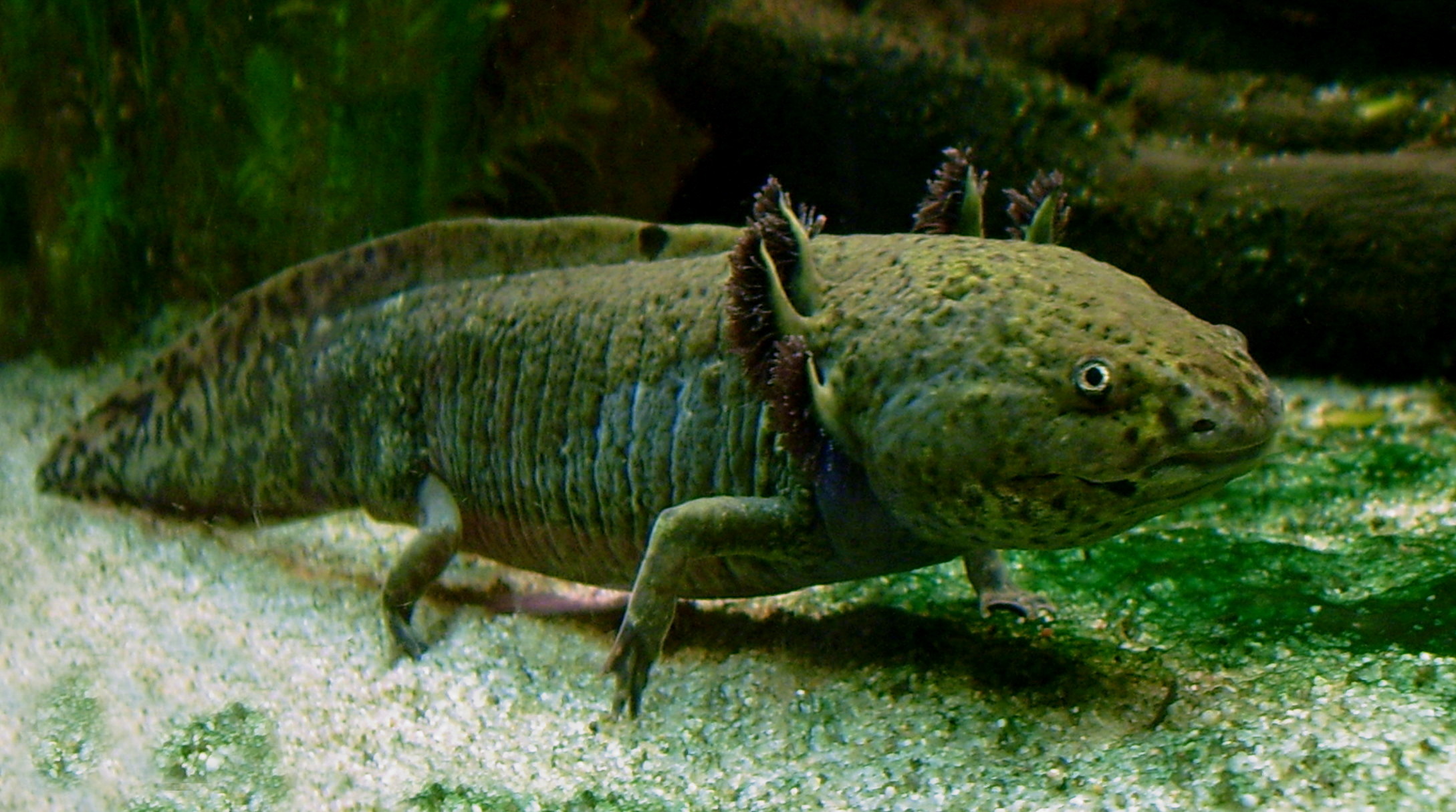
The axolotl is a neotenic salamander that keeps its larval, gilled form for life and is famous for remarkable limb-regeneration abilities. Although bred in huge numbers for the aquarium trade and research, the wild population in Mexico's Xochimilco canals is critically endangered.
ℹ️
Educational only. KinStation content is reviewed by licensed veterinarians but cannot replace an in-person exam. Always consult a licensed veterinarian or board-certified specialist for diagnosis, treatment, or any decision affecting your pet's health.
🩺 Need expert help with your axolotl?
Connect with a specialist near you or ask a licensed vet — never substitute online guidance for hands-on care in an emergency.
Neotenic salamander ~23-30 cm, retaining external gills for life.
Lifespan
10–15 years
Social needs
solo
Native region
Lake Xochimilco, Mexico City, Mexico
Origin
New World
Climate
🍂 Temperate
Family
Ambystomatidae
Genus
Ambystoma
Part of the Axolotls
Neotenic salamanders that retain feathery external gills and an aquatic body for life, kept fully submerged in cool freshwater tanks.
More axolotls coming soon.
Sounds & video
🎬 Video
Axolotl (Ambystoma mexicanum)
kori monster from portland · Wikimedia Commons · CC BY 2.0
Habitat & space requirements
From the minimum an animal needs to be kept humanely, up to the ideal setup. Bigger is almost always better — minimums are floors, not targets.
Photo coming soon
Minimum
Single-animal aquarium
20-gal long (≈ 30 × 12 in)
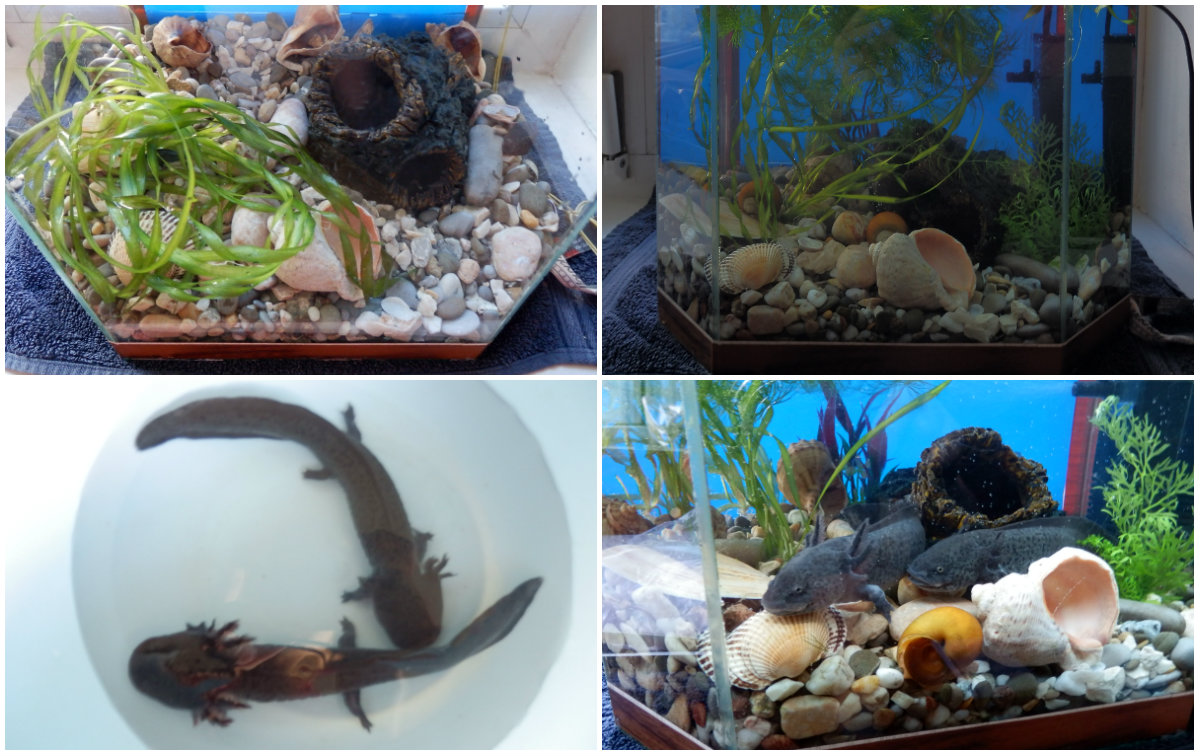
One adult axolotl needs a 20-gallon long minimum, fully cycled and gently filtered with low flow, kept cool at 16–18 °C with bare-bottom or fine sand only (gravel causes fatal impaction). They are solitary and best kept alone, since tankmates may be nipped or eaten and limbs can be bitten off.
Recommended
Planted cool-water tank
29–40 gal (≈ 36 × 18 in)
A 29–40 gallon footprint gives stable water chemistry and room for natural foraging, with fine sand, hides, shaded plants, and a chiller or cool room to hold 16–18 °C. Strong filtration with a spray bar to soften current keeps ammonia and nitrite at zero while avoiding stress from fast flow.
Regina Kolyanovska / CC BY-SA 3.0 (Wikimedia Commons)
Photo coming soon
Ideal
Large chilled aquascape
55+ gal, long footprint (≈ 48 in)
A long 55-gallon-plus aquarium maximises floor space, which matters far more than depth for this bottom-dwelling species, with a dedicated chiller locking 16–18 °C and heavily planted, dimly lit cover. Generous swimming room, multiple caves, and pristine cool water give the most natural behaviour and longest lifespan.
Life & growth stages
How this animal changes through its life — each stage often has its own care, diet and space needs.
Egg
Amphibian eggs are soft, jelly-coated spheres laid in or near water — in floating clutches, strings, or foam nests depending on the species. The dark embryo is visible within the clear gel as it develops.
Brandon Antonio Segura Torres & Priscilla Vieto Bonilla, CC BY-SA 4.0, via Wikimedia Commons
Photo coming soon
Tadpole / Larva
The aquatic larva (a tadpole in frogs/toads, a gilled larva in salamanders and newts) breathes through gills and feeds and grows in water. Frog/toad tadpoles are limbless at first, then sprout hind then front legs as metamorphosis nears.
Photo coming soon
Juvenile (froglet / eft)
At metamorphosis the animal develops legs and lungs and typically leaves the water as a froglet or, in many newts, a terrestrial eft. It resembles a small adult but is not yet sexually mature and its coloration may still be changing.
Adult
Adults reach full size and breeding condition, with the species' mature skin coloration and pattern. Many amphibians return to water to breed and can show seasonal or sex-specific changes such as nuptial coloration or crests.
Color & pattern variants
Natural variants occur in the wild; selectively bred (man-made) variants were developed in captivity.
Wild axolotls survive only in the remnant canals and wetlands of Xochimilco near Mexico City, where pollution, urbanization, and introduced fish have collapsed the population. Captive-bred axolotls are widely kept in cool, well-filtered freshwater aquaria; note that some jurisdictions (for example California) restrict or ban keeping them, so check local law. The wild population's plight is a separate conservation concern from the pervasive captive lineage.
Substrate
Use fine aquarium sand as the safest substrate, since gravel and small stones are readily swallowed and cause fatal impaction; bare-bottom tanks are an acceptable, easy-to-clean alternative for juveniles. Never use gravel with adults. Sand also lets these bottom-dwellers grip and walk naturally rather than slipping on glass.
Equipment & setup
Axolotls are fully aquatic, cold-water salamanders requiring a heavily filtered, cycled tank (a gentle sponge or baffled filter to reduce flow, since they dislike strong current) kept at 60-68F, ideally with a chiller or fans in warm climates. They need NO heater and NO bright lighting/UVB; provide dim lighting, hides/caves, and pristine water with low nitrates via regular partial water changes. Use dechlorinated water and keep ammonia and nitrite at zero.
Diet
A carnivore taking worms, small aquatic invertebrates, and prepared sinking foods in captivity. Cool, clean, dechlorinated water is essential to its health. Care framing applies to captive-bred animals only; wild collection is illegal and unnecessary.
Behavior & temperament
Sedentary and solitary, axolotls are prized in laboratories for regenerating limbs, parts of organs, and even portions of the brain. Their scientific and hobbyist ubiquity stands in stark contrast to their near-extinction in the wild, a paradox of a 'common pet' that is critically endangered in nature.
Health
An aquatic-experienced exotic veterinarian is the right resource, and as with fish, most axolotl health problems trace back to water quality and temperature. A test kit for ammonia, nitrite, nitrate, and pH is an essential husbandry tool, not an optional extra.
Documented concerns include ammonia burns and stress from poor water quality, fungal infections (often appearing as cottony growths, frequently secondary to injury or warm/poor water), impaction from swallowed substrate, and stress-related anorexia. These are addressed first by correcting the environment and then with veterinary care as needed.
Signs that warrant attention include curled or upward-curling tail tips, persistent floating, gill recession or deterioration, cottony growths, and refusal to eat. The first response is to check and correct water parameters and temperature; persistent or worsening signs warrant veterinary evaluation.
Tips, DIY & hacks
Keep them cool: temperatures above ~74F cause stress, illness, and death, so a fan blowing across the surface or a chiller is the key investment. Reduce filter flow with a spray bar or sponge to prevent stress (curled gills/forward-flicking tail signal too much current), and spot-tub in clean dechlorinated water if water quality slips. Frozen/live bloodworms, earthworms, and sinking pellets work well; remove uneaten food promptly to protect water quality.
Origin & history
The axolotl (Ambystoma mexicanum) is native to the lake and canal system around Mexico City, historically Lake Xochimilco. Unusually, it is neotenic — it keeps its larval, aquatic body plan and external gills throughout adult life rather than metamorphosing into a land salamander. It held cultural significance in Aztec mythology, tied to the god Xolotl.
In the wild the species is critically endangered due to habitat loss, pollution, and introduced predators, even as it thrives in captivity as both a pet and a premier laboratory animal for regeneration research. Captive colour variants include the wild-type dark form, leucistic (pale pink with dark eyes), albino, and 'GFP' lines from research stock. Pet axolotls should always come from captive-bred sources, and legality varies by U.S. state — check local laws first.
Anecdotes & owner lore
Community experience and cultural notes — not veterinary advice. Every animal is an individual; treat these as colour, not care instructions.
Few animals look as permanently delighted as an axolotl: the upturned mouth reads as a perpetual smile, and the frilly external gills framing the head like a feathery headdress have made them a runaway internet and pop-culture favourite (a wave that the video game Minecraft amplified enormously). Owners affectionately call them 'fluffy-gilled water puppies' and dote on their derpy, drifting charm.
Their regenerative superpower is the stuff of genuine wonder — a story every owner repeats is the axolotl that regrew a lost leg, toes and all — which is also why they are scientific royalty. The other recurring theme in the hobby is the cold-water crusade: keepers constantly remind newcomers that these are not warm tropical pets, and that a chiller or a cool room is the difference between a thriving smiley salamander and a stressed one.
Common ailments
Impaction — common — Loose gravel is the usual culprit; fine sand substrate is the standard preventive choice.
Ammonia poisoning / ammonia burns — common — Gill deterioration and stress are common signs; a test kit is essential husbandry.
Fungal infection — common — Frequently secondary to injury or warm/poor water.
Reviewed and signed off by: KinStation Editorial — conservation profile (pending DVM/biologist review)