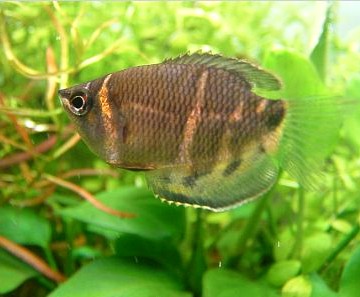
A beautiful but demanding gourami with a rich chocolate-brown body crossed by pale gold-yellow bars. Unusually for the family it is a mouthbrooder rather than a bubble-nester. It is sensitive to water chemistry and disease, so it is recommended for experienced keepers who can maintain soft, acidic blackwater conditions.
ℹ️
Educational only. KinStation content is reviewed by licensed veterinarians but cannot replace an in-person exam. Always consult a licensed veterinarian or board-certified specialist for diagnosis, treatment, or any decision affecting your pet's health.
🩺 Need expert help with your chocolate gourami?
Connect with a specialist near you or ask a licensed vet — never substitute online guidance for hands-on care in an emergency.
Gouramis are labyrinth-breathing freshwater fish from Asia that gulp air at the surface, build bubble nests, and range from tiny croaking species to large centerpiece fish. Many are peaceful and characterful, thriving in warm, calm, planted aquariums.
From the minimum an animal needs to be kept humanely, up to the ideal setup. Bigger is almost always better — minimums are floors, not targets.
Photo coming soon
Minimum
Pair blackwater nano
20 gal / 76 L blackwater
Sphaerichthys osphromenoides is delicate and demands soft, acidic, warm blackwater. 20-gal minimum, heavily planted with leaf litter, no flow, pH 4.5–6.0, and only species-only or extremely peaceful tankmates.
Photo coming soon
Recommended
Group blackwater tank
29 gal / 110 L planted blackwater
29-gal planted blackwater with a small group of 4–6, dense plants, peat substrate, very dim lighting, and warm 27–29 °C. Mouth-brooding behaviour observed in stable groups.
Photo coming soon
Ideal
Peat-swamp biotope
40 gal+ / 151 L+ biotope
Peat-swamp biotope with leaf litter, driftwood, very soft acidic blackwater, RO water, and a small breeding group. One of the most rewarding species when conditions are right.
Life & growth stages
How this animal changes through its life — each stage often has its own care, diet and space needs.
Photo coming soon
Egg
Fish eggs are small, translucent spheres, often laid in clutches on plants, substrate, or in a nest — or carried/brooded by a parent in livebearing and mouth-brooding species. A dark eye spot and the curled embryo become visible inside as development progresses.
Photo coming soon
Fry
Newly hatched fry are tiny and semi-transparent, frequently still carrying a yolk sac that fuels them before they feed freely. They lack full fin structure and adult coloration, staying near cover until they can swim and forage on their own.
Photo coming soon
Juvenile
Juveniles look like miniature adults but with developing fins and muted or different markings; many species shift pattern and color as they mature. Growth is rapid at this stage given clean water and steady feeding.
Adult
Adults show the species' full size, finnage, and mature coloration, and are sexually mature. Many fish develop sex-specific differences in size, color, or fin shape, which can intensify during breeding.
Habitat & enclosure
A mature, heavily planted 20 gallon (75 L) tank suits a small group. They require warm 78-86 F (26-30 C), soft and acidic water at pH 4.0-6.5 with very low mineral content. Keep flow minimal and lighting dim. Replicate their peat-swamp blackwater origins with tannin-stained water, dense vegetation and floating cover.
Substrate
Dark fine sand with leaf litter recreates the tannin-rich peat-swamp floor and helps maintain low pH. Indian almond and oak leaves plus driftwood release the tannins and humic substances these fish need.
Equipment & setup
Use a gentle sponge filter, ideally run over peat or with botanicals to soften and acidify the water, plus a heater for the high target temperature. RO or rainwater is usually required to achieve the very soft, acidic chemistry; a lid keeps the air layer warm and humid.
Diet
Micropredator that prefers small live and frozen foods such as baby brine shrimp, daphnia, cyclops and microworms. Some accept fine prepared foods, but live and frozen items are important for conditioning and long-term health.
Behavior & temperament
Peaceful, timid and easily outcompeted; keep in a group of six or more in a quiet, dimly lit tank. Best in a species setup or with equally calm, small softwater fish; avoid boisterous or fast feeders that stress them. Freshwater only.
Health
Notoriously sensitive to nitrate, hardness and pH instability, and prone to ich, bacterial infections and a wasting decline when conditions are wrong. Use mature stable blackwater, drip-acclimate slowly, quarantine new fish and keep nitrate very low to prevent loss.
Tips, DIY & hacks
This species is a maternal mouthbrooder; the female holds eggs and fry in her mouth for roughly two weeks before releasing free-swimming young. Stable, soft, warm blackwater and a stress-free group are the keys to both health and breeding.