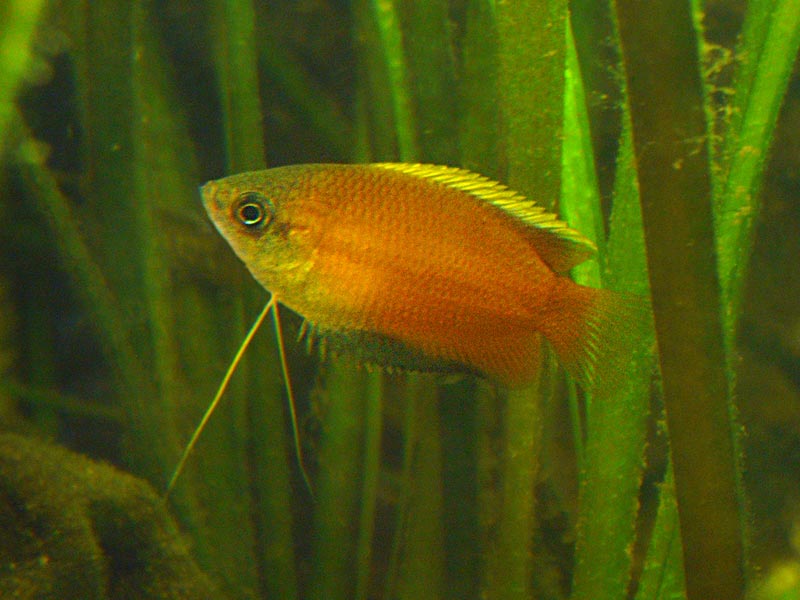
A tiny, gentle labyrinth fish from South Asia, the male glowing honey-gold to red at breeding time. Hardy, peaceful, and far more robust than its lookalike the dwarf gourami, making it an ideal nano community fish.
ℹ️
Educational only. KinStation content is reviewed by licensed veterinarians but cannot replace an in-person exam. Always consult a licensed veterinarian or board-certified specialist for diagnosis, treatment, or any decision affecting your pet's health.
🩺 Need expert help with your honey gourami?
Connect with a specialist near you or ask a licensed vet — never substitute online guidance for hands-on care in an emergency.
South Asia (India, Bangladesh, Nepal), in the Ganges and Brahmaputra basins
Origin
Old World
Climate
🌴 Tropical
Water type
💧 Freshwater
Family
Osphronemidae
Genus
Trichogaster
Part of the Gouramis
Gouramis are labyrinth-breathing freshwater fish from Asia that gulp air at the surface, build bubble nests, and range from tiny croaking species to large centerpiece fish. Many are peaceful and characterful, thriving in warm, calm, planted aquariums.
From the minimum an animal needs to be kept humanely, up to the ideal setup. Bigger is almost always better — minimums are floors, not targets.
Photo coming soon
Minimum
Pair nano planted
15 gal / 57 L planted
Trichogaster chuna reaches 2 in and is peaceful — keep a pair (1M/1F) or small group. 15-gal planted minimum with floating plants, soft slightly acidic water, gentle filtration, and a tight lid.
Photo coming soon
Recommended
Planted community
20 gal / 76 L planted
20-gal planted community with a pair or small group, floating plants for bubble nests, peaceful tankmates, and warm 24–28 °C. Male builds bubble nests and develops bright honey colour.
Photo coming soon
Ideal
South Asian biotope
29 gal+ / 110 L+ biotope
South Asian rice-paddy biotope with floating plants, leaf litter, very gentle flow, and a small breeding group. Hardy true gourami — much better choice than dwarf gourami for new keepers.
Life & growth stages
How this animal changes through its life — each stage often has its own care, diet and space needs.
Photo coming soon
Egg
Fish eggs are small, translucent spheres, often laid in clutches on plants, substrate, or in a nest — or carried/brooded by a parent in livebearing and mouth-brooding species. A dark eye spot and the curled embryo become visible inside as development progresses.
Photo coming soon
Fry
Newly hatched fry are tiny and semi-transparent, frequently still carrying a yolk sac that fuels them before they feed freely. They lack full fin structure and adult coloration, staying near cover until they can swim and forage on their own.
Photo coming soon
Juvenile
Juveniles look like miniature adults but with developing fins and muted or different markings; many species shift pattern and color as they mature. Growth is rapid at this stage given clean water and steady feeding.
Adult
Adults show the species' full size, finnage, and mature coloration, and are sexually mature. Many fish develop sex-specific differences in size, color, or fin shape, which can intensify during breeding.
Color & pattern variants
Natural variants occur in the wild; selectively bred (man-made) variants were developed in captivity.
Honey gouramis are well suited to nano and small community tanks; a pair or trio is comfortable in a 10-gallon aquarium, with 15-20 gallons better for a small group. They strongly prefer a densely planted layout with floating plants to soften the light, plus driftwood and a dark substrate, which make these shy fish feel secure and show their color.
Keep water at about 73-82°F (23-28°C), pH 6.0-8.0, and soft to moderately hard water (around 4-12 dGH) with very gentle flow. As labyrinth breathers they take air from the surface, so keep a warm, humid air gap beneath the lid and avoid turbulent currents.
Substrate
Dark sand or fine gravel suits them and intensifies their warm honey-amber coloration. A planted bottom with a botanical, blackwater feel matches the slow, vegetated waters they inhabit naturally.
Equipment & setup
Use a heater set to 74-82F and gentle filtration, since these labyrinth fish dislike strong current; a sponge filter is ideal. Keep a snug lid with a warm, humid air gap above the water so the labyrinth organ isn't chilled when they gulp surface air.
Diet
Omnivores with small mouths, honey gouramis eat finely crushed flakes, micro-pellets, and small frozen or live foods such as baby brine shrimp, daphnia, cyclops, and bloodworms. Include some plant-based food in the rotation.
Feed small amounts once or twice daily and make sure faster tankmates do not eat everything first, as honey gouramis are slow, deliberate feeders.
Behavior & temperament
One of the most peaceful and timid gouramis, the honey gourami rarely shows aggression and can be kept singly, in a pair, or in a small group with calm tankmates. They appreciate plenty of cover and may hide at first, gaining confidence in a well-planted, quiet tank. Males color up dramatically and build bubble nests when breeding.
Keep them only with small, gentle species; boisterous or nippy fish will bully them and discourage them from coming out. Floating plants and tall stems give them the security they need to display naturally.
Health
Honey gouramis are notably hardier than dwarf gouramis and are not the usual carriers of dwarf gourami iridovirus, though, as with any farmed fish, quarantine is still wise. The main risks are the standard freshwater diseases: ich, fin rot, fungal and bacterial infections, almost always triggered by poor water quality, chilling, or stress.
Maintain stable, clean, warm water with regular partial changes, feed a varied diet, and avoid stressful tankmates. Quarantine new fish before adding them.
*This is general care information, not veterinary advice. Consult an aquatic/exotics veterinarian for any sick animal.*
Tips, DIY & hacks
Provide floating plants (frogbit, water sprite) for cover and as anchor points for the bubble nests males build. They are shy, so dense planting and tankmates that aren't boisterous let them feel secure and color up fully.