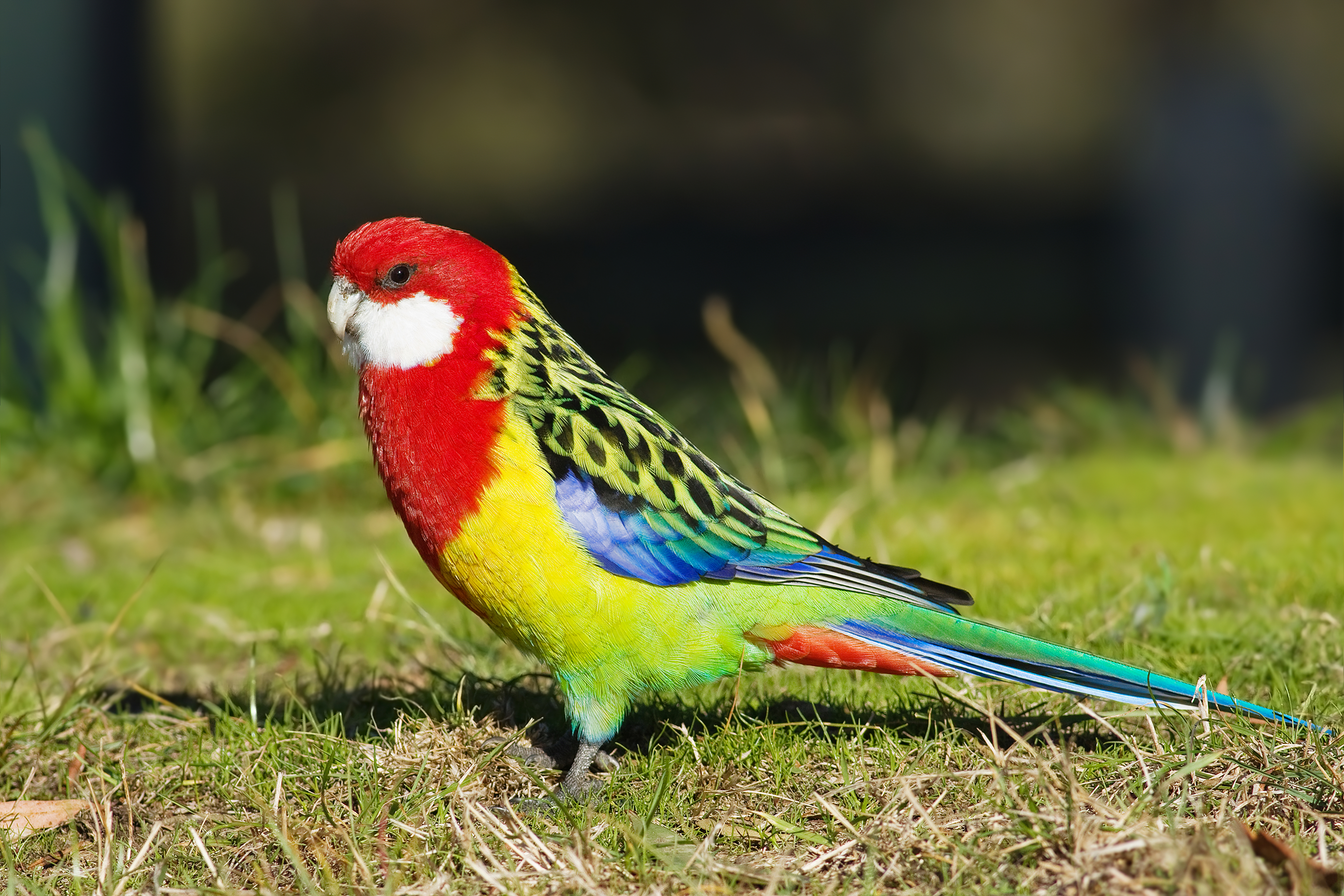
The eastern rosella is a brilliantly colored Australian parakeet best appreciated as an active aviary bird. Beautiful but typically less hands-on, it needs long flights and tends to be territorial.
ℹ️
Educational only. KinStation content is reviewed by licensed veterinarians but cannot replace an in-person exam. Always consult a licensed veterinarian or board-certified specialist for diagnosis, treatment, or any decision affecting your pet's health.
🩺 Need expert help with your eastern rosella?
Connect with a specialist near you or ask a licensed vet — never substitute online guidance for hands-on care in an emergency.
Rosellas (genus Platycercus) are medium-sized, brilliantly colored Australian parakeets with distinctive cheek patches and scalloped backs, prized as hardy, beautiful aviary birds.
Oceancetaceen Alice Chodura · Wikimedia Commons · CC BY-SA 3.0
Habitat & space requirements
From the minimum an animal needs to be kept humanely, up to the ideal setup. Bigger is almost always better — minimums are floors, not targets.
Photo coming soon
Minimum
Sheltered flight aviary (pair)
Flight aviary ≥ 8 × 3 × 6 ft (L×W×H)
Eastern rosellas are avid, powerful fliers that decline badly in ordinary cages, so the genuine humane minimum is a flight aviary at least 8 × 3 × 6 ft (about 2.4 m long) for a single pair, with ½-inch bar/mesh spacing, natural-branch perches, ground foraging, bathing water, and a draught-free sheltered roost. They must be kept as one compatible pair and never crowded with other birds, as they can be aggressive and territorial. A short cage is not acceptable for this species; protect them from frost and draughts.
Photo coming soon
Recommended
Outdoor flight aviary (pair)
Aviary ≥ 8 × 3 × 6 ft (L × W × H)
A responsible keeper should provide a planted outdoor flight aviary of at least 8 × 3 × 6 ft for one pair, with branches, a foraging floor, bathing water, and a sheltered roost. Length for sustained flight is essential, and a single pair should hold the aviary to avoid territorial fighting. Offer a frost-free, draught-protected night area in cold weather.
Photo coming soon
Ideal
Large planted aviary
Planted aviary ≥ 12 ft long
The ideal is a large planted walk-in aviary at least 12 ft long for a single pair, with living shrubs and grasses, varied perching, and ground foraging that mirror their open-woodland habitat. The extra length lets these strong fliers truly stretch their wings and express natural feeding behaviour. Pair them one bond per aviary and supply a weatherproof, frost-free shelter for roosting.
Life & growth stages
How this animal changes through its life — each stage often has its own care, diet and space needs.
Photo coming soon
Egg
Birds develop inside a hard-shelled egg incubated by the parent(s). Egg size, shell color, and clutch size vary by species; the embryo develops over days to weeks before hatching.
Photo coming soon
Hatchling / Chick
Hatchlings are either altricial — naked, blind, and dependent on parents (typical of parrots and songbirds) — or precocial — downy, mobile, and self-feeding soon after hatching (typical of poultry and waterfowl). Down gives way to the first feathers.
Photo coming soon
Juvenile / Fledgling
Fledglings grow in their juvenile plumage and begin to fly and feed themselves, though they may still beg from parents at first. Juvenile feathering is often duller than the adult and is replaced as the bird matures.
Adult
Adults attain full body size and mature plumage, and are capable of breeding. Many species show distinct adult coloration, and in sexually dimorphic birds males and females differ in plumage, size, or markings.
(c) Joanne Ryves, some rights reserved (CC BY-NC) via iNaturalist — https://www.inaturalist.org/observations/238699470
Color & pattern variants
Natural variants occur in the wild; selectively bred (man-made) variants were developed in captivity.
Rosellas are strong, fast fliers that fare poorly in small cages and are widely considered aviary birds first.
- **Minimum** — a single bird needs a flight cage no smaller than about 48×24×24 in (122×61×61 cm), oriented long for flight, with bar spacing of about 1.3–1.6 cm (1/2–5/8 in). Even this requires daily out-of-cage flight.
- **Recommended** — a larger flight cage or indoor flight at least 60×24×36 in (152×61×91 cm) with varied perches, branches, and foraging toys.
- **Ideal** — an outdoor planted aviary several metres long, which suits their need for sustained flight and is how they are most often kept.
Provide a bathing dish, natural branches to chew, and shelter from extremes; rosellas tolerate cool weather but need protection from heat, damp, and drafts. Keep them away from PTFE/Teflon fumes, smoke, and aerosols. Because they can be aggressive, housing usually means a single bird or a single compatible pair per flight.
Substrate
Line aviary or cage floors with newspaper or paper for indoor cages; in outdoor aviaries a deep layer of clean sand or pea gravel over a concrete base drains well and is easy to rake and disinfect. Rosellas spend time foraging on the ground, so keep flooring scrupulously clean to limit worm and coccidia buildup.
Equipment & setup
These active parakeets need a long flight cage or aviary (a 6+ foot flight is ideal) since they fly horizontally rather than climb; provide multiple natural perches and branches. Supply full-spectrum lighting indoors, a shallow bathing dish they'll use eagerly, and shelter from wind/wet plus shade in outdoor setups.
Diet
Feed a parakeet/small-parrot formulated pellet as the base, supplemented daily with fresh vegetables, leafy greens, sprouted seed, and some fruit, with a measured portion of a small-parrot seed mix. Rosellas in particular enjoy foraging, so scattering food and offering seeding grasses or browse provides valuable enrichment. As with all parrots, avoid making seed the staple to prevent obesity and nutritional disease. Offer fresh water daily and a cuttlebone for calcium. Avocado, chocolate, caffeine, alcohol, salt, and onion/garlic are toxic to birds.
Behavior & temperament
Eastern rosellas are stunning but generally more 'look but don't cuddle' birds: many are flighty and less inclined toward close handling than parrots like conures or amazons, and they are valued largely for their color and activity in a flight. They are moderately noisy, with melodic whistles and chattering, and males in particular can be territorial and aggressive, especially in the breeding season, which is why mixing rosellas with other birds or keeping multiple pairs together is risky. Hand-raised birds can become tamer companions, but even these tend to retain an independent streak. They are highly active and need room to fly, plus enrichment to prevent boredom.
Health
Establish care with an avian veterinarian and use routine wellness exams. Rosellas, like other ground- and grass-foraging Australian parakeets, can be prone to intestinal parasites and benefit from clean housing and fecal screening, particularly in outdoor aviaries. Reproductively active hens can experience egg binding, and all parrots can suffer fungal disease such as aspergillosis in poorly ventilated or damp conditions. They can also carry psittacosis. A fluffed, lethargic, or off-food bird should be examined promptly, since rosellas hide illness like other parrots.
Tips, DIY & hacks
Rosellas are prone to intestinal worms from ground foraging, so deworm on a vet-advised schedule and avoid floor-feeding directly on substrate. They can be territorial and noisy; house pairs in their own flight rather than mixing with other rosella species, and offer fresh eucalyptus or willow branches for safe chewing enrichment.
Origin & history
The eastern rosella is native to southeastern Australia and Tasmania, where it is a familiar sight in open woodland, farmland, parks, and gardens. It was one of the earliest Australian parrots to become established in European aviculture and remains a popular aviary species worldwide, prized for its vivid red, white, yellow, green, and blue plumage. Introduced populations have established in New Zealand. Most birds in the pet and aviary trade are captive-bred, and several color mutations have been developed by breeders.
Anecdotes & owner lore
Community experience and cultural notes — not veterinary advice. Every animal is an individual; treat these as colour, not care instructions.
Rosella enthusiasts often describe them as the supermodels of the parakeet world — breathtaking to look at, with a personality that politely declines to be smothered with affection. In Australia they are a beloved backyard bird, so iconic that a rosella has long adorned the label of a famous brand of preserves, and their bold mosaic of color makes them instantly recognizable on a garden lawn. Aviary keepers trade knowing remarks about rosella territoriality, noting that a breeding-season male in a mixed flight can turn from ornament to enforcer with little warning, which is why most are given a flight of their own.
Common ailments
Egg binding (dystocia) — common
Intestinal parasites — common
Reviewed and signed off by: KinStation Editorial — pre-launch draft (pending DVM review)