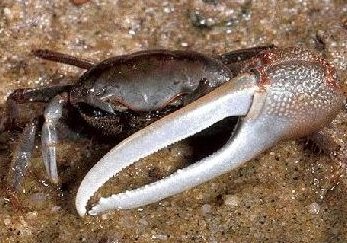
A small semi-terrestrial brackish-water crab famous for the male's single oversized 'fiddle' claw, which it waves to court females and deter rivals. Long traded as Uca pugnax, it was reclassified to Minuca pugnax in 2016. Sociable and entertaining, they need a brackish paludarium with both land and shallow water — a very common mistake is keeping them in fresh water, which shortens their lives.
ℹ️
Educational only. KinStation content is reviewed by licensed veterinarians but cannot replace an in-person exam. Always consult a licensed veterinarian or board-certified specialist for diagnosis, treatment, or any decision affecting your pet's health.
🩺 Need expert help with your fiddler crab?
Connect with a specialist near you or ask a licensed vet — never substitute online guidance for hands-on care in an emergency.
Carapace about 1.5-2.5 cm wide; males have one greatly enlarged claw
Lifespan
2–3 years
Social needs
group
Native region
Atlantic coast salt marshes of eastern North America
Origin
New World
Climate
🍂 Temperate
Water type
🌫️ Brackish
Family
Ocypodidae
Genus
Minuca
Part of the Freshwater crabs
Small crabs kept in aquariums and paludariums. Some, like the Thai micro crab, are fully aquatic, while many others (such as the red claw crab) are brackish and semi-terrestrial, needing both water and a dry land area to climb out and breathe air.
From the minimum an animal needs to be kept humanely, up to the ideal setup. Bigger is almost always better — minimums are floors, not targets.
Photo coming soon
Minimum
Brackish paludarium
20 gal (≈ 76 L), 60% land / 40% water
Uca / Minuca spp. are BRACKISH, not freshwater — SG 1.005–1.010. They drown in fully-aquatic setups. 60% sand land area + 40% brackish water, gentle slope, sand 5+ cm deep for burrowing. Group of 4+ (one male, multiple females).
Photo coming soon
Recommended
Larger brackish paludarium
30 gal paludarium, deep sand
A 30 gal paludarium with deep sand land area, brackish pool with filtration, mangrove roots or driftwood, and basking warmth. Groups of 1 male + 3–4 females reduce male-male aggression.
Photo coming soon
Ideal
Mangrove biotope paludarium
40+ gal mangrove paludarium
A planted mangrove biotope paludarium with live mangroves, deep sand flats, brackish tidal pool, and varied wood structure. Closest to natural fiddler habitat.
Life & growth stages
How this animal changes through its life — each stage often has its own care, diet and space needs.
Photo coming soon
Larva
Most marine invertebrates hatch into microscopic planktonic larvae (such as the zoea of crustaceans or the bipinnaria/veliger of echinoderms and mollusks) that drift and feed in the water column. The larva looks nothing like the adult and undergoes major reorganization.
Photo coming soon
Juvenile
After settling out of the plankton, the juvenile takes on a recognizable miniature of the adult body plan — a tiny shell, a small star, or a translucent shrimp. Crustaceans grow by molting, shedding the exoskeleton to enlarge.
Adult
Adults reach full size and reproductive maturity with the species' mature shell, shape, or coloration. Many continue to molt or grow throughout life, and some show sex differences in size or claw/appendage shape.
Habitat & enclosure
Set up a brackish paludarium with a clear land-and-water divide: a sloped sand beach or platform plus a shallow pool of brackish water. A 40-60 cm tank houses a small colony (e.g. one male with several females). Use brackish water at specific gravity ~1.005-1.010 (about 1-2 tablespoons marine salt per gallon, never aquarium 'tonic' salt alone). Keep air and water at 24-28 C with moderate humidity. Provide rocks, wood and driftwood haul-outs so every crab can leave the water. Tight lid required — they climb and wander.
Substrate
A deep (5+ cm) fine sand or sand/mud mix is essential so the crabs can burrow and sift, which is natural feeding and refuge behaviour. Smooth fine sand also protects soft post-moult shells. Keep the land substrate damp and the water section easy to access via a gentle slope.
Equipment & setup
Needs a heater for the water section (24-28 C), gentle filtration rated for brackish water (sponge or low-flow internal), marine salt mix and a hydrometer/refractometer to set specific gravity, and a secure climb-proof lid. No special lighting or UVB needed, though daylight-spectrum lighting supports algae/biofilm they graze.
Diet
Detritivorous omnivores that in the wild sift mud for algae, biofilm and microbes. Offer sinking pellets, algae wafers, dried/blanched vegetables, frozen bloodworm and brine shrimp, plus a little fish flake. They graze the sand for biofilm, so a mature substrate helps. Add a cuttlebone or crushed coral for moulting calcium. Feed small amounts daily.
Behavior & temperament
Diurnal, peaceful and highly social — best kept in groups, ideally one male to several females to limit claw-waving rivalry between males. Males display by waving the enlarged claw and may spar, but serious harm is rare. Not aggressive toward people; the big claw cannot pinch hard. They are shy and easily startled, dashing for cover, so they are an observation pet rather than a handling pet. Avoid mixing with fish that need full marine or pure fresh water.
Health
Moulting is the main vulnerability — provide calcium and let them bury and hide until the new shell hardens; do not disturb a soft, freshly moulted crab and leave the cast shell to be eaten. Chronic stress and shortened lifespan usually trace back to being kept fully aquatic or in fresh water; they must be able to leave the water and need brackish conditions. Watch for shell rot and fungus from dirty substrate, and avoid copper-based medications. Lost claws and legs regrow over successive moults.
Tips, DIY & hacks
The single biggest welfare fix is brackish, not fresh, water plus reliable land access — get a refractometer and marine salt. Keep one male per few females to reduce sparring. Provide a deep sand bed so they can burrow before moulting, and leave the shed exoskeleton in place. Quarantine new crabs and never dose copper. Top up evaporation with fresh dechlorinated water (salinity rises as water evaporates).