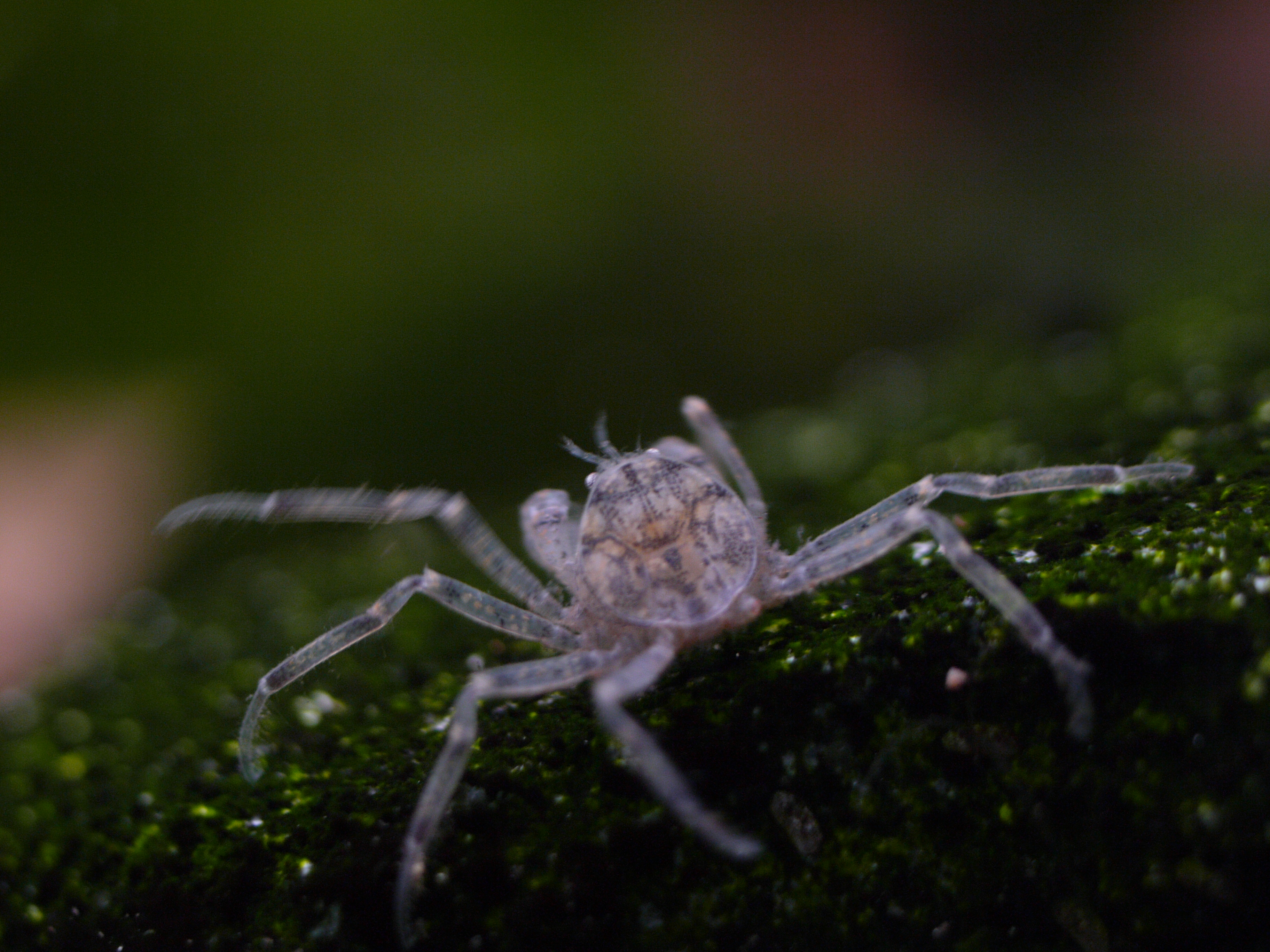
A minuscule, fully aquatic freshwater crab with hair-covered legs that trap food particles, making it part filter-feeder. Peaceful and harmless, it is one of the few true freshwater crabs that lives entirely underwater with no land requirement.
ℹ️
Educational only. KinStation content is reviewed by licensed veterinarians but cannot replace an in-person exam. Always consult a licensed veterinarian or board-certified specialist for diagnosis, treatment, or any decision affecting your pet's health.
🩺 Need expert help with your thai micro crab?
Connect with a specialist near you or ask a licensed vet — never substitute online guidance for hands-on care in an emergency.
Tiny; body about 0.4 in (1 cm) wide, legs spanning roughly 1 in (2.5 cm).
Lifespan
1–2 years
Social needs
group
Native region
Tha Chin River basin, central Thailand
Origin
Old World
Climate
🌴 Tropical
Water type
💧 Freshwater
Family
Hymenosomatidae
Genus
Limnopilos
Part of the Freshwater crabs
Small crabs kept in aquariums and paludariums. Some, like the Thai micro crab, are fully aquatic, while many others (such as the red claw crab) are brackish and semi-terrestrial, needing both water and a dry land area to climb out and breathe air.
From the minimum an animal needs to be kept humanely, up to the ideal setup. Bigger is almost always better — minimums are floors, not targets.
Photo coming soon
Minimum
Fully aquatic planted nano
5 gal (≈ 19 L), planted, sponge filter
Limnopilos naiyanetri is fully aquatic and tiny (~1 cm) — completely freshwater. Heavily planted nano with moss, sponge filter (no impeller intake), and only nano-fish-safe tankmates. Drowns is not a risk — they live underwater.
Photo coming soon
Recommended
Planted 10 gal colony
10 gal planted, moss + IAL
A planted 10 gal with dense moss, almond leaves, sponge filter, and shrimp tankmates only. Filter-feeders by nature — fine particulate foods help them thrive.
Photo coming soon
Ideal
Aquascape colony
10–20 gal aquascape, dense moss
A dense moss aquascape with stable parameters and shrimp companions. Generous moss surface area provides foraging perches for these tiny filter-feeders.
Life & growth stages
How this animal changes through its life — each stage often has its own care, diet and space needs.
Photo coming soon
Larva
Most marine invertebrates hatch into microscopic planktonic larvae (such as the zoea of crustaceans or the bipinnaria/veliger of echinoderms and mollusks) that drift and feed in the water column. The larva looks nothing like the adult and undergoes major reorganization.
Photo coming soon
Juvenile
After settling out of the plankton, the juvenile takes on a recognizable miniature of the adult body plan — a tiny shell, a small star, or a translucent shrimp. Crustaceans grow by molting, shedding the exoskeleton to enlarge.
Adult
Adults reach full size and reproductive maturity with the species' mature shell, shape, or coloration. Many continue to molt or grow throughout life, and some show sex differences in size or claw/appendage shape.
Habitat & enclosure
Keep a small group in a mature, heavily planted, cycled nano tank of 5-10 gallons (20-40 L). Unlike most pet crabs it is fully aquatic and needs NO land area; never keep it in a paludarium or semi-aquatic setup. Provide tropical, neutral water: temperature 72-82F (22-28C), pH 6.5-7.5, moderate GH/KH, ammonia and nitrite at zero. Dense moss (such as java moss), fine-leaved plants, and floating cover are essential, giving them grasping surfaces and hiding spots. Gentle flow helps deliver suspended food. They are tiny and easily lost, so a thickly planted, predator-free tank is best.
Substrate
Fine sand or gravel is fine; substrate matters less than plant cover. The most important 'substrate' is dense moss and fine-leaved plants that the crabs cling to and graze for biofilm.
Equipment & setup
Use a gentle sponge filter (so the tiny crabs are not pulled in or harmed) and a heater for tropical temperatures. Provide moderate flow to carry suspended food to filter-feeding crabs. A GH/KH test kit helps confirm minerals for molting. Avoid any copper-containing equipment or additives.
Diet
An omnivore and part-time filter feeder. Its hairy legs and claws sweep biofilm, microorganisms, and suspended particles from the water and plant surfaces. In a mature, mossy tank much of the diet is biofilm and microfauna; supplement with finely powdered shrimp/filter-feeder foods, crushed flake, and tiny bits of blanched vegetable. Feed small amounts so the crabs can graze without fouling the water. A biofilm-rich planted tank is the key to keeping them well fed.
Behavior & temperament
Extremely peaceful, shy, and reclusive; it spends most of its time clinging to moss and plants, sweeping for food. It is harmless to plants, snails, shrimp, and small peaceful fish, and is best kept in groups. Because it is so small and delicate it must not be housed with fish large enough to eat it; even many community fish will pick at it, especially after a molt. It is a display animal and is not handled.
Health
Sensitive to copper and to poor or unstable water quality like other inverts. Most losses come from predation, starvation in sparse tanks, or copper contamination. Never use copper-based medications. Provide dense moss for cover during the vulnerable soft-shell period right after molting. Maintain some GH for successful molts, acclimate slowly by drip, and quarantine new arrivals. Their small size makes them easy to siphon out accidentally during maintenance, so work carefully.
Tips, DIY & hacks
Keep them in a dedicated or near-dedicated nano tank packed with java moss; this both feeds and hides them. Count carefully, they are easy to lose and easy to siphon out by accident. Add powdered foods to the current so the filter-feeding behavior is fed. Avoid fish that nip; the crabs are most vulnerable just after molting.