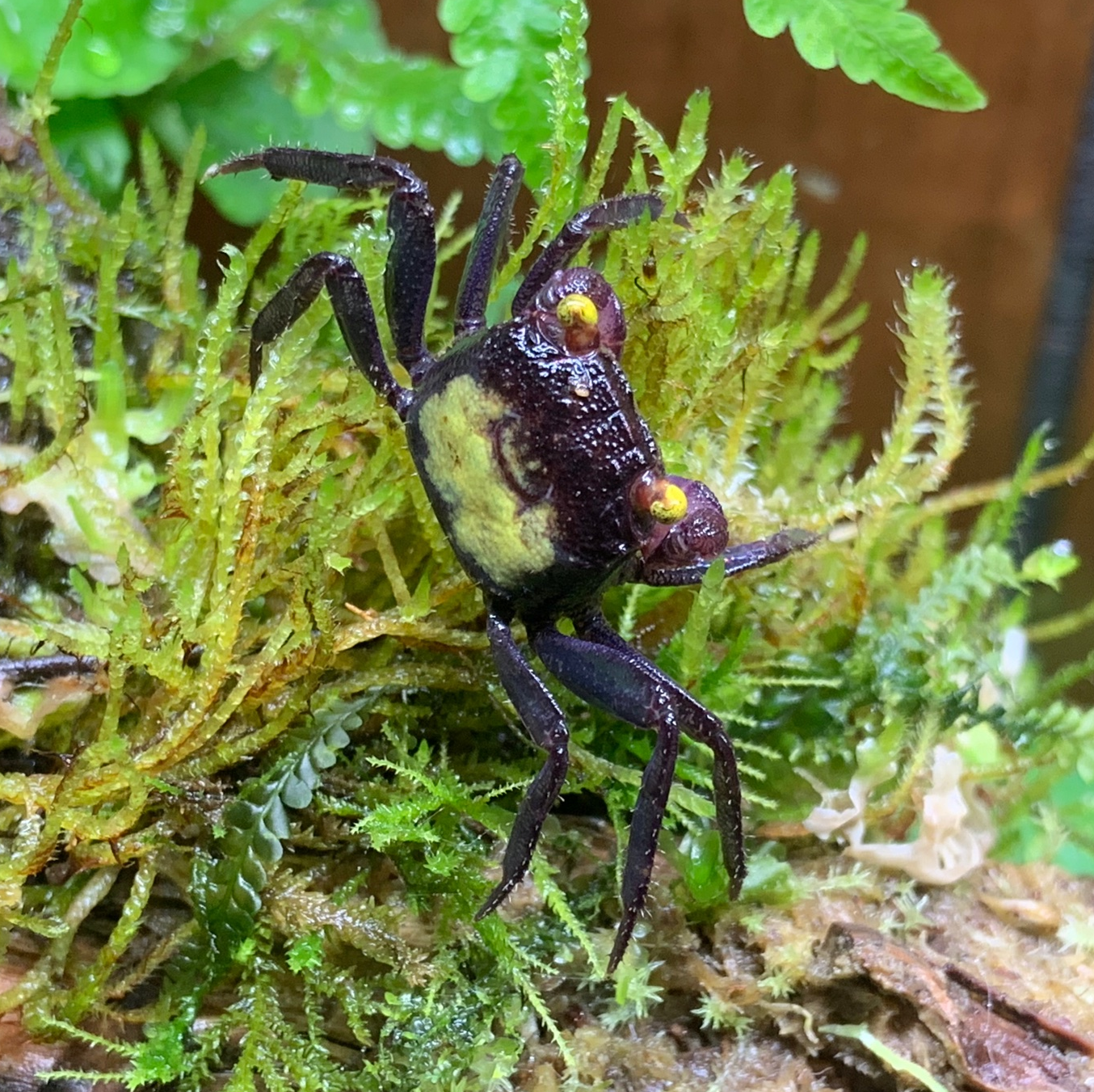
The vampire crab is a small, vividly coloured semi-terrestrial crab from Java, named for its glowing pale-yellow eyes set against a deep purple body and orange-tipped claws. It is a paludarium animal rather than a true aquarium fish: it needs both land and shallow fresh water, spending most of its time on shore. Hardy, peaceful and easy to breed (females carry few large eggs that hatch directly into crablets, with no larval saltwater stage), it is a rewarding species for keepers who can provide a humid, land-and-water vivarium.
ℹ️
Educational only. KinStation content is reviewed by licensed veterinarians but cannot replace an in-person exam. Always consult a licensed veterinarian or board-certified specialist for diagnosis, treatment, or any decision affecting your pet's health.
🩺 Need expert help with your vampire crab?
Connect with a specialist near you or ask a licensed vet — never substitute online guidance for hands-on care in an emergency.
Tiny — carapace about 2-2.5 cm (1 in) across; ~5 cm leg span.
Lifespan
2–3 years
Social needs
group
Native region
Java, Indonesia
Origin
Old World
Climate
🌴 Tropical
Water type
💧 Freshwater
Family
Sesarmidae
Genus
Geosesarma
Part of the Freshwater crabs
Small crabs kept in aquariums and paludariums. Some, like the Thai micro crab, are fully aquatic, while many others (such as the red claw crab) are brackish and semi-terrestrial, needing both water and a dry land area to climb out and breathe air.
From the minimum an animal needs to be kept humanely, up to the ideal setup. Bigger is almost always better — minimums are floors, not targets.
Photo coming soon
Minimum
Paludarium
10 gal (≈ 38 L), 70% land / 30% water
Geosesarma spp. are tiny (~2 cm) terrestrial paludarium crabs — fully freshwater, NOT brackish. 70% bioactive land with moss, leaf litter, cork bark; 30% shallow freshwater pool. Humid (~80%), warm (24–26 °C).
Photo coming soon
Recommended
Bioactive paludarium
20 gal bioactive paludarium
A 20 gal bioactive paludarium with live plants, deep moist substrate, leaf litter, multiple cork hides, and a shallow pool. Social — keep small groups; striking purple/orange colour morphs.
Photo coming soon
Ideal
Display paludarium
30+ gal planted paludarium
A planted bioactive paludarium with mosses, ferns, deep leaf litter, and a small shallow pool. Springtail/isopod cleanup crew completes a self-sustaining microhabitat.
Life & growth stages
How this animal changes through its life — each stage often has its own care, diet and space needs.
Photo coming soon
Larva
Most marine invertebrates hatch into microscopic planktonic larvae (such as the zoea of crustaceans or the bipinnaria/veliger of echinoderms and mollusks) that drift and feed in the water column. The larva looks nothing like the adult and undergoes major reorganization.
Photo coming soon
Juvenile
After settling out of the plankton, the juvenile takes on a recognizable miniature of the adult body plan — a tiny shell, a small star, or a translucent shrimp. Crustaceans grow by molting, shedding the exoskeleton to enlarge.
Adult
Adults reach full size and reproductive maturity with the species' mature shell, shape, or coloration. Many continue to molt or grow throughout life, and some show sex differences in size or claw/appendage shape.
Color & pattern variants
Natural variants occur in the wild; selectively bred (man-made) variants were developed in captivity.
House in a humid paludarium of at least 40-60 L (10-15 gal) footprint for a small group, with a secure tight-fitting lid — they are skilled escape artists and breathe air. Provide roughly 70-80% land to 20-30% shallow fresh water; the crabs forage on land and only enter the water briefly. Keep warm at 24-28 C (75-82 F) with high humidity (75-85%), shallow dechlorinated freshwater (not saltwater) at pH 7.0-8.0 and moderate hardness, plus a gentle filter or frequent water changes in the pool.
Decorate with cork bark, driftwood, leaf litter, moss, live plants and many caves and hides so each crab can claim territory and retreat to moult. A gentle land-water gradient (sloped substrate or rocks) lets them choose their depth.
Substrate
Use a moisture-retaining land substrate such as coco fibre, aquasoil or a planted-vivarium mix topped with leaf litter and moss, sloping down to a shallow water section over sand or fine gravel. The damp substrate and leaf litter support humidity, biofilm and natural foraging.
Equipment & setup
A sealed paludarium with a small internal or sponge filter for the water area, plus a heater or warm room and a method to maintain high humidity (misting, lid). Lighting need only support live plants. No protein skimmer; never use copper-based products near them.
Diet
Omnivorous scavenger. Offer a varied diet of sinking pellets, algae wafers, dried/frozen bloodworms and brine shrimp, blanched vegetables, fruit and occasional protein such as fish flake or insects. Leaf litter and biofilm provide natural grazing and aid moulting. Calcium-rich foods or a cuttlebone support healthy exoskeleton and moults.
Behavior & temperament
Peaceful and shy, but males can be territorial, so provide plenty of hides and keep them in groups with more females than males to spread aggression. Semi-terrestrial and largely nocturnal/crepuscular, hiding by day. Not a community fish-tank animal — small fish may be nipped and the crabs themselves can be predated; best kept in a species paludarium. Reef-irrelevant. Sociable enough to keep in colonies given space and cover.
Health
The main risks are moulting problems and escape. Crabs are vulnerable and soft just after moulting and must not be disturbed — never pull out what looks like a 'dead' crab, as it may be a shed exoskeleton. Low humidity, poor diet or low calcium cause failed moults; maintain humidity and calcium. They are extremely sensitive to copper and invert-toxic chemicals. Ensure clean, dechlorinated water and avoid ammonia spikes in the small water area.
Tips, DIY & hacks
Use freshwater, not brackish or marine — unlike many crabs, G. dennerle breeds in fresh water with direct development (females carry a few large eggs that hatch into miniature crabs), so no saltwater larval tank is needed. Secure every lid gap, as they climb and escape readily, and provide abundant hides to reduce male aggression and protect moulting individuals. Keep groups female-skewed and leave shed exoskeletons in place for the crab to eat (calcium recycling).