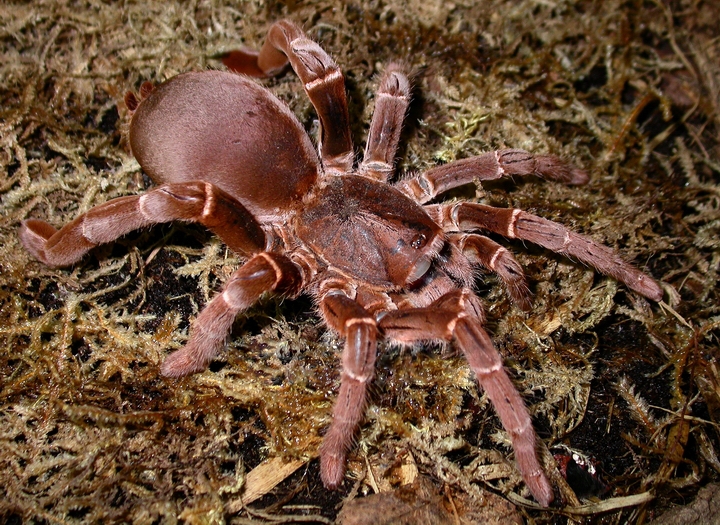
A massive, rust-colored African fossorial tarantula prized for its sheer size and deep burrows. It is a defensive Old World species with medically significant venom and no urticating hairs, making it a display-only animal for experienced keepers. Monotypic genus, formerly known as Citharischius crawshayi.
ℹ️
Educational only. KinStation content is reviewed by licensed veterinarians but cannot replace an in-person exam. Always consult a licensed veterinarian or board-certified specialist for diagnosis, treatment, or any decision affecting your pet's health.
🩺 Need expert help with your king baboon tarantula?
Connect with a specialist near you or ask a licensed vet — never substitute online guidance for hands-on care in an emergency.
Very large, heavy-bodied terrestrial/fossorial; leg span 7.5-9 in (19-23 cm), one of Africa's largest tarantulas
Lifespan
20–30 years
Social needs
solo
Native region
East Africa (Kenya, Tanzania)
Origin
Old World
Climate
🌴 Tropical
Family
Theraphosidae
Genus
Pelinobius
Part of the Tarantulas
Theraphosid spiders kept as low-maintenance display invertebrates. New World species are generally docile with mild venom but bear irritating urticating hairs, while Old World species lack those hairs but tend to be fast, defensive, and have more potent (though rarely life-threatening) venom.
From the minimum an animal needs to be kept humanely, up to the ideal setup. Bigger is almost always better — minimums are floors, not targets.
Photo coming soon
Minimum
Juvenile fossorial setup
8 × 8 × 10 in with 4–6 in substrate
Burrower setup with packed coco-fibre / topsoil deep enough to support a starter burrow, a cork-bark starter tunnel, and a water dish. The spider will spend most of its time underground; sparse surface decor is fine. King baboons (Pelinobius muticus) are massive old-world fossorials with significant venom — adult enclosure needs very deep packed substrate (10–15 in).
Photo coming soon
Recommended
Adult fossorial enclosure
12 × 12 × 12 in with 8–10 in substrate
Deep, firmly packed substrate so burrow walls hold; this matters more than floor area for true fossorials. Provide a starter burrow under cork bark, a water dish, and minimal disturbance.
Photo coming soon
Ideal
Deep-substrate naturalistic burrow
14 × 14 × 16 in with 10–15 in substrate
Tall front-opening enclosure packed with dense substrate, allowing the spider to engineer a multi-chambered burrow visible from the side. Bioactive cleanup and a stable humidity gradient support long, calm captivity.
Life & growth stages
How this animal changes through its life — each stage often has its own care, diet and space needs.
Photo coming soon
Egg
These invertebrates lay eggs — often in a guarded clutch, a silk sac (spiders), or a brood (carried by female isopods). The eggs are small and soft and develop without a true larval or pupal transformation.
Photo coming soon
Juvenile
Juveniles hatch as miniature versions of the adult and grow by molting their exoskeleton (or, in snails, by enlarging the shell). They gain size, segments, or leg pairs and gradually take on adult coloration with each molt.
Adult
Adults reach full size and reproductive maturity with the species' mature form and coloration. Many arachnids and myriapods continue to molt as adults, and sexes can differ in size or in specialized appendages.
Habitat & enclosure
House a single adult in a deeply burrowable terrestrial enclosure (roughly 12x12x12 in for adults, with substrate depth prioritized over floor area). Provide at least 8-12 in (20-30 cm) of packable substrate so it can excavate an extensive burrow. Keep temps 75-82 F (24-28 C) and humidity around 60-70%, achieved by moistening the lower substrate rather than misting the whole enclosure. A starter burrow against the glass and a water dish at the surface are appreciated.
Substrate
Deep, moisture-retentive, packable substrate is essential: a coco fiber and topsoil mix (optionally with a little sphagnum or sand) at 8-12 in depth so it can construct stable burrows. Keep lower layers lightly damp while letting the surface stay drier.
Equipment & setup
No UVB needed (nocturnal/fossorial). Maintain temperature with ambient room heat or a thermostatically controlled heat mat on the side (never under a deep-substrate enclosure). Use a secure, escape-proof lid, a sturdy water dish, and a hygrometer/thermometer. Cross-ventilation helps prevent stagnant, mold-prone air.
Diet
An aggressive eater that takes appropriately sized insects: crickets, dubia roaches, and locusts. Feed slings every 4-7 days and adults every 1-2 weeks. This species is notoriously slow-growing, so do not overfeed; remove uneaten prey within 24 hours, especially around molts.
Behavior & temperament
An Old World tarantula that is defensive, fast, and quick to throw a threat posture or stridulate loudly by rubbing its legs. Venom is medically significant and bites can cause severe localized pain, swelling, and muscle cramping lasting days. It lacks urticating hairs, relying entirely on retreat into its burrow or biting. Not handleable and not a beginner species; treat as a look-but-don't-touch animal.
Health
Hardy once established but sensitive to chronically dry or waterlogged conditions. Watch for dehydration (curled legs, lethargy) and ensure a constant water source. Like all tarantulas, it is vulnerable during molts and to falls; keep the enclosure low-profile. Avoid handling to prevent dangerous bites and drop injuries.
Tips, DIY & hacks
Start a burrow by leaning a piece of cork bark and pre-digging a hollow. Use long tongs for feeding and never put hands near the burrow entrance. Expect a shy, reclusive animal that may stay underground for weeks. Patience is key, as this is one of the slowest-growing tarantulas in the hobby.