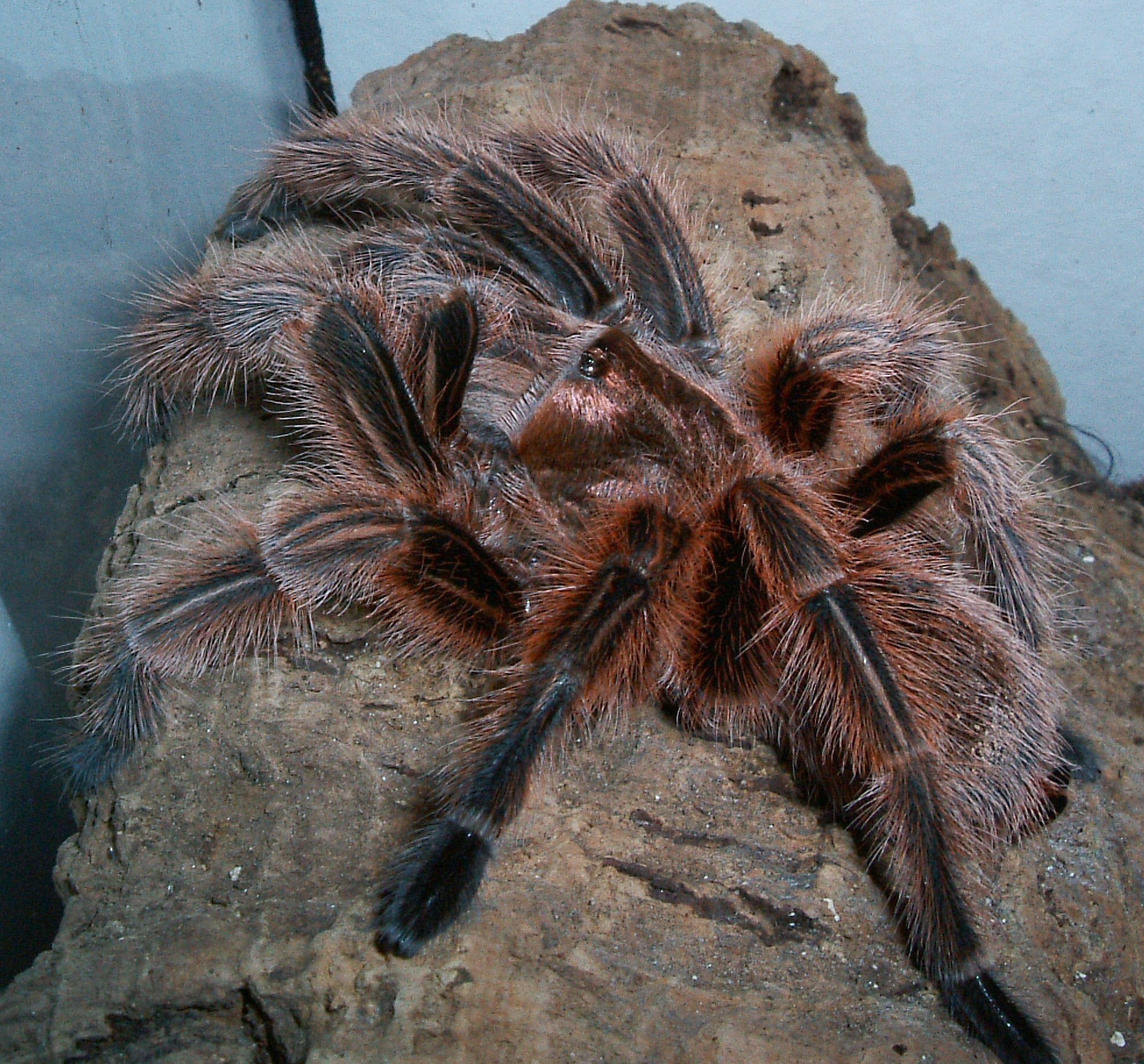
Chilean rose tarantulas are slow-moving, docile New World tarantulas widely kept as a first pet spider. They are long-lived, low-maintenance, and best regarded as display animals rather than handling pets.
ℹ️
Educational only. KinStation content is reviewed by licensed veterinarians but cannot replace an in-person exam. Always consult a licensed veterinarian or board-certified specialist for diagnosis, treatment, or any decision affecting your pet's health.
🩺 Need expert help with your chilean rose tarantula?
Connect with a specialist near you or ask a licensed vet — never substitute online guidance for hands-on care in an emergency.
Adult leg span 4.5–5.5 inches; mature females larger and heavier than males.
Lifespan
10–20 years
Social needs
solo
Native region
South America (Chile, Bolivia, Argentina)
Origin
New World
Climate
🏜️ Arid
Family
Theraphosidae
Genus
Grammostola
Part of the Tarantulas
Theraphosid spiders kept as low-maintenance display invertebrates. New World species are generally docile with mild venom but bear irritating urticating hairs, while Old World species lack those hairs but tend to be fast, defensive, and have more potent (though rarely life-threatening) venom.
From the minimum an animal needs to be kept humanely, up to the ideal setup. Bigger is almost always better — minimums are floors, not targets.
Photo coming soon
Minimum
Adult terrestrial enclosure
≈ 8 × 8 × 8 in floor (≈ 5–10 gal)
A single adult needs a secure, well-ventilated enclosure with floor space roughly two to three times its leg span and a low height (no more than about 1.5 leg spans of clearance above the substrate), on 2–3 in of dry coco-fibre or peat with a cork-bark hide and a shallow water dish. Keep at room temperature (18–24 °C) with low humidity (40–60%); this is a slow, sedentary surface-dwelling terrestrial, so excess height risks fatal falls. Tarantulas are strictly solitary and will cannibalise — never house two together.
Photo coming soon
Recommended
Footprint terrestrial vivarium
≈ 12 × 8 × 8 in (≈ 10 gal)
A horizontal enclosure giving generous floor area with 3–4 in of coco-fibre/peat substrate, a half-log or cork hide, sphagnum moss, and a clean water dish refreshed often. Maintain 18–24 °C and 40–60% humidity with cross-ventilation, keeping most of the substrate dry and one corner lightly moist. Keep the air gap above the substrate short so the spider cannot climb and fall far enough to rupture its abdomen, while still allowing it to web-mat the surface.
Photo coming soon
Ideal
Bioactive terrestrial terrarium
≈ 18 × 12 × 12 in (≈ 20-gal long)
A planted, bioactive terrestrial terrarium with cork-bark caves, leaf litter, a springtail/isopod cleanup crew, and live drought-tolerant plants under gentle ambient light. Use enough substrate to hold a stable surface but keep the climbable height low (a tall tank must be back-filled so the fall distance stays short). Stable 18–24 °C with mostly dry substrate, one damp corner, and a permanent water dish best mimics the dry Chilean scrubland this species inhabits, always as a single occupant.
Life & growth stages
How this animal changes through its life — each stage often has its own care, diet and space needs.
Photo coming soon
Egg
These invertebrates lay eggs — often in a guarded clutch, a silk sac (spiders), or a brood (carried by female isopods). The eggs are small and soft and develop without a true larval or pupal transformation.
Photo coming soon
Juvenile
Juveniles hatch as miniature versions of the adult and grow by molting their exoskeleton (or, in snails, by enlarging the shell). They gain size, segments, or leg pairs and gradually take on adult coloration with each molt.
Adult
Adults reach full size and reproductive maturity with the species' mature form and coloration. Many arachnids and myriapods continue to molt as adults, and sexes can differ in size or in specialized appendages.
Color & pattern variants
Natural variants occur in the wild; selectively bred (man-made) variants were developed in captivity.
The Chilean rose is a terrestrial tarantula, and the most important rule of its housing is that floor space beats height — a wide, low enclosure is far safer than a tall one, because a fall from height onto a hard surface can rupture the abdomen and be fatal. A modest enclosure with a secure lid suits a single adult; these are not animals that need elaborate space.
Provide a few inches of dry substrate (such as coco fiber or a peat-style mix), a cork-bark hide to retreat under, and a shallow water dish kept clean and filled. Ordinary room temperature is usually sufficient; supplemental heat is rarely needed and overheating dries the animal out, so most keepers avoid heat lamps and hot spots.
House them strictly alone — tarantulas are solitary and cannibalistic. A clean, simple, escape-proof enclosure with a hide and water is genuinely all this low-maintenance species requires.
Substrate
Provide 2-4 inches of dry-to-slightly-damp coconut fiber, peat, or topsoil, as this arid-region terrestrial prefers drier conditions than humid species. Let the substrate dry out almost completely between any light moistening.
Equipment & setup
A 5-10 gallon terrestrial enclosure at room temperature (68-78F) is ample, with no heat lamp, UVB, or supplemental heat needed in most homes. Supply a cork-bark hide and a shallow water dish kept filled, which provides the small amount of moisture this species requires.
Diet
Chilean rose tarantulas eat appropriately sized live insects such as crickets, dubia roaches, and mealworms. Adults eat sparingly — often once a week or even less — and this species is famous for long voluntary fasts that can stretch for weeks or months in an otherwise healthy, well-hydrated spider at stable weight. A fasting rose hair is usually normal, not a crisis.
Always keep a shallow dish of clean water available; hydration matters more than frequent feeding, and a shrunken, wrinkled abdomen is a sign of dehydration. Remove uneaten prey within a day, because loose feeder insects can stress or even injure the tarantula, particularly around a molt.
Never offer food during the molt period. A spider that has stopped eating, is hiding, or has darkened over the abdomen may be approaching a molt and should be left undisturbed with water available.
Behavior & temperament
Chilean rose tarantulas are slow-moving, generally docile, and long regarded as a good first pet spider — but the modern consensus leans toward treating them as display animals rather than handling pets. They are New World tarantulas armed with urticating hairs on the abdomen, which they kick off as a defence; these hairs cause itching and irritation to skin and, worse, to eyes and airways.
The bigger reason to limit handling is fragility: a fall of even a short distance can rupture the abdomen and kill the spider, so the risk is mostly to the animal. During maintenance, approach calmly; a tarantula that raises its front legs in a 'threat posture' is asking for space, and the right response is to back off.
Molting is the most dramatic behaviour. A pre-molt spider may stop eating, seal itself in, and eventually flip onto its back to shed — an alarming sight for newcomers, who must resist the urge to 'help' or feed during this vulnerable time.
Health
Tarantulas are hardy, and most health problems are husbandry-related and preventable. Dehydration is a leading issue, recognised by a shrunken, wrinkled abdomen; constant access to clean water and appropriate (not overly dry, not soggy) conditions are the main safeguards. Inadequate hydration also contributes to difficult, sometimes fatal molts.
Falls causing abdominal rupture are the other major killer, which is why low enclosures and minimal handling are emphasised. The molt period is a sensitive window: a molting tarantula should never be disturbed or offered food, and water should be available; interfering can cause injury or death.
Specialised veterinary care for tarantulas is limited, but an exotic-invertebrate-experienced veterinarian can sometimes help with injuries or failed molts. The strongest 'medicine' is prevention — proper hydration, a safe low enclosure, and leaving the spider alone through pre-molt and molt.
Tips, DIY & hacks
Famously hardy and slow-moving, this is a classic beginner tarantula that can fast for weeks or months without concern. Keep things simple and dry, resist the urge to over-mist, and just refill the water dish, as overly wet setups cause more problems than drought for this species.
Origin & history
The Chilean rose tarantula (Grammostola rosea) comes from the desert and scrub regions of Chile (and adjacent areas), and for decades it was among the most commonly sold pet tarantulas worldwide, largely because wild-collected adults were inexpensive and widely available. Its hardiness, calm disposition, and low maintenance cemented its 'beginner tarantula' reputation.
The name spans a few similar-looking rose-haired forms in the genus, and the common 'rose hair' label has been applied somewhat loosely in the trade. Captive-bred animals are increasingly available and are the more sustainable choice. Legality is generally uncomplicated for this species in the United States, though as with any exotic invertebrate it is worth confirming local rules.
Anecdotes & owner lore
Community experience and cultural notes — not veterinary advice. Every animal is an individual; treat these as colour, not care instructions.
The Chilean rose is the tarantula that has launched a thousand arachnophiles — affectionately abbreviated 'G. rosea' or just 'rosie,' it is many a keeper's gateway spider precisely because it is so mellow and forgiving. Its rosy sheen over a soft brown body is understatedly pretty, and a settled rosie sitting calmly in the open is a popular desk or shelf companion.
Two quirks dominate hobby lore. The first is the legendary hunger strike: rose hairs can refuse food for astonishing stretches, sending anxious new owners to forums only to be reassured that 'a fasting rosie is a classic rosie.' The second is the heart-stopping first molt, when the spider flips onto its back and lies motionless — every keeper remembers the panic of thinking their pet had died, then the marvel of watching a brand-new, vividly coloured tarantula emerge from the old skin.
Common ailments
Dehydration — common — A shrunken, wrinkled abdomen is the classic sign.
Fall injury / abdominal rupture — rare — Largely preventable by keeping enclosures low and limiting handling.
Molting complications — common — Never feed or disturb a molting tarantula; a flipped-over spider is molting, not dying.
Reviewed and signed off by: KinStation Editorial - pre-launch draft (pending DVM review)