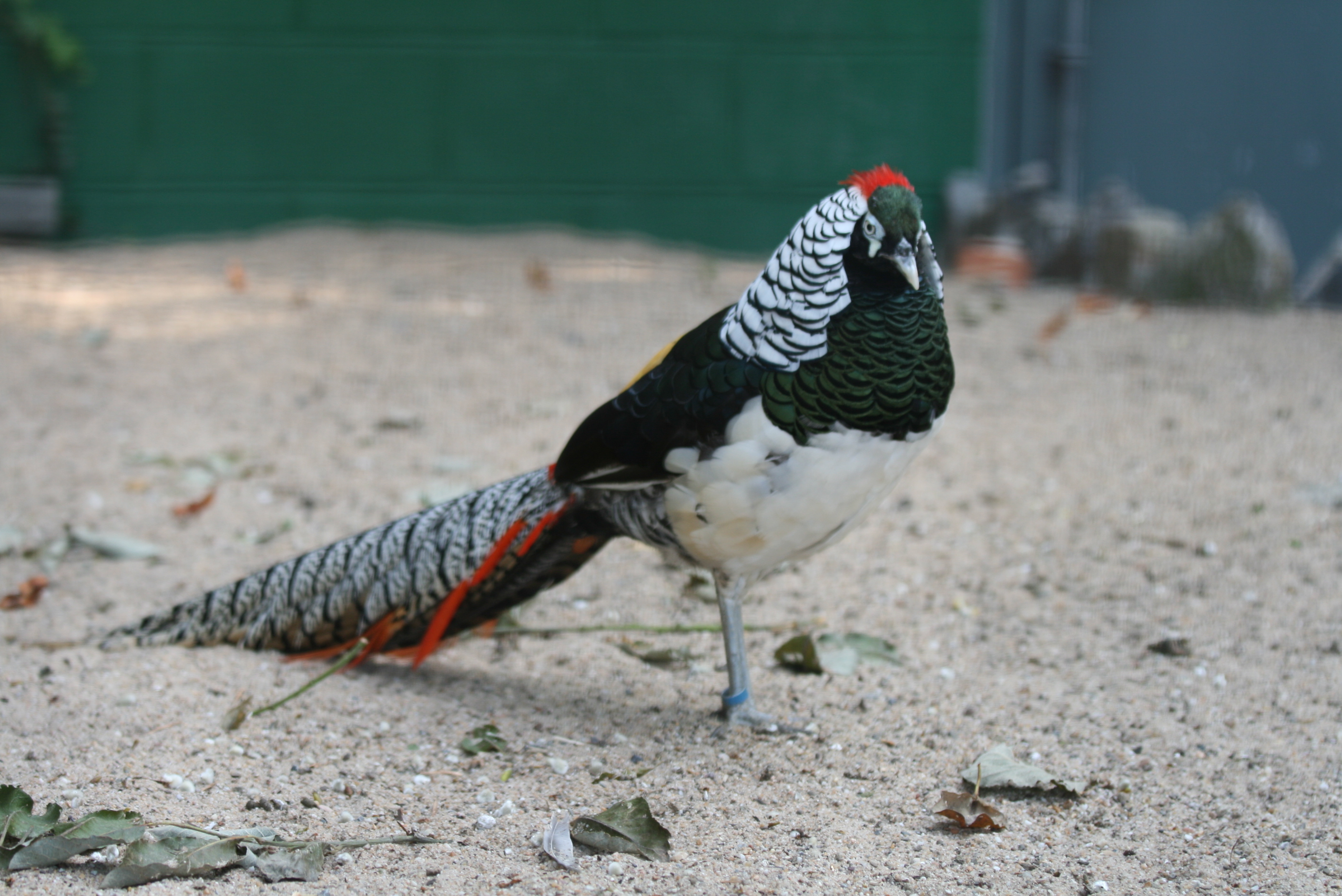
A spectacularly ornamental aviary pheasant, the male Lady Amherst's is famed for its black-and-silver ruff, iridescent green crown, red crest, and sweeping barred tail. Hardy and undemanding in a planted aviary, it is an ornamental/avicultural bird rather than a handleable pet.
ℹ️
Educational only. KinStation content is reviewed by licensed veterinarians but cannot replace an in-person exam. Always consult a licensed veterinarian or board-certified specialist for diagnosis, treatment, or any decision affecting your pet's health.
🩺 Need expert help with your lady amherst's pheasant?
Connect with a specialist near you or ask a licensed vet — never substitute online guidance for hands-on care in an emergency.
Large ornamental pheasant: males 100-120 cm (39-47 in) including the very long barred tail (tail alone up to ~80 cm); hens smaller at 60-67 cm. Body weight roug
Lifespan
6–15 years
Social needs
pair
Native region
Mountainous forests and bamboo thickets of southwestern China (Yunnan, Sichuan, Guizhou, Tibet) and adjacent northern My
Origin
Old World
Climate
⛰️ Montane
Family
Phasianidae
Genus
Chrysolophus
Part of the Pheasants
Pheasants, quail, and partridges are ground-dwelling galliformes kept in planted aviaries and pens for their striking plumage and displays. Hardy and relatively low-maintenance, they are avicultural and exhibition birds rather than handleable pets, and most require predator-proof outdoor housing.
From the minimum an animal needs to be kept humanely, up to the ideal setup. Bigger is almost always better — minimums are floors, not targets.
Photo coming soon
Minimum
Aviary + cover plants
≈ 100 sq ft aviary / pair, 6 ft tall
Lady Amherst's Pheasants are slim Tibetan woodland pheasants with extraordinarily long tails. A welfare minimum is 100 sq ft of aviary per pair, ≥ 6 ft tall, with dense cover plants, multiple raised perches, a half-roofed shelter, grit, calcium, clean water, and ½ in hardware cloth.
Photo coming soon
Recommended
Planted woodland aviary
≈ 150 sq ft aviary / pair, 8 ft tall
A 150 sq ft per pair planted aviary, ≥ 8 ft tall (to accommodate the cock's 3 ft tail), with dense cover, varied perches, and a half-roofed shelter gives Lady Amhersts room to forage, court, and roost. Tail damage from wire or low perches is the #1 welfare issue — height and clear perch paths matter.
Photo coming soon
Ideal
Woodland walk-in aviary
≥ 250 sq ft walk-in aviary / pair
A walk-in woodland aviary of 250+ sq ft per pair, planted with native shrubs and a 9 ft minimum height, is the welfare ideal. Provide high broad roosts, dust-baths, hidden nest cover, and visual barriers between rival males — the long tail and shy temperament both reward careful, naturalistic housing.
Life & growth stages
How this animal changes through its life — each stage often has its own care, diet and space needs.
Photo coming soon
Egg
Birds develop inside a hard-shelled egg incubated by the parent(s). Egg size, shell color, and clutch size vary by species; the embryo develops over days to weeks before hatching.
Photo coming soon
Hatchling / Chick
Hatchlings are either altricial — naked, blind, and dependent on parents (typical of parrots and songbirds) — or precocial — downy, mobile, and self-feeding soon after hatching (typical of poultry and waterfowl). Down gives way to the first feathers.
Photo coming soon
Juvenile / Fledgling
Fledglings grow in their juvenile plumage and begin to fly and feed themselves, though they may still beg from parents at first. Juvenile feathering is often duller than the adult and is replaced as the bird matures.
Adult
Adults attain full body size and mature plumage, and are capable of breeding. Many species show distinct adult coloration, and in sexually dimorphic birds males and females differ in plumage, size, or markings.
Habitat & enclosure
Best kept in a spacious, predator-proof planted aviary; a pair needs a minimum of roughly 3-4 m x 2-3 m (about 10-15 x 8-10 ft) of floor space with a sheltered, dry roosting area and natural cover (shrubs, branches, brush piles) for security. They are cold-hardy and tolerate temperate winters well given a draft-free shelter, but appreciate shade in heat. Tall planting and visual barriers reduce stress and aggression. A roof or netting is needed because they can fly, and the aviary must exclude rats, foxes, raptors, and other predators. Ground should drain well to prevent disease.
Substrate
Natural earth with growing plants and leaf litter works well in a well-drained aviary; sand, fine gravel, or bark can be used in shelter/run areas. Keep substrate dry and periodically rake or refresh it to limit parasite and pathogen buildup. Provide a dry, sheltered area and a dust-bathing spot.
Equipment & setup
A predator-proof aviary with secure netting/roof, a draft-free weatherproof shelter, elevated roosting branches/perches, dense planting or brush for cover, feeders and waterers kept off wet ground, grit and calcium dispensers, and nesting cover/boxes for breeding hens. A safety porch/double-door entry prevents escapes.
Diet
Feed a commercial game-bird or pheasant pellet/crumble as the staple, supplemented with mixed grains/seed, fresh greens, vegetables, and occasional fruit and live food (mealworms) especially during breeding. Provide insoluble grit to aid digestion and a calcium source (oyster shell/cuttlebone) for laying hens. Clean water must always be available. Avoid moldy feed, which causes aspergillosis.
Behavior & temperament
An ornamental, ground-dwelling bird that is shy and flighty rather than tame; it is not a handleable companion and is best appreciated visually in an aviary. Males can become territorial and aggressive toward each other and toward hens during the spring breeding season, so they are typically kept as single pairs or trios (one male with two hens) with ample cover. Generally calm and quiet outside breeding, with the male giving harsh calls in display. Lady Amherst's and golden pheasants (Chrysolophus pictus) readily hybridize, so they should not be housed together if pure stock is wanted.
Health
Common concerns include intestinal parasites (worms, coccidiosis), gapeworm (causing gasping/head-shaking), blackhead (histomoniasis, especially where kept with or after poultry/turkeys), and respiratory fungal disease (aspergillosis) from damp or moldy conditions. Routine fecal parasite checks, clean dry housing, rotation of ground or use of clean substrate, and quarantine of new birds are key. Keep separate from turkeys/chickens to reduce blackhead risk.
Tips, DIY & hacks
Provide plenty of visual barriers and cover to reduce stress and breeding-season aggression. Keep only one adult male per enclosure. To maintain pure stock, never house with golden pheasants, as the two hybridize freely. In some regions feral populations have established (notably a small historic population in England), so confirm local regulations and prevent escapes. Source disease-free stock and quarantine newcomers. They roost off the ground, so include elevated perches.