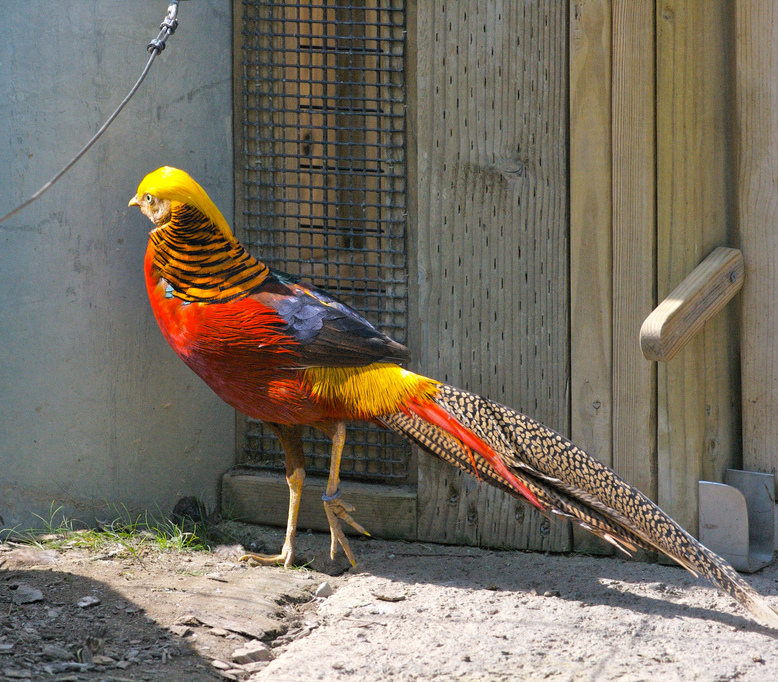
A small, dazzlingly colorful ornamental pheasant and one of the most popular aviary gamebirds. Hardy and easy to keep in planted flight pens, prized for the male's golden crest and red-and-gold plumage rather than for handling.
ℹ️
Educational only. KinStation content is reviewed by licensed veterinarians but cannot replace an in-person exam. Always consult a licensed veterinarian or board-certified specialist for diagnosis, treatment, or any decision affecting your pet's health.
🩺 Need expert help with your golden pheasant?
Connect with a specialist near you or ask a licensed vet — never substitute online guidance for hands-on care in an emergency.
Males ~90-105 cm total length (over half is tail), ~0.6 kg; females smaller (~0.6 kg) and camouflaged brown.
Lifespan
5–15 years
Social needs
pair
Native region
Mountain forests of western and central China
Origin
Old World
Climate
⛰️ Montane
Family
Phasianidae
Genus
Chrysolophus
Part of the Pheasants
Pheasants, quail, and partridges are ground-dwelling galliformes kept in planted aviaries and pens for their striking plumage and displays. Hardy and relatively low-maintenance, they are avicultural and exhibition birds rather than handleable pets, and most require predator-proof outdoor housing.
From the minimum an animal needs to be kept humanely, up to the ideal setup. Bigger is almost always better — minimums are floors, not targets.
Photo coming soon
Minimum
Aviary + cover plants
≈ 80 sq ft aviary / pair, 6 ft tall
Golden Pheasants are small, brightly coloured Chinese woodland gallinaceans. A welfare minimum is an 80 sq ft aviary per pair, ≥ 6 ft tall, with dense cover plants (conifer, bamboo, shrubs), a sand or dust-bath, perches at varied heights, a sheltered roost area, grit, calcium, and ½ in hardware cloth to keep out predators and rodents.
Recommended
Planted flight pen
≈ 120 sq ft aviary / pair, 7 ft tall
A 120 sq ft per pair planted aviary, ≥ 7 ft tall, with dense cover, branches, and a half-roofed shelter gives Goldens room to display, forage, and roost. Hens hide nests in dense cover; provide raised feed and water to deter rodents, and a winter sheltered roost — they tolerate cold if dry.
Ryan E. Poplin / CC BY-SA 2.0 (Wikimedia Commons)
Photo coming soon
Ideal
Woodland walk-in aviary
≥ 200 sq ft walk-in aviary / pair
A walk-in woodland aviary of 200+ sq ft per pair, planted with native shrubs and a half-roofed shelter, is the welfare ideal for this stunning Chinese pheasant. Provide dust-baths, multiple roost levels, varied insect and grain forage, and a hidden nest box — cocks display year-round and benefit from visual barriers between rival males.
Life & growth stages
How this animal changes through its life — each stage often has its own care, diet and space needs.
Photo coming soon
Egg
Birds develop inside a hard-shelled egg incubated by the parent(s). Egg size, shell color, and clutch size vary by species; the embryo develops over days to weeks before hatching.
Photo coming soon
Hatchling / Chick
Hatchlings are either altricial — naked, blind, and dependent on parents (typical of parrots and songbirds) — or precocial — downy, mobile, and self-feeding soon after hatching (typical of poultry and waterfowl). Down gives way to the first feathers.
Photo coming soon
Juvenile / Fledgling
Fledglings grow in their juvenile plumage and begin to fly and feed themselves, though they may still beg from parents at first. Juvenile feathering is often duller than the adult and is replaced as the bird matures.
Adult
Adults attain full body size and mature plumage, and are capable of breeding. Many species show distinct adult coloration, and in sexually dimorphic birds males and females differ in plumage, size, or markings.
(c) Lin, Zhanyi, some rights reserved (CC BY-NC) via iNaturalist — https://www.inaturalist.org/observations/260351939
Color & pattern variants
Natural variants occur in the wild; selectively bred (man-made) variants were developed in captivity.
Golden pheasants thrive in a **planted, covered flight aviary** with **dense cover, perches, and hiding spots**. They are smaller and less explosive than ring-necks but still fly and need a **soft or high roof**; a pair or trio does well in a moderately sized planted pen with shrubs, evergreen cover, and a sheltered, dry corner. They are notably **cold-hardy** (often kept outdoors year-round with just a dry, draft-free shelter) but need shade in heat. Provide low cover where the wary hen can hide and nest. Secure mesh and a buried apron keep predators out.
Substrate
Use **natural earth with planting and cover** in the aviary, or **sand and bark/wood chips** with added brush and conifer boughs. Keep it well-drained and dry; damp ground breeds parasites. A dry **dust-bathing area** supports natural parasite control. Chicks need a **non-slip, dry brooder surface**. Live plants and leaf litter let them forage and hide naturally.
Equipment & setup
Provide a **covered, predator-proof planted aviary** with **perches**, **shelter**, and **dense cover**, plus **feeders/waterers**. A **brooder with heat plate/lamp** and shallow, drown-proof water rears chicks. Because they're small and cold-hardy, elaborate heating is rarely needed — a dry, draft-free shelter suffices through winter in most climates. Soft netting or a high roof prevents flush injuries.
Diet
Feed a **gamebird/ornamental-pheasant maintenance pellet** supplemented with grains, greens, fruit, and live food (mealworms) for variety and breeding condition. **Chicks need high-protein gamebird starter (~28%)**. Provide **grit** and **oyster shell** for laying hens. They forage on seeds, insects, and vegetation. Clean water at all times; chicks need shallow, drown-proof water. A varied diet keeps the male's plumage vivid.
Behavior & temperament
Golden pheasants are **shy, wary, and ornamental** — not tame, and they prefer to skulk in cover, dashing for hiding spots when disturbed. Males perform a striking **lateral courtship display**, spreading the orange-and-black cape over the face. They are generally peaceful but males can be **territorial in breeding season**, so a pair or single-male trio per pen works best; multiple males may fight. Hens are reasonable sitters but many breeders incubate. They roost on perches at night. Plenty of cover keeps them calm and confident.
Health
Hardy in well-kept aviaries; main concerns are **internal parasites** (gapeworm, cecal worms — deworm on a vet-guided schedule), **coccidiosis** in chicks, **blackhead** (keep separate from chickens), and stress/feather-picking if crowded or under-covered. Chicks are delicate early on (chilling, drowning). They can carry **avian influenza**; maintain biosecurity. Provide clean, dry housing and ample cover to minimize stress-related disease. A gamebird-aware avian vet is helpful.
Tips, DIY & hacks
Golden pheasants are an ideal **first ornamental pheasant** — colorful, hardy, and undemanding in a **planted flight pen**. Keep them as a **pair or single-male trio** with lots of cover so the shy hen feels secure and the male can display. Add **evergreen boughs and shrubs** for cover and calm. Keep strictly **away from chickens** (blackhead). Many hens incubate, but plan to **artificially incubate** for reliable hatches. They hybridize readily with Lady Amherst's pheasants, so house the two species separately to keep bloodlines pure. Generally legal to keep across the US, but **confirm local exotic/gamebird rules**.