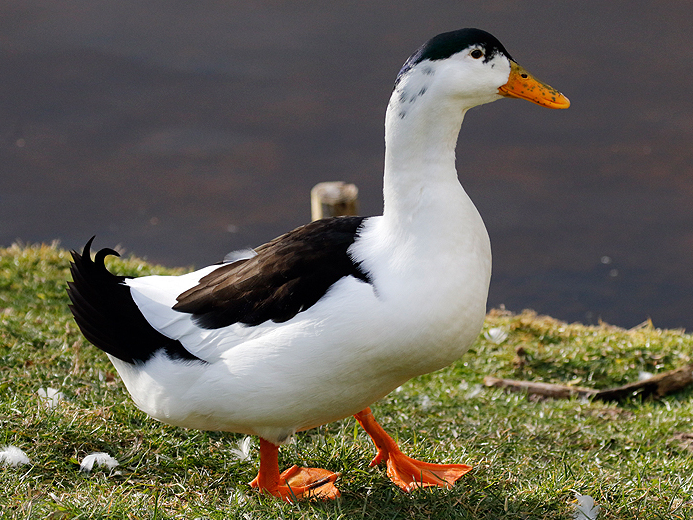
An active, light dual-purpose utility duck developed in early-20th-century Britain, prized as a prolific layer of large white-to-blue/green eggs and recognizable by its black-and-white 'magpie' markings. Hardy and good forager, well suited to free-range smallholdings.
ℹ️
Educational only. KinStation content is reviewed by licensed veterinarians but cannot replace an in-person exam. Always consult a licensed veterinarian or board-certified specialist for diagnosis, treatment, or any decision affecting your pet's health.
🩺 Need expert help with your magpie duck?
Connect with a specialist near you or ask a licensed vet — never substitute online guidance for hands-on care in an emergency.
From the minimum an animal needs to be kept humanely, up to the ideal setup. Bigger is almost always better — minimums are floors, not targets.
Photo coming soon
Minimum
Shelter + run + water
4 sq ft shelter + 15 sq ft run / bird + pool
Magpie Ducks are medium-weight Welsh dual-purpose ducks. A welfare minimum is 4 sq ft of shelter and 15 sq ft of run per bird, with deep clean water for full head dunking, a kiddie-pool ≥ 20 gal per bird, grit, calcium, clean nest area, and predator-proof ½ in hardware cloth.
Photo coming soon
Recommended
Shelter + roomy run + pool
6 sq ft shelter + 25 sq ft run / bird + pool
A 6 sq ft per bird shelter with a 25+ sq ft per bird run and a large pool gives Magpies room to forage and swim. Good layers (220+ eggs/yr) with striking black-and-white plumage; calm temperament makes them homestead favourites.
Photo coming soon
Ideal
Pasture + pond
10 sq ft shelter + pasture + natural pond
A 10 sq ft per bird shelter with rotated pasture and natural pond access is the welfare ideal for this rare Welsh heritage breed. Provide overhead cover, a draught-free winter shelter, and ample swim water — Magpies self-harvest invertebrates and tolerate weather well.
Life & growth stages
How this animal changes through its life — each stage often has its own care, diet and space needs.
Photo coming soon
Egg
Birds develop inside a hard-shelled egg incubated by the parent(s). Egg size, shell color, and clutch size vary by species; the embryo develops over days to weeks before hatching.
Photo coming soon
Hatchling / Chick
Hatchlings are either altricial — naked, blind, and dependent on parents (typical of parrots and songbirds) — or precocial — downy, mobile, and self-feeding soon after hatching (typical of poultry and waterfowl). Down gives way to the first feathers.
Photo coming soon
Juvenile / Fledgling
Fledglings grow in their juvenile plumage and begin to fly and feed themselves, though they may still beg from parents at first. Juvenile feathering is often duller than the adult and is replaced as the bird matures.
Adult
Adults attain full body size and mature plumage, and are capable of breeding. Many species show distinct adult coloration, and in sexually dimorphic birds males and females differ in plumage, size, or markings.
no rights reserved via iNaturalist — https://www.inaturalist.org/observations/16238282
Color & pattern variants
Natural variants occur in the wild; selectively bred (man-made) variants were developed in captivity.
Provide a predator-proof coop or duck house (about 0.4 m2 / 4 sq ft floor space per bird) with deep, dry bedding and a secure run. As an active forager this breed thrives with daytime free-range access to pasture and insects. Supply clean water deep enough to dip the whole head and ideally a pond or wading pool for bathing and preening; they are strong fliers compared with heavier breeds, so fence or wing-clip if containment matters.
Diet
Feed a balanced waterfowl or poultry pellet — grower/maintenance ration for non-layers and a layer ration (16-18% protein, added calcium) for laying ducks. Supplement with leafy greens, foraged insects, slugs and snails. Provide insoluble grit for digestion and crushed oyster shell free-choice for laying hens. Niacin needs are higher than chickens; ensure rations are formulated for waterfowl or add brewer's yeast.
Behavior & temperament
Dual-purpose but kept mainly for eggs: a strong layer producing roughly 220-290+ large eggs per year, mostly white though some lay blue or green-tinted eggs. Active, alert, vocal and good foragers; they tend to be flighty rather than cuddly and rarely go broody, so reliable laying continues year to year. Calmer if raised with regular gentle handling.
Health
Generally robust and free of breed-specific defects. Watch for common waterfowl issues: niacin deficiency (leg weakness in ducklings), bumblefoot from hard or wet-dirty footing, and external parasites. The breed standard's pied pattern can be hard to attain but carries no health penalty — markings broaden with age and vary widely.
Tips, DIY & hacks
Because they're flighty and can fly short distances, handle young and provide a calm routine to keep them manageable; use a low fence or a covered run if you want them confined. Their bright markings make them easy to count at dusk. Excellent insect/slug control for gardens and orchards. Provide shade and ample water in heat. Watch the markings settle as the bird matures before judging show quality.