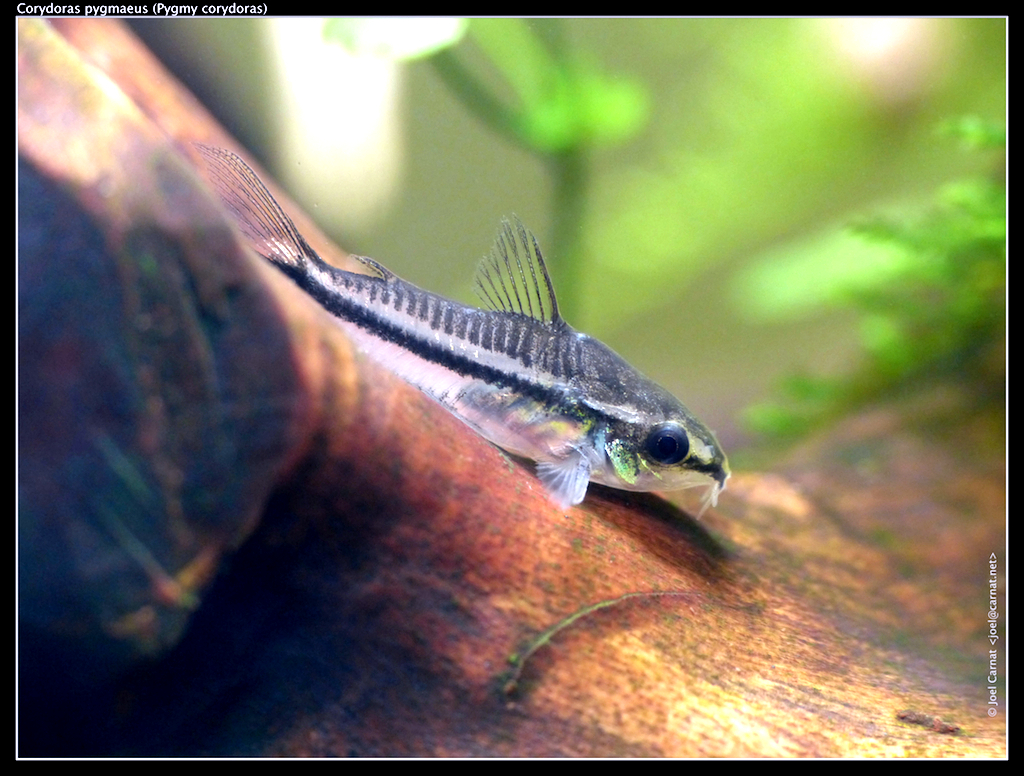
A nano-sized armored catfish that, unlike most corydoras, shoals throughout the mid-water rather than just the bottom. Tiny, peaceful, and highly social, it is a charming choice for planted nano and community tanks with small, gentle tankmates.
ℹ️
Educational only. KinStation content is reviewed by licensed veterinarians but cannot replace an in-person exam. Always consult a licensed veterinarian or board-certified specialist for diagnosis, treatment, or any decision affecting your pet's health.
🩺 Need expert help with your pygmy cory?
Connect with a specialist near you or ask a licensed vet — never substitute online guidance for hands-on care in an emergency.
One of the smallest corydoras, reaching only about 2-3 cm (0.8-1.2 in), silver with a dark lateral stripe.
Lifespan
3–5 years
Social needs
group
Native region
South America (Madeira River basin, Brazil)
Origin
New World
Climate
🌴 Tropical
Water type
💧 Freshwater
Family
Callichthyidae
Genus
Corydoras
Part of the Catfish
Catfish are a diverse order of mostly bottom-dwelling fish, including peaceful shoaling corydoras, armored loricariids, and scavengers prized for keeping the lower levels of an aquarium active and clean.
From the minimum an animal needs to be kept humanely, up to the ideal setup. Bigger is almost always better — minimums are floors, not targets.
Photo coming soon
Minimum
Nano school tank
10 gal / 38 L (school of 6+)
Corydoras pygmaeus stays under 3 cm and shoals in mid-water (unlike most corys). Soft sand, dense planting, group of 6+, soft warm water (22–26 °C).
Photo coming soon
Recommended
Planted nano community
20 gal long / 75 L
Long footprint suits a school of 10–15. Pair with chili rasboras, ember tetras, or shrimp. Sponge filter, gentle flow.
Photo coming soon
Ideal
Aquascaped biotope
29 gal+ / 110 L+ biotope
Long aquascaped tank with deep sand, leaf litter, and large school. Mid-water shoaling behaviour is unique among corys and a constant display.
Life & growth stages
How this animal changes through its life — each stage often has its own care, diet and space needs.
Photo coming soon
Egg
Fish eggs are small, translucent spheres, often laid in clutches on plants, substrate, or in a nest — or carried/brooded by a parent in livebearing and mouth-brooding species. A dark eye spot and the curled embryo become visible inside as development progresses.
Photo coming soon
Fry
Newly hatched fry are tiny and semi-transparent, frequently still carrying a yolk sac that fuels them before they feed freely. They lack full fin structure and adult coloration, staying near cover until they can swim and forage on their own.
Photo coming soon
Juvenile
Juveniles look like miniature adults but with developing fins and muted or different markings; many species shift pattern and color as they mature. Growth is rapid at this stage given clean water and steady feeding.
Adult
Adults show the species' full size, finnage, and mature coloration, and are sexually mature. Many fish develop sex-specific differences in size, color, or fin shape, which can intensify during breeding.
Habitat & enclosure
Because they stay so small, a group thrives in a tank of at least 40-60 litres (10-15 US gal), but they need company: keep eight or more, as larger shoals school tightly in mid-water. Provide a soft sand substrate, dense planting, driftwood, and gentle flow, with fine-leaved plants giving the cover and security they favor.
They are tropical: keep water at 22-26 C (72-79 F), pH 6.0-7.5, soft to moderately hard, in stable, mature conditions. Being so small, they are sensitive to poor water quality and to being outcompeted, so gentle filtration and regular water changes are important.
Substrate
Use a soft, fine sand substrate to protect their delicate barbels and allow natural sifting. Add fine-leaved plants and driftwood, which they perch on and shelter among.
Equipment & setup
Provide gentle filtration, such as a sponge filter, that keeps water clean without strong current or risk of pulling in these tiny fish, plus a heater for stable warmth. Dense planting and subdued lighting suit their shy, schooling nature.
Diet
Micro-omnivores that need small foods: offer micro pellets, crushed flake, baby brine shrimp, daphnia, cyclops, and finely chopped frozen bloodworm. They forage along the bottom and pick food from plant leaves and mid-water.
Because their mouths are tiny, ensure foods are small enough and that enough reaches them past faster tankmates. Feed small amounts a couple of times a day, and avoid large or aggressive feeders that would intimidate them away from food.
Behavior & temperament
Peaceful, timid, and intensely social; they should be kept in groups of eight or more and feel insecure in smaller numbers. Uniquely for corydoras, they shoal in mid-water as well as on the bottom, drifting together and resting on plant leaves. Ideal tankmates are small, gentle fish such as nano tetras, rasboras, and dwarf shrimp.
Avoid any fish large enough to eat them, as these tiny catfish are vulnerable. In a large group they are confident and active, hovering and grazing together; kept alone or in pairs they hide and fail to thrive.
Health
Their small size makes them sensitive to water-quality swings, ich, and to salt and copper medications, which must be reduced. Barbel erosion from sharp or dirty substrate also affects them, so keep a soft, clean bottom.
They ship and acclimate poorly due to their size, so drip-acclimate carefully and add them to a mature, stable tank. Quarantine new fish, keep nitrates low with frequent small water changes, and ensure they are not outcompeted for food, which can lead to wasting.
Tips, DIY & hacks
Keep a large shoal, ideally ten or more, to bring out their tight mid-water schooling. Use a sponge filter to avoid trapping such small fish, drip-acclimate slowly, and pair only with peaceful nano tankmates that cannot eat them.