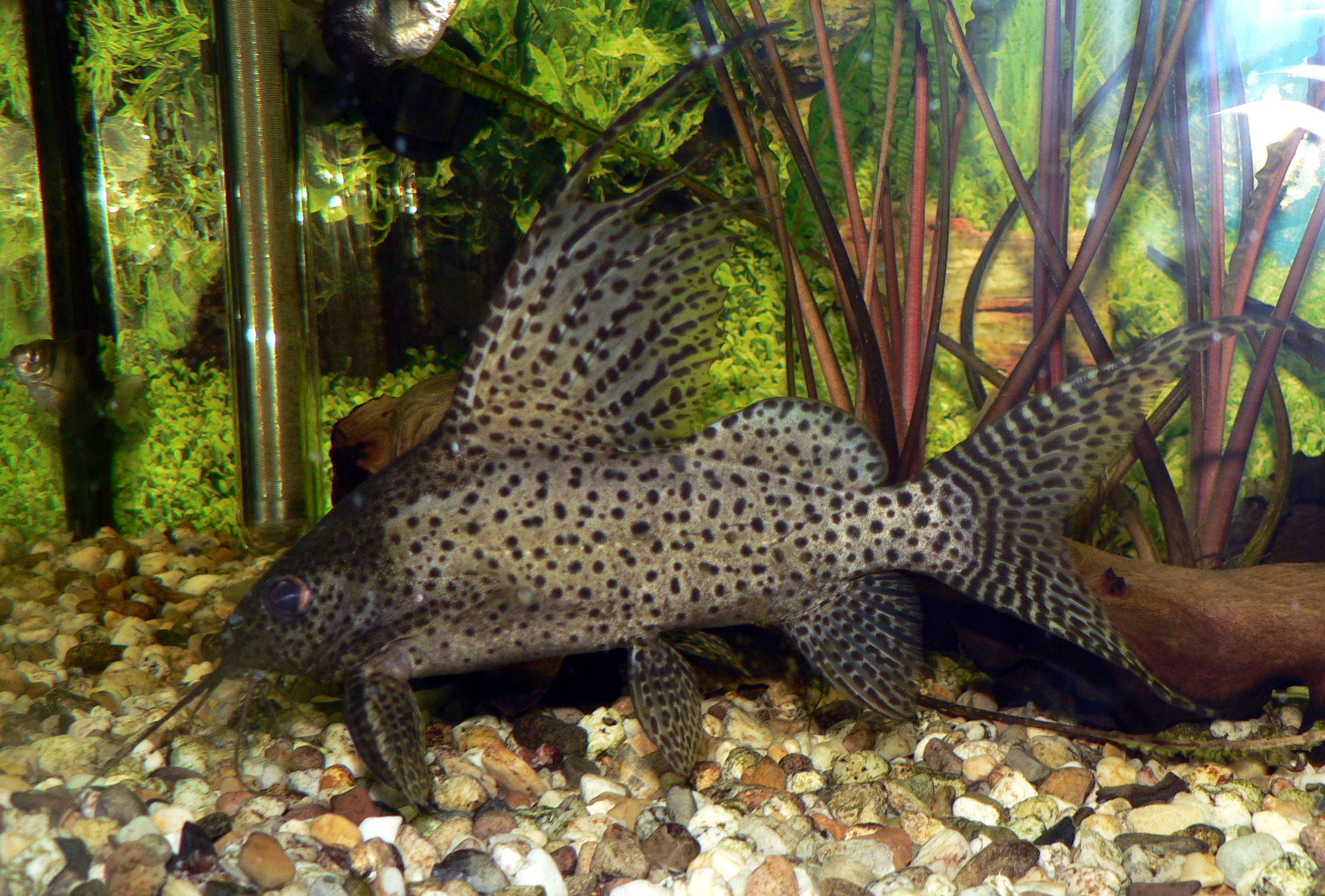
A hardy, long-lived African upside-down catfish family member named for the ornate, feathered dorsal fin of young fish. A peaceful but boisterous bottom-dweller that grows large, lives for decades, and produces audible squeaking sounds when handled.
ℹ️
Educational only. KinStation content is reviewed by licensed veterinarians but cannot replace an in-person exam. Always consult a licensed veterinarian or board-certified specialist for diagnosis, treatment, or any decision affecting your pet's health.
🩺 Need expert help with your featherfin synodontis?
Connect with a specialist near you or ask a licensed vet — never substitute online guidance for hands-on care in an emergency.
Robust African catfish reaching about 20-30 cm (8-12 in); juveniles show a dramatic feathery, sail-like dorsal fin.
Lifespan
10–25 years
Social needs
solo
Native region
Africa (White Nile and Chad basins, Sudan and West-Central Africa)
Origin
Old World
Climate
🌴 Tropical
Water type
💧 Freshwater
Family
Mochokidae
Genus
Synodontis
Part of the Catfish
Catfish are a diverse order of mostly bottom-dwelling fish, including peaceful shoaling corydoras, armored loricariids, and scavengers prized for keeping the lower levels of an aquarium active and clean.
From the minimum an animal needs to be kept humanely, up to the ideal setup. Bigger is almost always better — minimums are floors, not targets.
Photo coming soon
Minimum
Sub-adult group tank
75 gal / 284 L long
Synodontis eupterus (featherfin) reaches 8 in. 75-gal long minimum, ideally a group of 3+ (less aggression). Strong filtration, driftwood caves, dim lighting, and varied carnivore diet. Soft to moderately hard water.
Photo coming soon
Recommended
African community
125 gal / 473 L long
125-gal long African community with multiple synodontis, rocky/wood caves, peaceful larger tankmates, and dim lighting. Nocturnal — feeds best at lights-out.
Photo coming soon
Ideal
African river biotope
180 gal+ / 681 L+ biotope
African river biotope with multiple caves, driftwood, sand, dim lighting, and a small group. Long-lived (15+ years) and develops a real personality.
Life & growth stages
How this animal changes through its life — each stage often has its own care, diet and space needs.
Photo coming soon
Egg
Fish eggs are small, translucent spheres, often laid in clutches on plants, substrate, or in a nest — or carried/brooded by a parent in livebearing and mouth-brooding species. A dark eye spot and the curled embryo become visible inside as development progresses.
Photo coming soon
Fry
Newly hatched fry are tiny and semi-transparent, frequently still carrying a yolk sac that fuels them before they feed freely. They lack full fin structure and adult coloration, staying near cover until they can swim and forage on their own.
Photo coming soon
Juvenile
Juveniles look like miniature adults but with developing fins and muted or different markings; many species shift pattern and color as they mature. Growth is rapid at this stage given clean water and steady feeding.
Adult
Adults show the species' full size, finnage, and mature coloration, and are sexually mature. Many fish develop sex-specific differences in size, color, or fin shape, which can intensify during breeding.
Habitat & enclosure
A single adult needs a tank of at least 280-340 litres (75-90 US gal); they grow large, are robust swimmers, and become territorial in cramped quarters. Provide plenty of caves, driftwood, rockwork, and shaded hiding places, with a soft substrate and dim or planted cover suited to their nocturnal, retiring habits.
They are tropical: keep water at 22-27 C (72-81 F), pH 6.5-7.5, soft to moderately hard, with strong filtration and brisk flow to mimic their river habitat. They are messy, high-bioload fish, so generous filtration and regular water changes are essential to keep nitrates in check.
Substrate
Use fine sand or smooth gravel to protect their barbels and underside as they forage along the bottom. Pair with driftwood, slate caves, and smooth rockwork to provide the shaded retreats they need.
Equipment & setup
Provide powerful filtration (canister recommended) to handle their heavy waste output, plus a heater for stable tropical temperatures. Good flow and oxygenation suit their riverine origin, and a secure, weighted lid prevents escapes by this strong, restless fish.
Diet
Unfussy omnivores that scavenge the bottom: offer sinking pellets, catfish wafers, frozen and live bloodworms, brine shrimp, and the occasional snail or bit of vegetable. They forage by scent at night and will eat almost anything that reaches the substrate.
Feed a varied diet with both meaty and plant components, and avoid relying on leftovers alone, as a fish this size needs deliberate feeding. They readily eat snails, making them useful for snail control, but should not be left to scavenge a sparse tank.
Behavior & temperament
Generally peaceful toward fish too large to eat but can be territorial and pushy with their own kind and other bottom-dwellers, especially in tight space. They mix well with larger, robust community fish and African cichlids, and ignore mid-water species. Small fish may be eaten at night.
They are nocturnal, secretive by day, and active foragers after dark, sometimes swimming inverted near surfaces in the family tradition. The species name 'squeaker' refers to the stridulation sounds they make with their pectoral spines when stressed or handled.
Health
As a largely scaleless catfish they are sensitive to ich and to copper- and salt-based medications, which should be dosed conservatively. Bloat and constipation can occur from a monotonous or overly rich diet, so vary the menu and include fibre.
Their sharp, locking pectoral and dorsal spines tangle in nets and can injure handlers and other fish, so move them in a container. Keep water clean and well oxygenated to prevent fin and barbel erosion, and quarantine newcomers to avoid introducing parasites.
Tips, DIY & hacks
Avoid netting them; their spines lock and snag, so use a container to transfer. Buy them for the long haul, as they can outlive many other aquarium fish by decades, and provide a cave each fish can claim as its own daytime retreat.