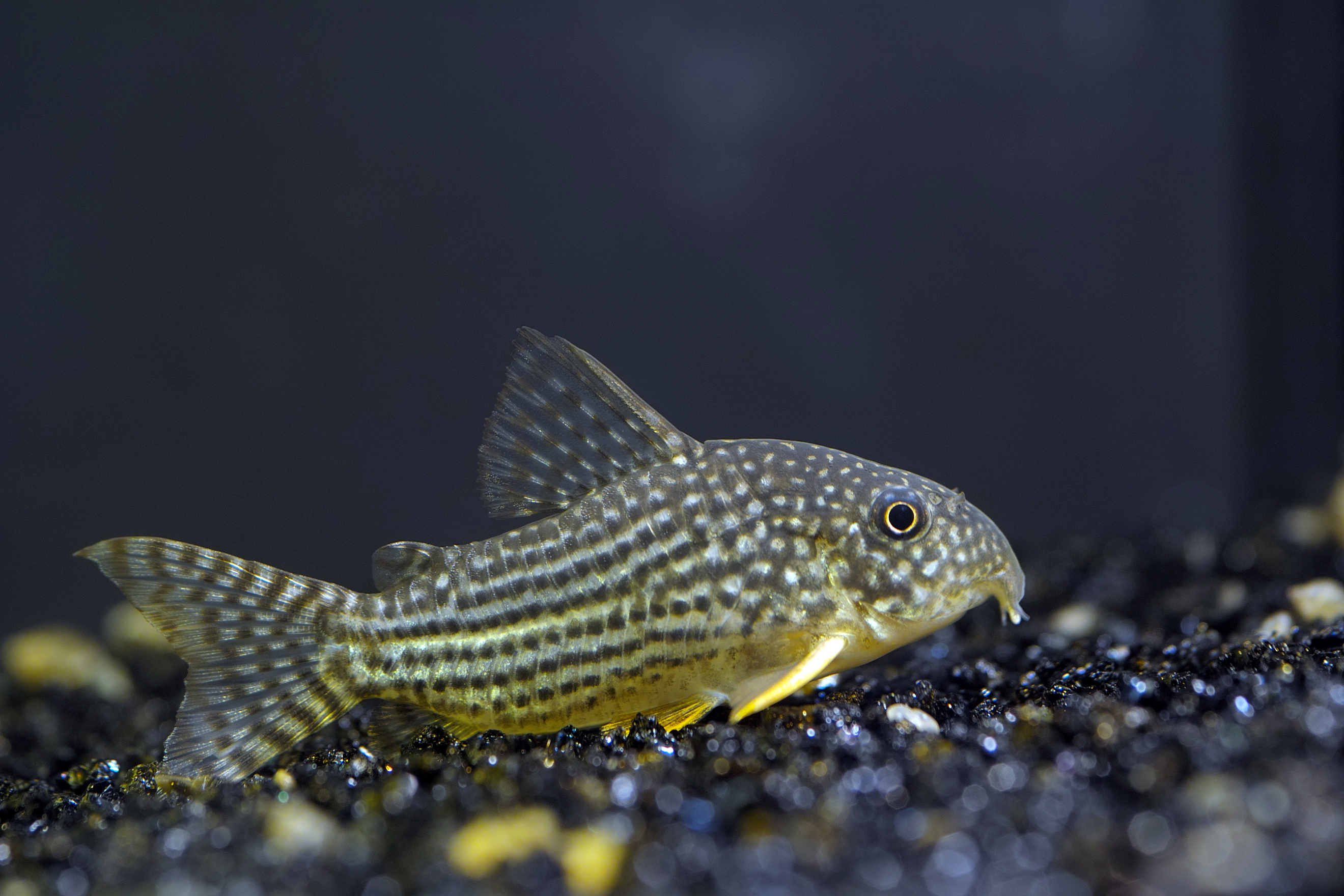
Sterba's cory is a popular, peaceful bottom-dwelling catfish recognized by its dark body covered in white-cream spots and orange-tinged pectoral fins. Hardy and social, it tolerates warmer water than many corys, making it a favorite community and discus-tank companion.
ℹ️
Educational only. KinStation content is reviewed by licensed veterinarians but cannot replace an in-person exam. Always consult a licensed veterinarian or board-certified specialist for diagnosis, treatment, or any decision affecting your pet's health.
🩺 Need expert help with your sterba's cory?
Connect with a specialist near you or ask a licensed vet — never substitute online guidance for hands-on care in an emergency.
Catfish are a diverse order of mostly bottom-dwelling fish, including peaceful shoaling corydoras, armored loricariids, and scavengers prized for keeping the lower levels of an aquarium active and clean.
From the minimum an animal needs to be kept humanely, up to the ideal setup. Bigger is almost always better — minimums are floors, not targets.
Photo coming soon
Minimum
Sand-bottom school tank
29 gal / 110 L (group of 6+)
Corydoras sterbai reach 7 cm and tolerate warmer water than most corys (24–28 °C, can handle discus tanks). Fine sand, gentle filter, group of 6+.
Photo coming soon
Recommended
Long planted community
40–55 gal / 150–200 L
Long footprint for a school of 8–10. Pair with discus, angelfish, or tetras — sterbai are robust enough for community life. Driftwood and broadleaf plants.
Photo coming soon
Ideal
Amazonian biotope
75 gal+ / 280 L+ biotope
Long warm biotope with deep fine sand, leaf litter, and a school of 12+. Most natural foraging trains and breeding aggregations.
Life & growth stages
How this animal changes through its life — each stage often has its own care, diet and space needs.
Photo coming soon
Egg
Fish eggs are small, translucent spheres, often laid in clutches on plants, substrate, or in a nest — or carried/brooded by a parent in livebearing and mouth-brooding species. A dark eye spot and the curled embryo become visible inside as development progresses.
Photo coming soon
Fry
Newly hatched fry are tiny and semi-transparent, frequently still carrying a yolk sac that fuels them before they feed freely. They lack full fin structure and adult coloration, staying near cover until they can swim and forage on their own.
Photo coming soon
Juvenile
Juveniles look like miniature adults but with developing fins and muted or different markings; many species shift pattern and color as they mature. Growth is rapid at this stage given clean water and steady feeding.
Adult
Adults show the species' full size, finnage, and mature coloration, and are sexually mature. Many fish develop sex-specific differences in size, color, or fin shape, which can intensify during breeding.
Color & pattern variants
Natural variants occur in the wild; selectively bred (man-made) variants were developed in captivity.
Selectively bred (man-made)
representative
Albino Sterbai
A selectively bred pink-white form with red eyes; same care as the wild type.
Habitat & enclosure
Keep a shoal of 6 or more in a 20+ gallon tank with plenty of open floor space. Water should be 73-82 F (23-28 C) — they handle the high end better than most Corydoras, hence their popularity in discus setups — with pH 6.0-7.5 and soft to moderate hardness. Gentle to moderate flow and clean, well-oxygenated water suit them best.
Substrate
Smooth, fine sand is strongly preferred and protects their barbels; avoid sharp gravel. Sand also lets them sift and forage naturally. Keep the substrate clean to prevent barbel erosion from accumulated waste.
Equipment & setup
Reliable filtration with gentle outflow, a heater, and a securely planted, well-decorated layout with driftwood and broad-leaved plants for cover. Good surface agitation or an air stone supports oxygenation, particularly at warmer temperatures.
Diet
Omnivorous bottom-feeder. Offer sinking pellets, wafers, frozen bloodworms, daphnia, and brine shrimp. They forage constantly across the substrate but should not be left to rely on tankmate leftovers; feed dedicated sinking food to ensure they get enough. Blanched vegetables are taken occasionally.
Behavior & temperament
Peaceful, active, and gregarious; they thrive in groups and become stressed when kept alone or in small numbers. Constantly bustle along the bottom and sometimes 'wink' by rotating an eye. Completely community-safe and handle-free; never house with aggressive or fin-nipping species. They occasionally dash to the surface to gulp air, which is normal.
Health
Hardy when water is clean. Their delicate barbels erode on sharp or dirty substrate, leading to infection — the single most common husbandry mistake. Sensitive to high nitrates and to salt/medication overdosing (scaleless skin absorbs chemicals readily). Quarantine new fish and dose medications cautiously at reduced strength.
Tips, DIY & hacks
Always keep them in groups of 6+ for natural behavior and confidence. Use sand and keep it spotless to protect their barbels. They breed readily — a cooler water change can trigger spawning, after which females deposit sticky eggs on glass and plants. Dose medications at half strength as for all scaleless catfish.