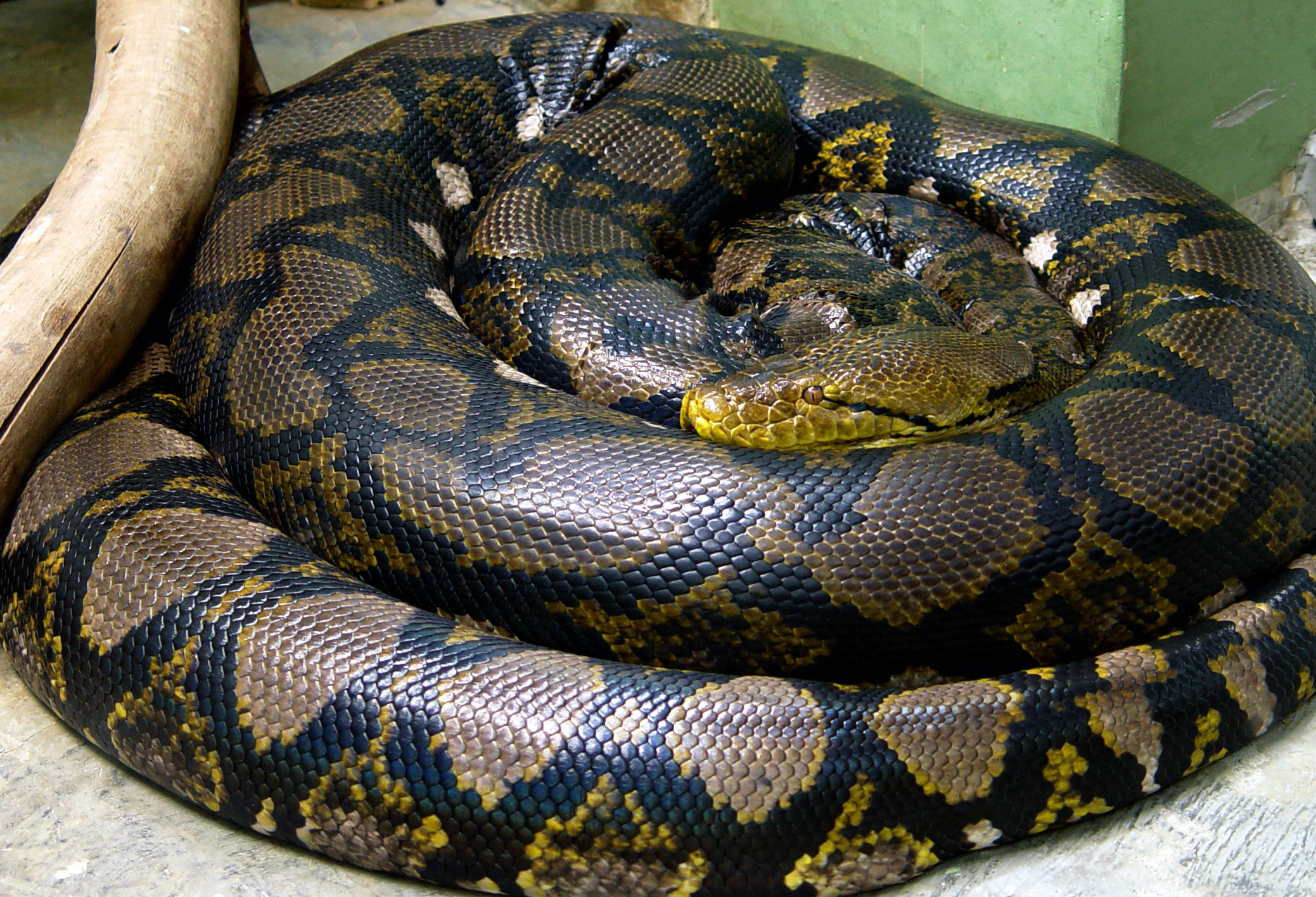
Photo: This photography was created by Mariluna . Other photos see here . · CC BY-SA 3.0
The reticulated python is the world's longest snake, a powerful constrictor with a striking net-like pattern and remarkable intelligence. It is a large-constrictor species for experienced keepers only, with serious safety, space, and legal considerations that make it unsuitable for beginners.
ℹ️
Educational only. KinStation content is reviewed by licensed veterinarians but cannot replace an in-person exam. Always consult a licensed veterinarian or board-certified specialist for diagnosis, treatment, or any decision affecting your pet's health.
🩺 Need expert help with your reticulated python?
Connect with a specialist near you or ask a licensed vet — never substitute online guidance for hands-on care in an emergency.
One of the longest snakes in the world. Mainland females commonly reach 4.5-6 m (15-20 ft) and can exceed 7 m in exceptional cases; males are smaller. Dwarf and
Lifespan
20–30 years
Social needs
solo
Native region
South and Southeast Asia, from Bangladesh and Myanmar through the Malay Peninsula to the Indonesian and Philippine archi
Origin
Old World
Climate
🌴 Tropical
Family
Pythonidae
Genus
Malayopython
Part of the Pythons
Pythons are non-venomous constrictors of the Old World tropics and subtropics, ranging from small, beginner-friendly species to giants. Many are hardy, long-lived, and popular in the pet trade, though the largest species carry serious legal and safety considerations.
From the minimum an animal needs to be kept humanely, up to the ideal setup. Bigger is almost always better — minimums are floors, not targets.
Photo coming soon
Minimum
Adult enclosure — expert only
8 × 3 × 2 ft (custom, ≈ 360 gal+)
Reticulated pythons are the world's longest snake (10–20+ ft). Minimum is a custom 8×3×2 (small adult) but mature animals need 12–16 ft enclosures or dedicated rooms. Two-keeper handling above 8 ft. Expert-only species.
Photo coming soon
Recommended
Walk-in enclosure
12 × 4 × 4 ft, custom built
Custom 12×4×4+ walk-in enclosure with industrial latches, multiple very large hides, basking 32 °C, cool 26 °C, humidity 60–80%. Often a dedicated reinforced room.
Photo coming soon
Ideal
Dedicated reptile room
Full room (≥ 16 × 6 × 8 ft)
Purpose-built reptile room with climbing structure, large water feature, varied substrate, and full thermal/humidity zoning. Only suitable for the most experienced and well-resourced keepers.
Life & growth stages
How this animal changes through its life — each stage often has its own care, diet and space needs.
Photo coming soon
Egg / Neonate
Most reptiles lay leathery- or hard-shelled eggs incubated by ambient warmth, though some snakes and lizards give live birth. Incubation temperature can influence sex and development in many species.
Photo coming soon
Hatchling
Hatchlings emerge as fully formed miniatures of the adult, often using an egg tooth to slit the shell. They are independent from birth but small and vulnerable, and may show brighter or different juvenile patterning.
Photo coming soon
Juvenile
Juveniles grow steadily, shedding their skin periodically as they enlarge. Coloration and proportions shift toward the adult form, and growth rate depends heavily on temperature, diet, and basking/UVB access.
Adult
Adults reach the species' full length and mass and become sexually mature. Many reptiles show sex differences in size, coloration, or features (such as larger heads, hemipenal bulges, or femoral pores), and continue to shed throughout life.
Color & pattern variants
Natural variants occur in the wild; selectively bred (man-made) variants were developed in captivity.
Island localities that mature at a fraction of mainland size (roughly 2.4-3.5 m); super-dwarfs such as Kalatoa and Kayaudi stay smallest. They are the only realistically keepable retics for most private homes.
Tip: Buy verified, well-documented locality stock — much of the trade is mislabeled or mainland-crossed, and a 'super-dwarf' carrying mainland genes can outgrow your enclosure to 5 m. Even a dwarf is a large constrictor; still hook-train and use two handlers for adults.
Selectively bred (man-made)
representative
Tiger / Super Tiger
CommonAdvanced
A co-dominant pattern morph that breaks the net-like reticulation into vertical striping; the homozygous Super Tiger is even cleaner and brighter. A foundational, healthy gene in retic breeding.
Tip: No health defect with Tiger or Super Tiger — the super form is fully viable, so it can be bred safely. Difficulty here is the species' size, strength, and feeding response, not the morph.
representative
Albino (Purple, Lavender, White)
CommonAdvanced
Recessive amelanistic morphs lacking dark pigment, sold as Purple, Lavender, and White albino lines; widely combined with other genes for designer retics. Vision is mildly light-sensitive but the morph carries no lethal trait.
Tip: Offer a shaded retreat and avoid harsh overhead lighting, as amelanistic eyes are more light-sensitive; otherwise care equals any retic — secure, lockable, escape-proof caging is the real priority.
representative
Genetic Stripe / Motley / Sunfire
UncommonAdvanced
Simple-recessive (Genetic Stripe, Motley) and co-dominant (Sunfire) pattern and color traits widely stacked in modern retic projects. All are health-neutral genes with no documented neurological issues.
Tip: These genes are safe to combine and breed; do not let designer looks distract from husbandry — a giant constrictor of any pattern needs radiant heat guarded against burns and a documented two-person handling plan.
Habitat & enclosure
Mainland animals are giants requiring custom, room-sized enclosures or a dedicated reptile room — a full-grown female needs an enclosure at least as long as the snake and deep enough to turn around, often 2.4-3.6 m (8-12 ft) long. Dwarf localities can be kept in large but more manageable PVC enclosures. Provide a warm side of 31-33 C (88-92 F) with a basking spot, an ambient cool side of 26-28 C (79-82 F), and humidity of 60-80%. A large, sturdy water container, secure hide(s), and absolutely escape-proof locking are essential; a strong adult will test every weakness in an enclosure. Two-person handling is the standard safety rule for any large adult.
Substrate
Cypress mulch, coconut husk, or aspen (kept dry) all work; cypress and coconut hold humidity well. Whatever the choice, it must be deep enough to absorb the very large waste these snakes produce and must be spot-cleaned promptly and fully replaced regularly. Avoid substrates that mold when damp, and never use cedar or pine, which are toxic to reptiles.
Equipment & setup
Use thermostatically controlled radiant heat (radiant heat panels or ceramic heat emitters) guarded against contact burns, paired with a reliable thermostat and digital thermometers/hygrometers. UVB is optional but low-level UVB benefits welfare. The single most important equipment consideration is a heavy-duty, lockable, escape-proof enclosure with secured doors. Long snake hooks, a snake bag/tube, and a documented two-person handling plan are basic safety equipment for adults.
Diet
An obligate carnivore and aggressive feeder. Juveniles take rats; adults take large rats, rabbits, and appropriately sized poultry roughly every 1-3 weeks depending on size and body condition. Feed thawed prey with long tongs from behind a barrier or using a clear feeding protocol, never by hand — retics have a strong feeding response and excellent food association. Avoid overfeeding; a lean, muscular retic is healthier and safer than an obese one, and power-feeding to maximize size is detrimental to welfare.
Behavior & temperament
Highly alert, intelligent, and food-motivated. Temperament varies enormously: many captive-bred retics, especially dwarf lines, become genuinely tractable, while others remain defensive. Regardless of disposition, the combination of size, strength, speed, and a powerful constricting drive makes a large retic potentially dangerous to humans, and fatal constriction incidents are documented. They learn routines quickly and can distinguish feeding cues. Use hook-training, controlled handling, and never handle a large adult alone — the standard is one experienced person per roughly 1.5 m (5 ft) of snake.
Health
Respiratory infections from cool or damp conditions, mites, scale rot, and mouth rot are the common ailments; their large size makes any infection harder and costlier to treat. Obesity from overfeeding stresses the organs and is widespread in captivity. Burns from unguarded heat elements are a risk given the animal's strength. Quarantine new animals, screen for parasites and snake-relevant viruses, and establish a relationship with an experienced reptile veterinarian before acquiring one — many vets will not treat giant constrictors.
Tips, DIY & hacks
Start by checking your local and national law before anything else — see the legality note below. In the United States the reticulated python was added to the Lacey Act injurious wildlife list in 2015, which restricts importation and (subject to ongoing litigation) interstate transport, and many states, counties, and municipalities ban or require permits for large constrictors. Choose a captive-bred dwarf or super-dwarf locality if you want a more manageable adult size. Hook-train from a young age to separate handling cues from feeding cues, and always work with a second experienced handler for large animals. Keep prey out of the room until you are ready to feed, feed from tongs behind a barrier, and never handle after presenting food. Plan for a 20-30 year commitment, the cost of large prey, and the difficulty of rehoming a giant snake before you buy.