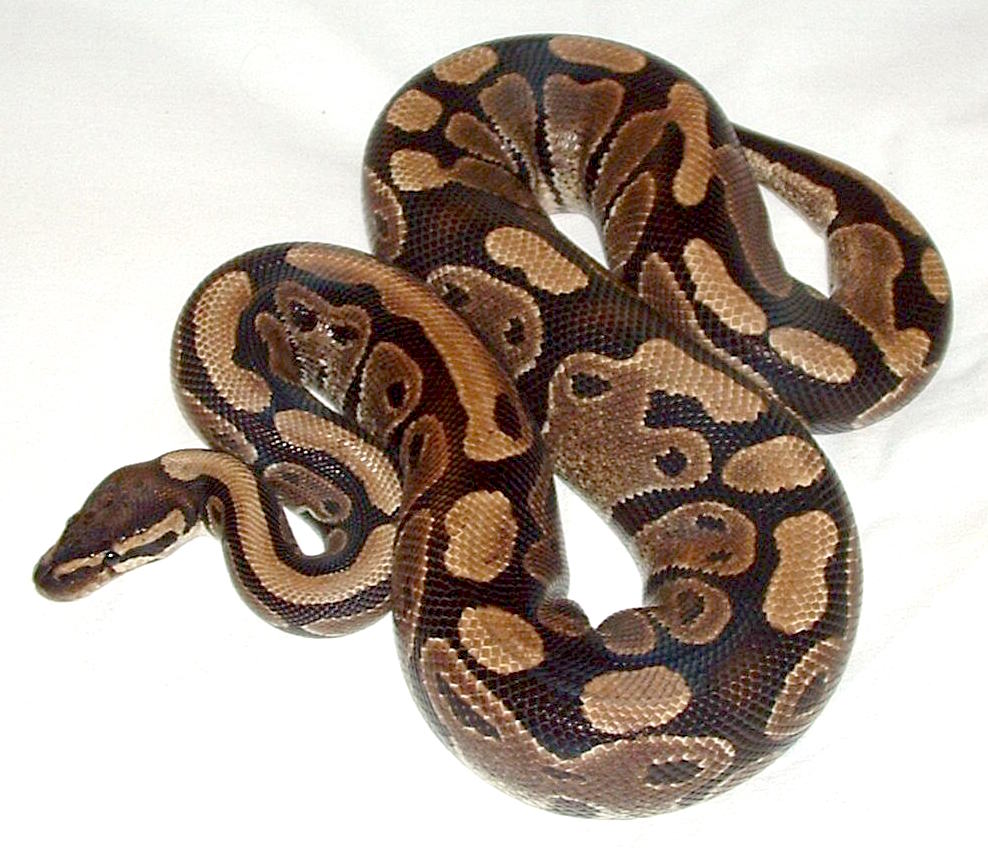
Ball pythons, named for their tendency to curl into a defensive ball, are West African snakes commonly kept as pets due to their generally calm temperament. They are long-lived and need consistent husbandry.
ℹ️
Educational only. KinStation content is reviewed by licensed veterinarians but cannot replace an in-person exam. Always consult a licensed veterinarian or board-certified specialist for diagnosis, treatment, or any decision affecting your pet's health.
🩺 Need expert help with your ball python?
Connect with a specialist near you or ask a licensed vet — never substitute online guidance for hands-on care in an emergency.
Adults 3–5 feet long; females typically larger than males.
Lifespan
20–30 years
Social needs
solo
Native region
Sub-Saharan West and Central Africa
Origin
Old World
Climate
🌴 Tropical
Family
Pythonidae
Genus
Python
Part of the Pythons
Pythons are non-venomous constrictors of the Old World tropics and subtropics, ranging from small, beginner-friendly species to giants. Many are hardy, long-lived, and popular in the pet trade, though the largest species carry serious legal and safety considerations.
Trevor Zoo at Millbrook School · Wikimedia Commons · CC BY 3.0
Habitat & space requirements
From the minimum an animal needs to be kept humanely, up to the ideal setup. Bigger is almost always better — minimums are floors, not targets.
Minimum
Adult enclosure
4 × 2 × 1.5 ft (≈ 40 gal)
Adult ball pythons need an enclosure at least as long as the snake, with a warm and cool hide of equal snugness, a thermal gradient, and ambient humidity control. Hatchlings prefer smaller, secure spaces.
MatthewHoobin / CC BY-SA 4.0 (Wikimedia Commons)
Photo coming soon
Recommended
Front-opening vivarium
4 × 2 × 2 ft, front-opening
A 4×2 PVC/front-opening vivarium with two hides, climbing branches, clutter for security, a large water bowl, and stable humidity. Front access reduces stress vs top-down handling.
Photo coming soon
Ideal
Bioactive enclosure
6 × 2 × 2 ft, bioactive
Larger bioactive setup with live plants, deep substrate, multiple hides at both ends, and branches. Enrichment and a strong gradient encourage exploration in this often under-stimulated species.
Life & growth stages
How this animal changes through its life — each stage often has its own care, diet and space needs.
Photo coming soon
Egg / Neonate
Most reptiles lay leathery- or hard-shelled eggs incubated by ambient warmth, though some snakes and lizards give live birth. Incubation temperature can influence sex and development in many species.
Hatchling
Hatchlings emerge as fully formed miniatures of the adult, often using an egg tooth to slit the shell. They are independent from birth but small and vulnerable, and may show brighter or different juvenile patterning.
Eclipse Exotics (WingedWolfPsion), CC BY-SA 3.0, via Wikimedia Commons
Photo coming soon
Juvenile
Juveniles grow steadily, shedding their skin periodically as they enlarge. Coloration and proportions shift toward the adult form, and growth rate depends heavily on temperature, diet, and basking/UVB access.
Adult
Adults reach the species' full length and mass and become sexually mature. Many reptiles show sex differences in size, coloration, or features (such as larger heads, hemipenal bulges, or femoral pores), and continue to shed throughout life.
Color & pattern variants
Natural variants occur in the wild; selectively bred (man-made) variants were developed in captivity.
Ball pythons are terrestrial West African snakes that spend much of their time in burrows and feel safest in a secure, enclosed space. Adults do well in a horizontally oriented enclosure of at least around four feet in length; front-opening PVC reptile cages and glass terrariums both work, provided they hold heat and humidity and latch securely, because snakes are escape artists. Floor space and security matter more than height for this ground-dwelling species.
A proper thermal gradient is essential, with a warm side and a cooler side maintained by thermostat-controlled heating so the snake can choose its temperature. Humidity should be kept in a moderate range and raised during shedding, supported by a humidity-retaining substrate such as cypress mulch or coconut husk and a sturdy water bowl large enough for occasional soaking. A hygrometer and thermometer (ideally probe-based) take the guesswork out of monitoring.
Provide at least two snug hides — one on the warm side and one on the cool side — so the snake never has to choose between security and the right temperature. Ball pythons value tight, dark retreats; a snake that always sits exposed may not have adequate hiding. Clutter such as artificial plants and branches adds security and enrichment for what can otherwise be a shy animal.
Substrate
Cypress mulch, coco husk/fiber, or aspen all work well; cypress and coco hold humidity better, while aspen must be kept from getting damp to avoid mold and scale rot. Provide enough depth for light burrowing and easy spot-cleaning of waste.
Equipment & setup
Maintain a warm side of 88-92 F (31-33 C) and a cool side around 78-80 F (25-27 C) using a thermostat-controlled under-tank heater or overhead radiant panel, with ambient humidity of 55-65% (raised to 70%+ during sheds). A low-level UVB lamp is beneficial; provide at least two snug, identical hides (warm and cool) so the snake never has to choose between security and temperature.
Diet
Ball pythons are carnivores that eat whole prey, and in captivity the standard, and generally most humane and practical, approach is feeding appropriately sized frozen-thawed rodents rather than live prey, which can injure the snake. Prey size is chosen to be proportionate to the snake's girth, and feeding frequency decreases with age — younger snakes eat more often than adults, which may eat only every week or two or even less.
Water should always be available in a clean bowl. After a meal, the snake should be left undisturbed to digest, and handling is best avoided for a day or more to prevent regurgitation. Feeding in the snake's enclosure is standard, though some keepers have preferences here.
Ball pythons are notorious for going off food, sometimes for weeks or even months, particularly in the cooler months or during breeding season. In an otherwise healthy snake maintaining its weight, a hunger strike is often not an emergency and is a well-known quirk of the species. That said, prolonged refusal accompanied by weight loss, or any other sign of illness, warrants a check of husbandry and a veterinary consult.
Behavior & temperament
The ball python earns its name from its signature defense: when frightened it curls into a tight ball, tucking its head in the center, rather than striking. This generally docile, non-aggressive temperament is a big part of why the species is so popular. They are crepuscular to nocturnal and solitary, and like all snakes should be housed individually.
Most ball pythons tolerate calm, regular handling well once settled in, and gentle handling can help keep them accustomed to people. There are sensible times to leave a snake alone, however: during shedding (when their eyes cloud over and vision is poor), for a day or more after feeding, and whenever the snake is balled up, hissing, or otherwise signaling stress. Reading these cues prevents both stress and the occasional defensive bite.
Ball pythons are not especially active or 'interactive' compared with some lizards, and a shy, retreat-loving disposition is normal rather than a problem. A secure enclosure with good hides actually encourages a snake to be more relaxed and visible over time. Sudden changes in behavior — persistent restlessness, refusing to settle, or unusual posturing — can indicate a husbandry problem worth investigating.
Health
Ball pythons are long-lived, frequently reaching their twenties or beyond, so they are a multi-decade commitment, and consistent husbandry is the best preventive care. A reptile-experienced veterinarian is the right resource for this species, and an annual exam helps catch problems early.
Many health issues are husbandry-driven. Respiratory infections are often linked to temperatures that are too low or chronically poor conditions; retained shed (dysecdysis) typically reflects insufficient humidity; and scale rot or skin infection can arise from substrate that is too wet or unhygienic. Snakes can also carry mites and, like other boas and pythons, are susceptible to inclusion body disease, a serious viral condition.
Warning signs that warrant veterinary evaluation include wheezing, open-mouth breathing, or mucus or bubbling around the mouth and nose (possible respiratory infection); prolonged food refusal with weight loss; discolored, blistered, or ulcerated belly scales; retained shed or stuck eye caps; visible mites; and any abnormal posture or neurological signs. As always, treatment should be guided by a veterinarian rather than over-the-counter products.
Tips, DIY & hacks
Ball pythons are shy ambush feeders, so offer appropriately sized prey (roughly the width of the snake) in the evening and reduce stress with plenty of cover, including PVC hides and clutter like silk or live plants. If a snake refuses food, check temps, humidity, and hide security first, as fasting is common and rarely an emergency in a healthy adult.
Origin & history
The ball python (Python regius) is native to the grasslands and forest edges of West and Central Africa, where it shelters in rodent burrows and termite mounds. Its calm temperament, manageable adult size, and willingness to breed in captivity made it one of the most widely kept pet snakes in the world. The species' alternate name, 'royal python,' reflects a tradition in which the snakes were associated with royalty in parts of their native range.
Ball pythons have become the centerpiece of reptile 'morph' breeding, with selective breeding producing a vast and ever-growing catalog of color and pattern mutations — from albino and pastel to clown, piebald, and countless combinations — that drives a large hobbyist and breeding community. While captive breeding is now widespread, the species' popularity has also raised ongoing conservation and welfare discussions around wild collection in its native range.
Anecdotes & owner lore
Community experience and cultural notes — not veterinary advice. Every animal is an individual; treat these as colour, not care instructions.
The defensive 'ball' that gives the species its name is the first thing every new keeper learns to expect: a nervous ball python will tuck into a tidy, head-hidden coil and simply wait out the scary moment, a strategy so unaggressive that it has helped make these snakes a favorite first serpent. Owners also swap stories about the infamous ball-python hunger strike — a snake calmly declining dinner for weeks while staying perfectly healthy and plump, leaving its keeper far more anxious than the snake.
Much of ball-python culture revolves around morphs. Breeders and hobbyists trade and collect color and pattern combinations with the enthusiasm of any pedigree pursuit, and a striking new morph can become a minor celebrity in the community. Beyond the genetics, keepers grow fond of individual quirks: the slow, exploratory 'periscoping' as a snake lifts its head to survey a new space, the favorite hide a snake returns to without fail, and the gentle, deliberate way a settled ball python will wind itself around a warm hand — a reminder of why a famously shy snake has won so many devoted keepers.
Common ailments
Respiratory infection — common — Often driven by inadequate enclosure temperatures.
Retained shed (dysecdysis) — common
Scale rot (blister disease) — common
Inclusion body disease (IBD) — rare
Reviewed and signed off by: KinStation Editorial - pre-launch draft (pending DVM review)