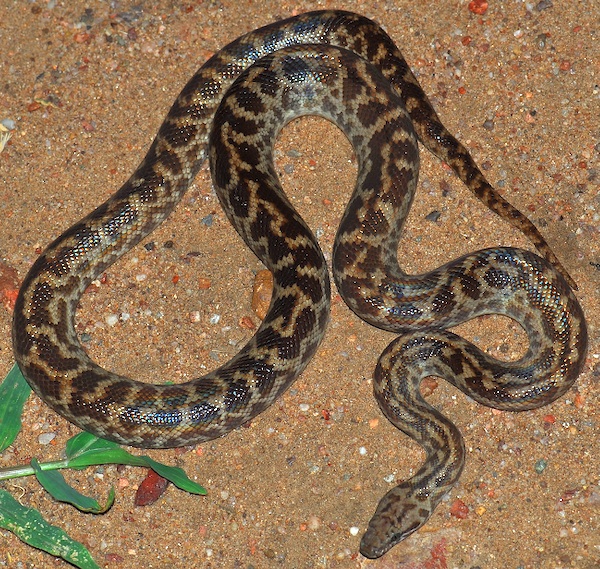
A small, docile Australian python that is widely regarded as one of the best beginner pythons thanks to its manageable size, hardy nature, and calm temperament. Captive-bred and long-lived, it makes an excellent first snake for keepers who can commit to its multi-decade lifespan.
ℹ️
Educational only. KinStation content is reviewed by licensed veterinarians but cannot replace an in-person exam. Always consult a licensed veterinarian or board-certified specialist for diagnosis, treatment, or any decision affecting your pet's health.
🩺 Need expert help with your spotted python?
Connect with a specialist near you or ask a licensed vet — never substitute online guidance for hands-on care in an emergency.
Small python; typically 3-4.5 ft (100-140 cm), the largest of the Antaresia
Lifespan
20–30 years
Social needs
solo
Native region
Northeastern Australia (eastern Queensland) and southern New Guinea, in dry forest, rocky outcrops, and around caves
Origin
Old World
Climate
⛅ Subtropical
Family
Pythonidae
Genus
Antaresia
Part of the Pythons
Pythons are non-venomous constrictors of the Old World tropics and subtropics, ranging from small, beginner-friendly species to giants. Many are hardy, long-lived, and popular in the pet trade, though the largest species carry serious legal and safety considerations.
From the minimum an animal needs to be kept humanely, up to the ideal setup. Bigger is almost always better — minimums are floors, not targets.
Photo coming soon
Minimum
Adult enclosure
3 × 1.5 × 1.5 ft (≈ 30 gal)
Spotted pythons (Antaresia maculosa) are small (3–4 ft) Australian pythons. Minimum is a 3×1.5×1.5 with two hides, basking 32 °C, cool 24 °C, humidity 50–60%. Very docile.
Photo coming soon
Recommended
Front-opening vivarium
4 × 2 × 1.5 ft, naturalistic
A 4×2×1.5 with low branches, hides, dig substrate, and clutter. Spotted pythons are calm active explorers — provide both ground and low climbing opportunities.
Photo coming soon
Ideal
Bioactive Australian forest
4 × 2 × 2 ft, bioactive
Bioactive Queensland forest enclosure with deep substrate, varied hardscape, climbing structure, and live plants. Mimics their natural rocky outcrop habitat.
Life & growth stages
How this animal changes through its life — each stage often has its own care, diet and space needs.
Photo coming soon
Egg / Neonate
Most reptiles lay leathery- or hard-shelled eggs incubated by ambient warmth, though some snakes and lizards give live birth. Incubation temperature can influence sex and development in many species.
Photo coming soon
Hatchling
Hatchlings emerge as fully formed miniatures of the adult, often using an egg tooth to slit the shell. They are independent from birth but small and vulnerable, and may show brighter or different juvenile patterning.
Photo coming soon
Juvenile
Juveniles grow steadily, shedding their skin periodically as they enlarge. Coloration and proportions shift toward the adult form, and growth rate depends heavily on temperature, diet, and basking/UVB access.
Adult
Adults reach the species' full length and mass and become sexually mature. Many reptiles show sex differences in size, coloration, or features (such as larger heads, hemipenal bulges, or femoral pores), and continue to shed throughout life.
Color & pattern variants
Natural variants occur in the wild; selectively bred (man-made) variants were developed in captivity.
Natural
representative
Normal / wild-type
The standard form: a tan to reddish-brown body covered in irregular darker brown blotches, variable by locality.
representative
Granite
A naturally occurring pattern morph in which the blotches break up into a finer, speckled 'granite' appearance, selectively bred in captivity.
Selectively bred (man-made)
representative
Albino
A recessive amelanistic morph lacking dark pigment, producing yellow-and-white patterning with red eyes; fixed and propagated in captive breeding lines.
Habitat & enclosure
A terrestrial, partly crepuscular python that does well in a secure front-opening enclosure. A single adult needs a minimum of about 36"L x 18"W x 18"H (a 3 ft / ~75 L footprint), though larger is always welcomed and some climbing opportunity is appreciated. Provide a thermal gradient with a warm/basking zone of 88-90F (31-32C) and a cool end around 75-78F (24-26C), with a modest nighttime drop. Maintain humidity around 50-60%, raising it temporarily during sheds. Two snug hides (one over the warm end, one over the cool end) are essential for this secretive species. Supplemental low-level UVB is beneficial though not strictly required.
Substrate
Use a substrate that holds light humidity and allows occasional burrowing, such as aspen (kept dry), cypress mulch, coconut husk, or a coconut/orchid-bark blend. Spot-clean promptly and do full changes as needed. Avoid cedar and pine, whose oils are toxic to reptiles, and avoid chronically soggy bedding to prevent scale rot.
Equipment & setup
Secure front-opening or locking-lid enclosure; under-tank heat mat or low-wattage overhead heat source controlled by a thermostat (mandatory to prevent burns); digital thermometer and hygrometer at both ends; two tight hides; sturdy water bowl large enough to soak in; optional climbing branch; optional low-output UVB.
Diet
A constrictor and rodent feeder. Hatchlings start on appropriately sized pinky mice and graduate through fuzzies to adult mice or small rats as they grow; prey should be roughly the width of the snake's widest body point. Feed hatchlings every 5-7 days, juveniles weekly, and adults every 10-14 days to avoid obesity. Frozen-thawed prey is strongly recommended over live for safety. In the wild this species also takes small reptiles, birds, and bats, but captive rodents fully meet its needs.
Behavior & temperament
Generally calm, curious, and tractable once settled, which makes it a favorite first python. Hatchlings can be nippy and food-motivated but reliably tame down with gentle, regular handling. Most active around dusk and night. Non-venomous and kills prey by constriction. Its small size means even a defensive bite is minor, and well-started captive-bred animals handle readily.
Health
Hardy overall. Watch for respiratory infections (wheezing, open-mouth breathing, mucus) from cool or overly damp conditions, retained shed and stuck eyecaps from low humidity, scale rot from chronically wet substrate, obesity from overfeeding, and external mites. Quarantine new animals and keep husbandry within range. A good feeding response, clean full sheds, and clear vent/eyes are signs of health; respiratory or persistent feeding problems warrant a reptile vet.
Tips, DIY & hacks
Buy captive-bred, as this species is abundant and well-established in the hobby. Always run heat through a thermostat. Use a small hook or tongs to break feeding-response association during handling of food-driven hatchlings. Feed frozen-thawed prey warmed to body temperature. Give new arrivals a week or two undisturbed before handling, and plan for a 20-30 year commitment.