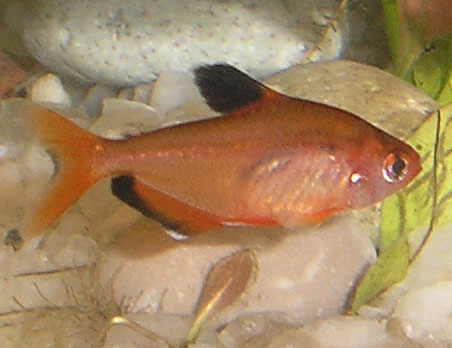
The serpae tetra is a striking deep-red characin with a dark shoulder spot and black-tipped fins, popular for its bold colour and hardiness. It is, however, a notorious fin-nipper and is best kept in a large shoal so its semi-aggressive squabbling stays directed within the group rather than at tankmates. A long-finned 'red minor' form is widely traded.
ℹ️
Educational only. KinStation content is reviewed by licensed veterinarians but cannot replace an in-person exam. Always consult a licensed veterinarian or board-certified specialist for diagnosis, treatment, or any decision affecting your pet's health.
🩺 Need expert help with your serpae tetra?
Connect with a specialist near you or ask a licensed vet — never substitute online guidance for hands-on care in an emergency.
Upper Paraguay and Guaporé river basins, South America (Brazil, Bolivia, Paraguay, Argentina)
Origin
New World
Climate
🌴 Tropical
Water type
💧 Freshwater
Family
Characidae
Genus
Hyphessobrycon
Part of the Tetras
Small, often brightly colored characin fishes popular as peaceful shoaling community aquarium fish. Tetras are kept in groups, appreciate soft, slightly acidic water and planted tanks, and range from tiny nano species to larger schooling fish.
From the minimum an animal needs to be kept humanely, up to the ideal setup. Bigger is almost always better — minimums are floors, not targets.
Photo coming soon
Minimum
Schooling tank
20 gal long / 75 L (school of 6+)
Hyphessobrycon eques reaches 5 cm and is a notorious fin-nipper — schools of 6+ minimum to disperse aggression. Soft warm water (24–28 °C), planted, gentle flow.
Recommended
Planted community
29–40 gal / 110–150 L
Larger school of 10+ further reduces nipping. Avoid long-finned tankmates (angels, gouramis). Driftwood and dim light bring out blood-red colour.
Faucon / CC BY-SA 2.5 (Wikimedia Commons)
Photo coming soon
Ideal
Amazonian biotope
55 gal+ / 200 L+ biotope
Long blackwater biotope with large school, leaf litter, and selected tankmates (corys, hatchets). Natural schooling and reduced aggression.
Life & growth stages
How this animal changes through its life — each stage often has its own care, diet and space needs.
Photo coming soon
Egg
Fish eggs are small, translucent spheres, often laid in clutches on plants, substrate, or in a nest — or carried/brooded by a parent in livebearing and mouth-brooding species. A dark eye spot and the curled embryo become visible inside as development progresses.
Photo coming soon
Fry
Newly hatched fry are tiny and semi-transparent, frequently still carrying a yolk sac that fuels them before they feed freely. They lack full fin structure and adult coloration, staying near cover until they can swim and forage on their own.
Photo coming soon
Juvenile
Juveniles look like miniature adults but with developing fins and muted or different markings; many species shift pattern and color as they mature. Growth is rapid at this stage given clean water and steady feeding.
Adult
Adults show the species' full size, finnage, and mature coloration, and are sexually mature. Many fish develop sex-specific differences in size, color, or fin shape, which can intensify during breeding.
Color & pattern variants
Natural variants occur in the wild; selectively bred (man-made) variants were developed in captivity.
Keep a shoal of at least 6-8 (the more the better for diffusing nipping) in a tank of 75 litres (20 gal) or larger. It is adaptable: temperature 22-27 °C (72-81 °F), pH 5.0-7.8, soft to moderately hard (GH up to ~25). Provide moderate flow and a layout with open swimming space plus planted or wood cover to break sightlines.
This species is tolerant of a wide parameter range, but stable, well-maintained water keeps colour strong and aggression manageable.
Substrate
Dark sand or fine gravel deepens the red body colour. Driftwood, leaf litter and plants provide cover that helps break up aggression among the group.
Equipment & setup
A standard filter (sponge, HOB or canister) and a heater are sufficient. Moderate flow and subdued lighting with some plant cover suit it; CO2 is optional and only for planted-tank goals.
Diet
Easily fed omnivore. Takes flake and micro-pellets eagerly; supplement with frozen and live foods such as bloodworm, daphnia and brine shrimp. A varied diet intensifies the red coloration.
Behavior & temperament
Lively, semi-aggressive shoaler and a persistent fin-nipper. Keep in a large group to spread out its nipping behaviour, and avoid slow-moving or long-finned tankmates such as bettas, gouramis, angelfish and guppies. Best matched with fast, robust similarly sized fish. Small groups tend to bully each other and other fish.
Health
Hardy and disease-resistant overall, but prone to ich and bacterial infections under stress or poor water. Quarantine new fish and maintain low nitrates with routine water changes.
Tips, DIY & hacks
Always buy the biggest shoal you can afford and avoid keeping long-finned, slow tankmates to minimise fin-nipping problems. Dark substrate and tannin-stained water bring out the deepest blood-red. It spawns readily in soft, acidic water with fine-leaved plants; remove adults after spawning as they eat eggs.