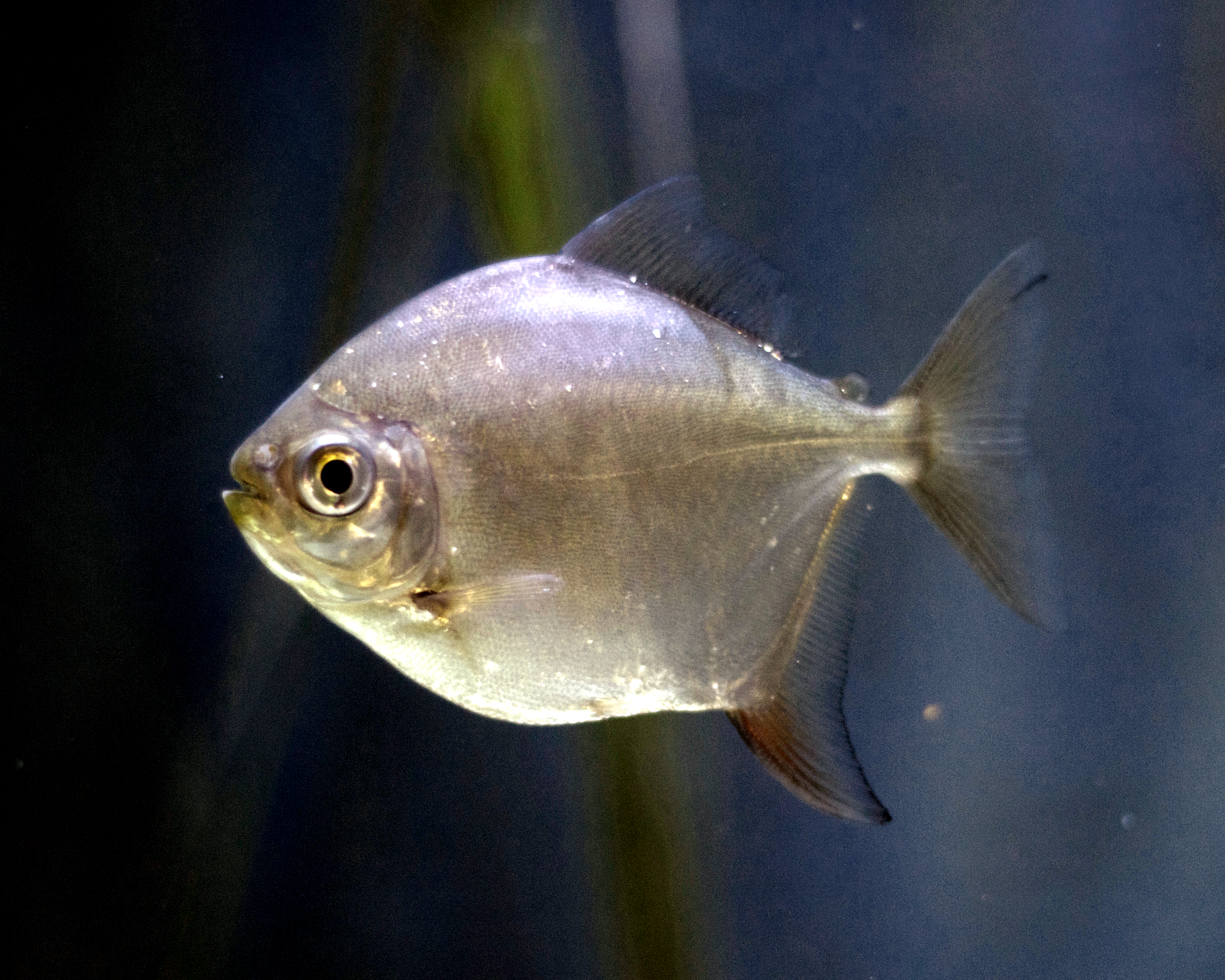
The silver dollar is a large, disc-shaped, silvery characin from the same family as piranhas and pacus, but a peaceful, herbivorous shoaling fish. Its tall, coin-bright body and tight schooling behaviour make a group an impressive centrepiece for big tanks. It is best known among keepers for one trait: it will eat almost any soft aquarium plant, so it is usually kept in robustly hardscaped or plastic-planted setups.
ℹ️
Educational only. KinStation content is reviewed by licensed veterinarians but cannot replace an in-person exam. Always consult a licensed veterinarian or board-certified specialist for diagnosis, treatment, or any decision affecting your pet's health.
🩺 Need expert help with your silver dollar?
Connect with a specialist near you or ask a licensed vet — never substitute online guidance for hands-on care in an emergency.
Amazon and Tapajós river basins, South America (Brazil, Guyana)
Origin
New World
Climate
🌴 Tropical
Water type
💧 Freshwater
Family
Serrasalmidae
Genus
Metynnis
Part of the Tetras
Small, often brightly colored characin fishes popular as peaceful shoaling community aquarium fish. Tetras are kept in groups, appreciate soft, slightly acidic water and planted tanks, and range from tiny nano species to larger schooling fish.
From the minimum an animal needs to be kept humanely, up to the ideal setup. Bigger is almost always better — minimums are floors, not targets.
Photo coming soon
Minimum
Long schooling tank
75 gal / 280 L (school of 5+)
Metynnis species reach 15 cm and shoal in mid-water. Group of 5+, 4-ft+ length, ROBUST plants only (they eat soft plants). Soft warm water (24–28 °C).
Photo coming soon
Recommended
Larger long community
100–125 gal / 380–470 L
School of 6–8 in a long tank with anubias/java fern only and driftwood structure. Pair with similarly sized peaceful tankmates (larger tetras, severums).
Photo coming soon
Ideal
Amazonian biotope
180 gal+ / 680 L+ biotope
Large biotope with deep sand, driftwood, and a school of 10+. Tight schooling display rivals any marine fish for impact.
Life & growth stages
How this animal changes through its life — each stage often has its own care, diet and space needs.
Photo coming soon
Egg
Fish eggs are small, translucent spheres, often laid in clutches on plants, substrate, or in a nest — or carried/brooded by a parent in livebearing and mouth-brooding species. A dark eye spot and the curled embryo become visible inside as development progresses.
Photo coming soon
Fry
Newly hatched fry are tiny and semi-transparent, frequently still carrying a yolk sac that fuels them before they feed freely. They lack full fin structure and adult coloration, staying near cover until they can swim and forage on their own.
Photo coming soon
Juvenile
Juveniles look like miniature adults but with developing fins and muted or different markings; many species shift pattern and color as they mature. Growth is rapid at this stage given clean water and steady feeding.
Adult
Adults show the species' full size, finnage, and mature coloration, and are sexually mature. Many fish develop sex-specific differences in size, color, or fin shape, which can intensify during breeding.
Habitat & enclosure
Keep a shoal of at least 5-6 in a large tank of 300 litres (75 gal) or more, given the adult size and active swimming. Provide warm, soft to moderately hard, slightly acidic to neutral water: temperature 24-28 °C (75-82 °F), pH 5.5-7.5, GH 4-18. Moderate flow and a tall tank with open swimming space suit this deep-bodied schooler.
These are nervous, fast fish that may dash and injure themselves if startled, so provide a secure, dimly lit tank with a dark background and avoid sudden disturbances.
Substrate
Fine sand or smooth gravel works well; a dark substrate and background calm these nervous fish. Use sturdy driftwood and rocks for an aquascape, since most live plants will be eaten.
Equipment & setup
A powerful canister or oversized filter is needed for this large, messy schooler, alongside a heater rated for the big tank volume. Moderate flow and subdued lighting reduce skittishness; a secure lid is important as startled fish can jump.
Diet
Primarily herbivorous. Base the diet on vegetable matter: blanched spinach, lettuce, courgette, cucumber, peas, spirulina flake and algae/veggie wafers, with only occasional small meaty foods. A high-plant diet keeps them healthy and reduces them grazing aquascape plants.
Behavior & temperament
Peaceful, gregarious shoaler despite its piranha relatives; it must be kept in a group or it becomes stressed and skittish. Suitable tankmates include other peaceful large community fish such as larger characins, peaceful cichlids (e.g. severums), larger barbs, plecos and robust catfish. It is a determined plant-eater, so use hardy unpalatable plants, plastic plants, or a hardscape-only layout.
Health
Hardy in clean, spacious tanks but prone to ich and stress-related issues, and to physical injury from panicked dashing in cramped or brightly lit tanks. Maintain strong filtration and good water quality given the bioload; quarantine new stock and keep the group calm.
Tips, DIY & hacks
Choose tankmates and decor for a big, calm tank: dim lighting, dark background and ample swimming length stop the group dashing into glass and decor. Feed plenty of vegetables to satisfy the herbivorous appetite and spare any plants you do keep. Sexually mature males develop a reddish anal-fin edge, useful for forming breeding groups.