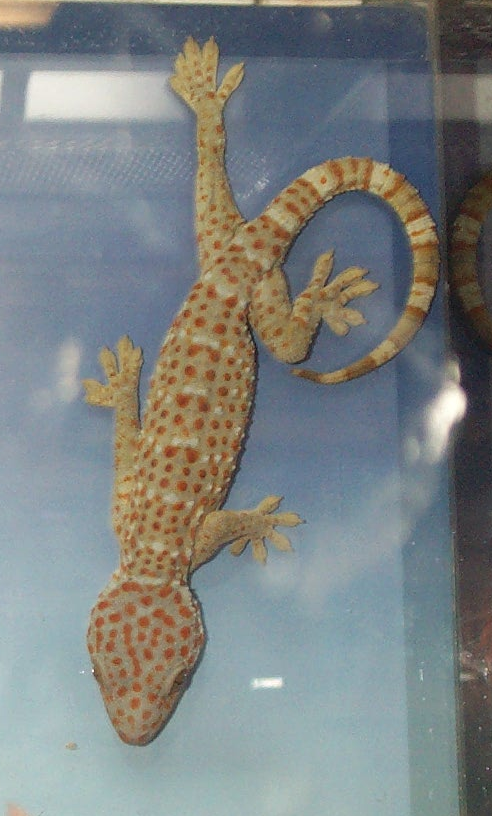
A large, vividly blue-and-orange-spotted arboreal gecko from Southeast Asia, famous for its loud 'to-kay' call and a notoriously bold, bite-prone temperament best suited to experienced keepers.
ℹ️
Educational only. KinStation content is reviewed by licensed veterinarians but cannot replace an in-person exam. Always consult a licensed veterinarian or board-certified specialist for diagnosis, treatment, or any decision affecting your pet's health.
🩺 Need expert help with your tokay gecko?
Connect with a specialist near you or ask a licensed vet — never substitute online guidance for hands-on care in an emergency.
One of the largest geckos: adults 25-35 cm (10-14 in) total length; males larger than females.
Lifespan
10–15 years
Social needs
solo
Native region
Southeast Asia and the Indo-Pacific (Northeast India through Indonesia)
Origin
Old World
Climate
🌴 Tropical
Family
Gekkonidae
Genus
Gekko
Part of the Geckos
Geckos range from desert ground-dwellers to humid cave and forest specialists; eyelid geckos like Goniurosaurus and leopard geckos have movable eyelids and are largely terrestrial.
From the minimum an animal needs to be kept humanely, up to the ideal setup. Bigger is almost always better — minimums are floors, not targets.
Photo coming soon
Minimum
Large arboreal terrarium
24 × 18 × 36 in (≈ 65 gal)
Tokays are large (up to 14 in) defensive arboreal geckos. Single adult needs at least a 24×18×36 with thick cork rounds, branches, and dense cover. Day 26–30 °C, humidity 60–80%. Not a handling species.
Photo coming soon
Recommended
Tall planted vivarium
36 × 18 × 36 in, planted
A 36×18×36 planted vertical enclosure with cork hides, broad-leaf plants, and multiple territory zones. Low UVB. Tokays bite hard — minimal handling, observation animal.
Photo coming soon
Ideal
Bioactive forest vivarium
48 × 24 × 48 in, bioactive
Bioactive Southeast Asian forest enclosure with cork mosaics, live plants, cleanup crew, and natural day-night cycle. Captive-bred only — wild import has been heavy.
Life & growth stages
How this animal changes through its life — each stage often has its own care, diet and space needs.
Photo coming soon
Egg / Neonate
Most reptiles lay leathery- or hard-shelled eggs incubated by ambient warmth, though some snakes and lizards give live birth. Incubation temperature can influence sex and development in many species.
Photo coming soon
Hatchling
Hatchlings emerge as fully formed miniatures of the adult, often using an egg tooth to slit the shell. They are independent from birth but small and vulnerable, and may show brighter or different juvenile patterning.
Photo coming soon
Juvenile
Juveniles grow steadily, shedding their skin periodically as they enlarge. Coloration and proportions shift toward the adult form, and growth rate depends heavily on temperature, diet, and basking/UVB access.
Adult
Adults reach the species' full length and mass and become sexually mature. Many reptiles show sex differences in size, coloration, or features (such as larger heads, hemipenal bulges, or femoral pores), and continue to shed throughout life.
Color & pattern variants
Natural variants occur in the wild; selectively bred (man-made) variants were developed in captivity.
Provide a tall, well-ventilated arboreal enclosure of at least 18 x 18 x 24 in (45 x 45 x 60 cm) for one adult, larger for a proven pair, oriented vertically with abundant cork bark, bamboo, and broad-leaved plants. As a powerful climber with strong adhesive toe pads, a tokay needs secure climbing surfaces, multiple elevated hides, and visual barriers to feel secure and reduce defensive aggression. A moisture-retaining substrate such as coco fiber suits the high humidity required.
Maintain a daytime gradient of about 78-88F (26-31C) with a basking area near 90F (32C) and a nighttime drop into the low 70sF. Keep humidity high, around 60-80%, with daily misting and good airflow to avoid stagnation. Nocturnal by nature, tokays do not strictly require UVB, though low-level UVB plus dietary D3 supports bone health.
Substrate
Bioactive coconut fiber/orchid-bark soil mix holds humidity well and supports live plants; sphagnum moss in hide areas boosts local humidity for shedding. Avoid loose sand and any substrate that dries out the enclosure.
Equipment & setup
Use a tall, well-planted arboreal terrarium with cork bark, bamboo, and dense foliage for climbing and cover; provide 78-88F ambient with a low-wattage basking spot and a nighttime drop. Maintain 60-80% humidity via daily misting or an automatic mister, plus low-level UVB (5%) and a shallow water dish.
Diet
An aggressive insectivore that takes a varied diet of appropriately sized crickets, dubia roaches, locusts, and superworms; large adults may occasionally take a pinky mouse, though this should be infrequent. Feed juveniles every 1-2 days and adults every 2-3 days, offering prey no wider than the gecko's head.
Gut-load feeders and dust with calcium (plus D3 if UVB is absent) at most feedings, with a multivitamin once or twice weekly. Provide water via misting and a shallow dish; many tokays prefer to lap droplets off leaves and decor.
Behavior & temperament
Bold, territorial, and defensive: a cornered tokay will gape, lunge, and deliver a strong, tenacious bite that can break skin, and wild-caught individuals are especially aggressive. They are not a 'handling' pet; they are best appreciated as a display animal, and captive-bred babies socialized with patience are far more manageable than imports.
They are highly vocal, especially males, producing the loud 'to-kay' bark for which they are named, plus croaks and hisses. Enrichment comes from vertical complexity, secure hides, and a varied insect diet; house singly except for a carefully introduced, well-fed breeding pair, as same-sex pairs and crowded conditions trigger serious fighting.
Health
Wild-caught tokays (still common in the trade) frequently carry internal parasites, mites, and stress-related illness, so a veterinary fecal exam, deworming, and quarantine are strongly advised; choosing captive-bred animals avoids most of these problems. Husbandry issues include metabolic bone disease from poor supplementation, retained shed from low humidity, and respiratory infection from cold, damp, poorly ventilated setups.
Watch for mouth rot, weight loss, labored breathing or mucus (signs of respiratory infection), and tail loss from rough handling. Bites are a keeper-safety concern more than a health one for the gecko, but reinforce the need to avoid restraint. A reptile veterinarian should assess any animal with chronic inappetence or respiratory signs.
Tips, DIY & hacks
Tokays are notoriously bold and will bite hard, so use long feeding tongs and a hook/box transfer method rather than handling. Heavy plant cover and multiple cork-tube hides reduce stress; mist in the evening since they are nocturnal and lick water droplets off leaves and glass.