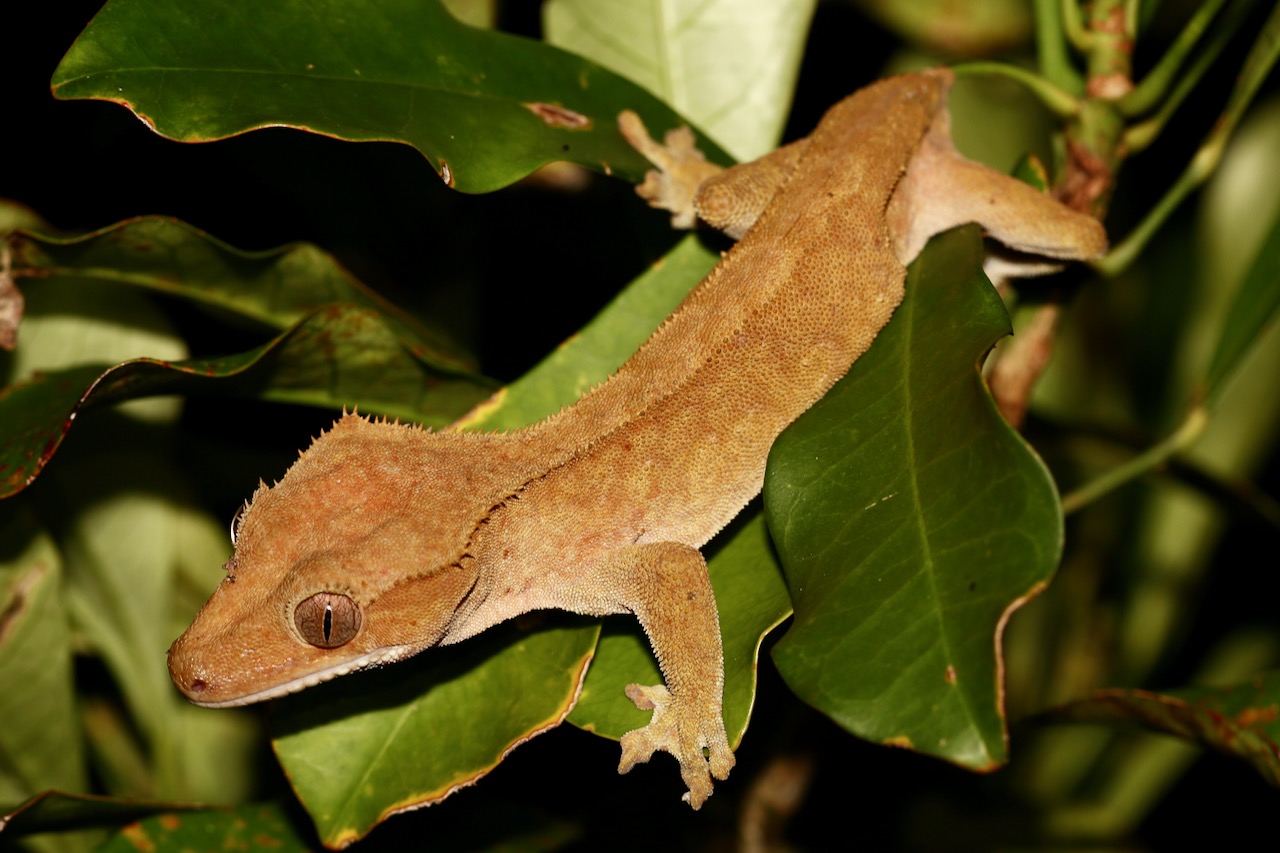
Crested geckos are arboreal nocturnal lizards from New Caledonia, kept as pets in vast color and pattern morphs. Their tolerance of room-temperature husbandry and complete commercial diets have made them one of the most beginner-friendly arboreal reptiles.
ℹ️
Educational only. KinStation content is reviewed by licensed veterinarians but cannot replace an in-person exam. Always consult a licensed veterinarian or board-certified specialist for diagnosis, treatment, or any decision affecting your pet's health.
🩺 Need expert help with your crested gecko?
Connect with a specialist near you or ask a licensed vet — never substitute online guidance for hands-on care in an emergency.
Geckos range from desert ground-dwellers to humid cave and forest specialists; eyelid geckos like Goniurosaurus and leopard geckos have movable eyelids and are largely terrestrial.
From the minimum an animal needs to be kept humanely, up to the ideal setup. Bigger is almost always better — minimums are floors, not targets.
Photo coming soon
Minimum
Adult arboreal terrarium
18 × 18 × 24 in (≈ 34 gal)
A single adult needs a vertically oriented enclosure at least 18 × 18 × 24 inches with plenty of climbing branches, cork bark, and broad-leaved (live or silk) plants for cover and security. Keep it cool at roughly 22–26 °C with no basking heat, mist nightly so humidity peaks around 70–80 % and drops to 50–60 % by day, and provide a planted bioactive or paper-towel substrate; never house two males together as they will fight.
Photo coming soon
Recommended
Planted bioactive terrarium
18 × 18 × 36 in
A taller 18 × 18 × 36-inch enclosure gives far more vertical climbing space, which is how cresties naturally live. Furnish it bioactively with a drainage layer, live pothos and ferns, dense cork and vine networks, 22–26 °C temperatures, and nightly misting for a 70–80 % humidity spike that dries back to 50–60 % between sprays; add a low-level UVB source (UVI around 1–2) for better long-term health.
Photo coming soon
Ideal
Tall bioactive rainforest vivarium
24 × 24 × 48 in or larger
A large, heavily planted bioactive vivarium of 24 × 24 × 48 inches or more lets a crested gecko range, leap, and forage as it would in New Caledonian forest. Include a custom misting/fogging system for a natural humidity cycle, abundant live plants, layered branches, low UVB (UVI 1–2), and a cleanup crew of springtails and isopods; this is the best welfare outcome and most natural setup.
Life & growth stages
How this animal changes through its life — each stage often has its own care, diet and space needs.
Photo coming soon
Egg / Neonate
Most reptiles lay leathery- or hard-shelled eggs incubated by ambient warmth, though some snakes and lizards give live birth. Incubation temperature can influence sex and development in many species.
Photo coming soon
Hatchling
Hatchlings emerge as fully formed miniatures of the adult, often using an egg tooth to slit the shell. They are independent from birth but small and vulnerable, and may show brighter or different juvenile patterning.
Photo coming soon
Juvenile
Juveniles grow steadily, shedding their skin periodically as they enlarge. Coloration and proportions shift toward the adult form, and growth rate depends heavily on temperature, diet, and basking/UVB access.
Adult
Adults reach the species' full length and mass and become sexually mature. Many reptiles show sex differences in size, coloration, or features (such as larger heads, hemipenal bulges, or femoral pores), and continue to shed throughout life.
Color & pattern variants
Natural variants occur in the wild; selectively bred (man-made) variants were developed in captivity.
Crested geckos are arboreal, so a vertically oriented enclosure is essential, densely furnished with climbing branches, live or artificial vines, and broad-leaved foliage that gives them cover and surfaces to grip. Cresties are most comfortable around normal room temperatures with a slight nighttime drop, and many keepers do not need supplemental heat; where heat is used, it must be modest, because these geckos are heat-sensitive and overheating is dangerous.
Humidity is managed with a moisture-retaining substrate and daily light misting, allowing the enclosure to cycle between humid and drier rather than staying soggy. A low-output UVB source on a regular cycle is increasingly recommended to support calcium metabolism, even though cresties were long kept without it.
House them singly: males will fight, and mixed-sex housing leads to chronic egg-laying. Provide a shallow water dish in addition to misting droplets.
Substrate
For bioactive setups use a drainage layer topped with a moisture-retaining mix (coco fiber, peat, soil with leaf litter) and clean-up crews like springtails and isopods; for simple maintenance, paper towel is hygienic for quarantine while moist coco coir or ABG mix holds the humidity these arboreal geckos need.
Equipment & setup
House in a tall, well-ventilated front-opening terrarium (18x18x24 in for an adult) with dense cork bark, branches, and live or artificial foliage for climbing and cover. They thrive at room temperature (72-78°F) and must stay under ~82°F; no heat lamp is usually needed, and a low-level (5-6%) UVB plus a misting/fogging system to maintain 60-80% humidity with nightly drops is beneficial.
Diet
One of the reasons crested geckos became so popular is the availability of complete, commercially formulated powdered diets (often abbreviated CGD) that are mixed with water and fed as a balanced staple — this can make up the entire diet for many pet cresties. Choosing a reputable formulated diet removes much of the guesswork around calcium and vitamin balance.
Live insects such as appropriately sized crickets, dubia roaches, or black soldier fly larvae can be offered as enrichment and variety, dusted with a calcium supplement, but they are not strictly required when a quality formulated diet is used. Avoid wild-caught insects, which carry pesticide and parasite risks, and avoid citrus.
Even on a formulated diet, calcium and vitamin D3 status matters for preventing metabolic bone disease; any supplementation beyond the formulated food is best guided by a reptile veterinarian. Provide fresh water and misting for hydration.
Behavior & temperament
Crested geckos are nocturnal and arboreal, becoming active and exploring their vertical space after dark. They are generally docile and many tolerate short, calm handling sessions once acclimated, though they can be quick and prone to leaping, so handling low over a soft surface is wise.
A defining trait is that they can drop their tails (autotomy) when stressed or grabbed — and, unlike many geckos, an adult crestie's tail does not grow back. A tailless 'frog-butt' crestie is common in captivity and lives a perfectly normal life, but it is a reason to handle gently and never restrain by the tail.
Stress signals include hissing, gaping, and chittering; if a gecko shows these, it is best to back off and try again later. Reading those cues keeps handling low-stress for both gecko and keeper.
Health
A reptile-experienced veterinarian is the right resource, and because cresties are small and nocturnal, owner observation of body condition, appetite, and movement is the main early-warning system. Weighing the gecko periodically helps track health.
The headline preventable disease is metabolic bone disease, driven by calcium, phosphorus, or vitamin D3 imbalance; early signs include lethargy, tremors, trouble climbing, and a softening jaw, while advanced disease causes permanent skeletal deformities. Floppy tail syndrome, retained shed around the toes (a humidity issue), and parasites in newly imported animals are also documented.
Preventive themes are a balanced (ideally formulated) diet, appropriate calcium and lighting, correct humidity, and avoiding overheating. Lethargy, weight loss, a kinked spine or tail base, a soft jaw, or prolonged refusal to eat all warrant veterinary evaluation — bone deformities, once formed, are permanent.
Tips, DIY & hacks
They are crepuscular and arboreal, so vertical space and a powdered complete diet (e.g. Pangea/Repashy mixed with water) cut the need for live feeding. Use magnetic ledges and floating plastic plants to maximize climbing surface, mist heavily in the evening, and never house males together as they fight; dropped tails do not regenerate.
Origin & history
The crested gecko (Correlophus ciliatus) is endemic to New Caledonia in the South Pacific and was once thought extinct before being rediscovered in the 1990s. Captive breeding took off rapidly afterward, and the species is now one of the most widely bred pet reptiles, available in a remarkable range of colours and patterns ('morphs') such as harlequin, pinstripe, dalmatian, and flame.
Its rise was helped enormously by the development of complete powdered diets, which simplified care, and by its tolerance of room-temperature husbandry. The pet population is entirely captive-bred; wild collection is not the source, and legality for keepers is generally straightforward, though local rules are worth confirming.
Anecdotes & owner lore
Community experience and cultural notes — not veterinary advice. Every animal is an individual; treat these as colour, not care instructions.
Crested geckos owe their nickname 'eyelash geckos' to the spiky crest of skin above each eye that gives them a permanently surprised, fringed-lash look. Keepers adore their expressive faces and the way they 'fire up' — darkening and intensifying in colour when active or stressed — and 'fire down' to paler tones at rest.
The community has made peace with the tail situation: so many captive cresties drop their tails that a stumpy 'frog-butt' gecko is practically a badge of normal life, and owners reassure each other that it does not hurt the animal's quality of life. Their leap-first temperament generates plenty of stories about geckos launching themselves off a hand onto the curtains, which is why everyone learns to handle them sitting down, low to a soft landing.
Common ailments
Metabolic bone disease (MBD) — common — Largely preventable with a balanced/formulated diet, calcium, and appropriate lighting; advanced bone changes are permanent.
Floppy tail syndrome — common — Should be differentiated from MBD; providing angled climbing surfaces may help.
Retained shed (dysecdysis) — common — Toes are the classic problem area; usually a humidity issue.
Reviewed and signed off by: KinStation Editorial - pre-launch draft (pending DVM review)