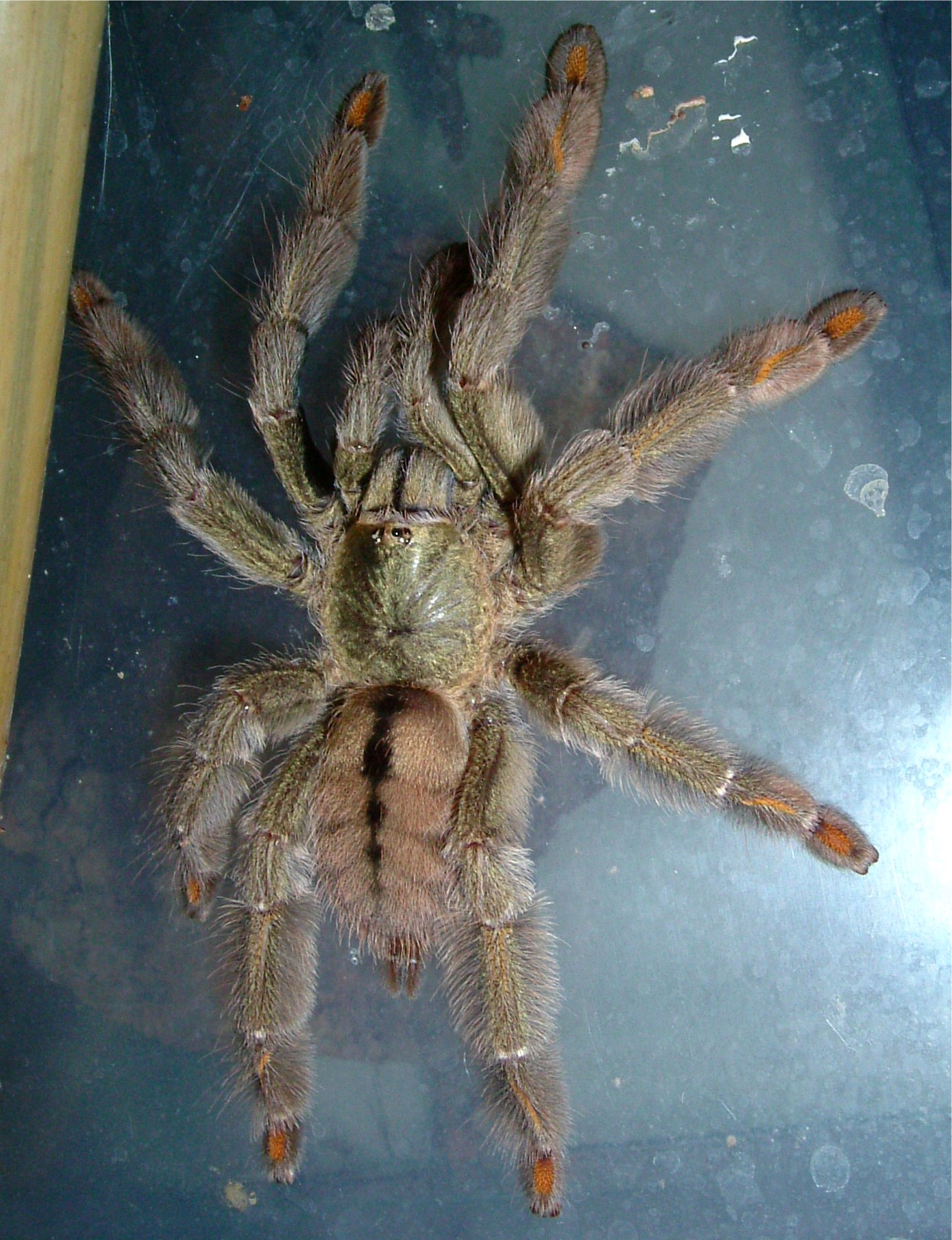
A fast, semi-arboreal New World tarantula from Trinidad with a velvety olive-brown body and chevron markings on the abdomen. It lacks urticating hairs and is quick and defensive, making it a step up from docile terrestrial beginners.
ℹ️
Educational only. KinStation content is reviewed by licensed veterinarians but cannot replace an in-person exam. Always consult a licensed veterinarian or board-certified specialist for diagnosis, treatment, or any decision affecting your pet's health.
🩺 Need expert help with your trinidad chevron tarantula?
Connect with a specialist near you or ask a licensed vet — never substitute online guidance for hands-on care in an emergency.
Large; leg span about 6-7 in (15-18 cm), slender arboreal build.
Lifespan
4–14 years
Social needs
solo
Native region
Trinidad (Caribbean), with relatives across northern South America
Origin
New World
Climate
🌴 Tropical
Family
Theraphosidae
Genus
Psalmopoeus
Part of the Tarantulas
Theraphosid spiders kept as low-maintenance display invertebrates. New World species are generally docile with mild venom but bear irritating urticating hairs, while Old World species lack those hairs but tend to be fast, defensive, and have more potent (though rarely life-threatening) venom.
From the minimum an animal needs to be kept humanely, up to the ideal setup. Bigger is almost always better — minimums are floors, not targets.
Photo coming soon
Minimum
Juvenile / sub-adult enclosure
8 × 8 × 8 in (juvi) → 10 × 10 × 8 in (sub-adult)
Clear acrylic or glass enclosure with cross-ventilation, 3–4 in of dry coco-fibre or topsoil mix, a cork-bark hide, and a shallow water dish. Floor space matters more than height for terrestrials; the spider should be able to turn around comfortably. Trinidad chevrons (Psalmopoeus cambridgei) are fast, semi-arboreal — actually keep them in a taller mixed setup (cork verticals + floor space) with damp substrate.
Photo coming soon
Recommended
Adult terrestrial enclosure
12 × 12 × 8 in (≈ floor 3× adult DLS)
Adult floor space targets roughly three times the diagonal leg span so the spider can web, walk, and ambush. Add 4–5 in of substrate, a half-log hide, low decor, and a water dish; height stays modest to prevent a fatal fall onto the abdomen.
Photo coming soon
Ideal
Naturalistic terrestrial vivarium
14 × 10 × 10 in, bioactive
A bioactive footprint with deeper substrate (5–6 in), leaf litter, a sculpted hide, and one or two live hardy plants. Cleanup crew (springtails, isopods) keeps the dry-but-not-arid microclimate stable for long-term welfare.
Life & growth stages
How this animal changes through its life — each stage often has its own care, diet and space needs.
Photo coming soon
Egg
These invertebrates lay eggs — often in a guarded clutch, a silk sac (spiders), or a brood (carried by female isopods). The eggs are small and soft and develop without a true larval or pupal transformation.
Photo coming soon
Juvenile
Juveniles hatch as miniature versions of the adult and grow by molting their exoskeleton (or, in snails, by enlarging the shell). They gain size, segments, or leg pairs and gradually take on adult coloration with each molt.
Adult
Adults reach full size and reproductive maturity with the species' mature form and coloration. Many arachnids and myriapods continue to molt as adults, and sexes can differ in size or in specialized appendages.
Habitat & enclosure
House one spider alone in an arboreal-style enclosure that is taller than it is wide, with secure vertical cork bark for climbing and a hide. A footprint around 12x12x18 in (30x30x45 cm) suits an adult. Provide anchor points for webbing and a shallow water dish. Keep at 75-82F (24-28C) with moderate humidity: keep part of the substrate lightly moist, mist occasionally, and allow ventilation to prevent stagnation. No UVB or special lighting is required.
Substrate
Use 2-4 in (5-10 cm) of a coco-fiber and topsoil mix at the base, kept lightly moist on one side. Most activity is vertical, so prioritize tall cork-bark slabs and anchor points for the silk retreat the spider will build off the ground.
Equipment & setup
No heater is usually needed at normal room temperatures; if required, use a thermostat-controlled side-mounted heat mat. No UVB. Provide a tall, well-sealed arboreal enclosure (escapes are a major risk with this fast species), vertical cork bark, webbing anchors, and a shallow water dish. A hygrometer helps maintain moderate humidity.
Diet
An opportunistic insectivore and a voracious, fast feeder. Feed appropriately sized crickets, dubia roaches, and the occasional larger feeder for adults; slings take flightless fruit flies and pinhead crickets. Slings eat 2-3x weekly, juveniles weekly, adults every 1-2 weeks. Remove uneaten prey within 24 hours and withhold food during premolt. Always provide clean water.
Behavior & temperament
Although a New World genus, Psalmopoeus lacks urticating hairs and behaves more like an Old World spider: very fast, skittish, and prone to bolting or, if cornered, throwing a threat posture. It is a defensive, not-for-handling species. Its venom is more potent than that of docile beginner tarantulas, and although not considered life-threatening, a bite delivered by its long fangs can be genuinely painful and has been reported to cause local swelling, and in some cases systemic effects such as muscle cramping, nausea, or dizziness. Treat it as a strictly hands-off display animal and always work over a contained surface.
Health
Hardy and fast-growing when humidity and ventilation are balanced. Main risks are escapes (it is extremely fast), dehydration if kept too dry, and mold or mites if kept soggy and stagnant. Keep the water dish full and provide good airflow. Watch for premolt (it will web up and refuse food); never disturb a molting spider, which for an arboreal species often happens in its silk retreat.
Tips, DIY & hacks
Do all maintenance with a catch cup ready and over a bin, because this spider can bolt out of an opened enclosure in an instant. Never handle it. Give it tall vertical structure and it will build an attractive silk-lined tube retreat. A good first 'fast and defensive' species for keepers ready to graduate from docile terrestrials, but respect its speed and its painful bite.