Mangrove forests are intertidal coastal woodlands of salt-tolerant trees and shrubs that root in oxygen-poor, waterlogged mud between land and sea. Their tangled prop roots buffer coastlines, store enormous amounts of carbon, and serve as nurseries for a huge range of fish and invertebrates.
Geography
Mangroves line sheltered tropical and subtropical shores worldwide — estuaries, lagoons, and deltas — with the greatest extent in Southeast Asia, plus West Africa, the Americas, and northern Australia. They thrive where rivers deposit fine sediment and wave energy is low, forming a shifting boundary that advances and retreats with the tide.
Climate
Warm and humid, mangroves are limited by frost and so are largely confined to the tropics and warm subtropics. They endure daily tidal flooding, fluctuating salinity from fresh river input to full seawater, and low-oxygen soils, which the trees overcome with specialized aerial roots (pneumatophores) and salt-excreting leaves.
Flora & fauna
Red, black, and white mangroves dominate the flora, with their distinctive stilt and 'snorkel' roots. The fauna is amphibious and rich: mudskippers, fiddler and mangrove crabs, archerfish, juvenile reef fish, shrimp, oysters, snails, wading birds, and (regionally) crocodiles and proboscis monkeys. Many aquarium and brackish species spend their early lives among the roots.
Conservation
Mangroves have been cleared at high rates for shrimp aquaculture, coastal development, and agriculture, despite being powerful 'blue carbon' sinks and natural storm barriers. Pollution and altered river flow add stress. Conservation emphasizes replanting, protected coastal zones, and recognizing mangroves' value for fisheries and flood defense.
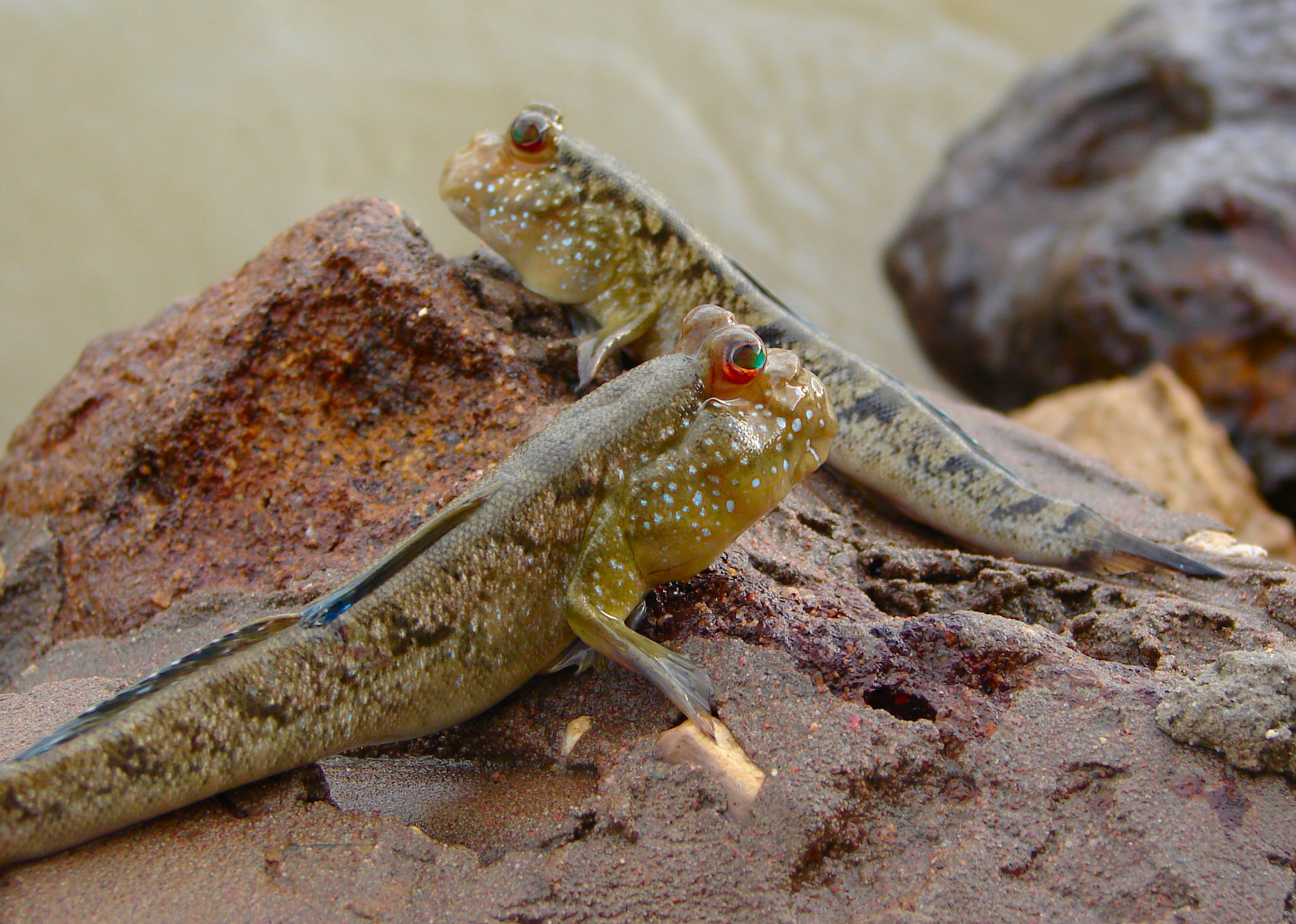
The Atlantic mudskipper is an amphibious brackish-water goby that spends much of its time out of water, breathing through its skin and gill chambers and 'walking' on muscular pectoral fins. It needs a custom paludarium-style setup with both brackish water and dry land, making it a charming but specialized aquarium subject.
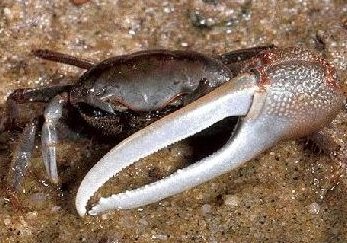
A small semi-terrestrial brackish-water crab famous for the male's single oversized 'fiddle' claw, which it waves to court females and deter rivals. Long traded as Uca pugnax, it was reclassified to Minuca pugnax in 2016. Sociable and entertaining, they need a brackish paludarium with both land and shallow water — a very common mistake is keeping them in fresh water, which shortens their lives.
A small, feisty brackish-water crab with bright red claws and a dark carapace, native to mangrove estuaries. It is semi-terrestrial and a notorious escape artist, requiring a tightly covered brackish paludarium with both water and accessible land.
A spectacularly coloured land crab from Central American coasts, with a deep purple-black body, orange legs and yellow eyespots. It is almost entirely terrestrial, needing a warm, humid setup with deep substrate plus BOTH a fresh and a brackish water dish — not a fully aquatic tank, and never salt water alone, which it cannot survive on.
A small, charismatic brackish-water puffer with bold yellow-on-brown figure-eight markings and eyespots near the tail. It is intelligent and personable but has continuously growing beak-like teeth and is best kept alone in low-end brackish water.
The Archangel is a striking ornamental pigeon prized for its iridescent metallic copper-and-bronze body offset by lustrous wings, kept almost exclusively for exhibition and beauty. Originating in Italy, it is a hardy, active flyer that breeds and parents reliably.
A striking spotted, fully aquatic freshwater crab endemic to Lake Matano on Sulawesi, prized for its leopard-like markings. It does not need a land area, but it is a territorial, opportunistic predator that hunts slow fish and small tankmates, and is best kept singly. Note that all trade stock is currently wild-caught and the species is IUCN-listed as Endangered due to nickel mining degrading its only lake habitat.