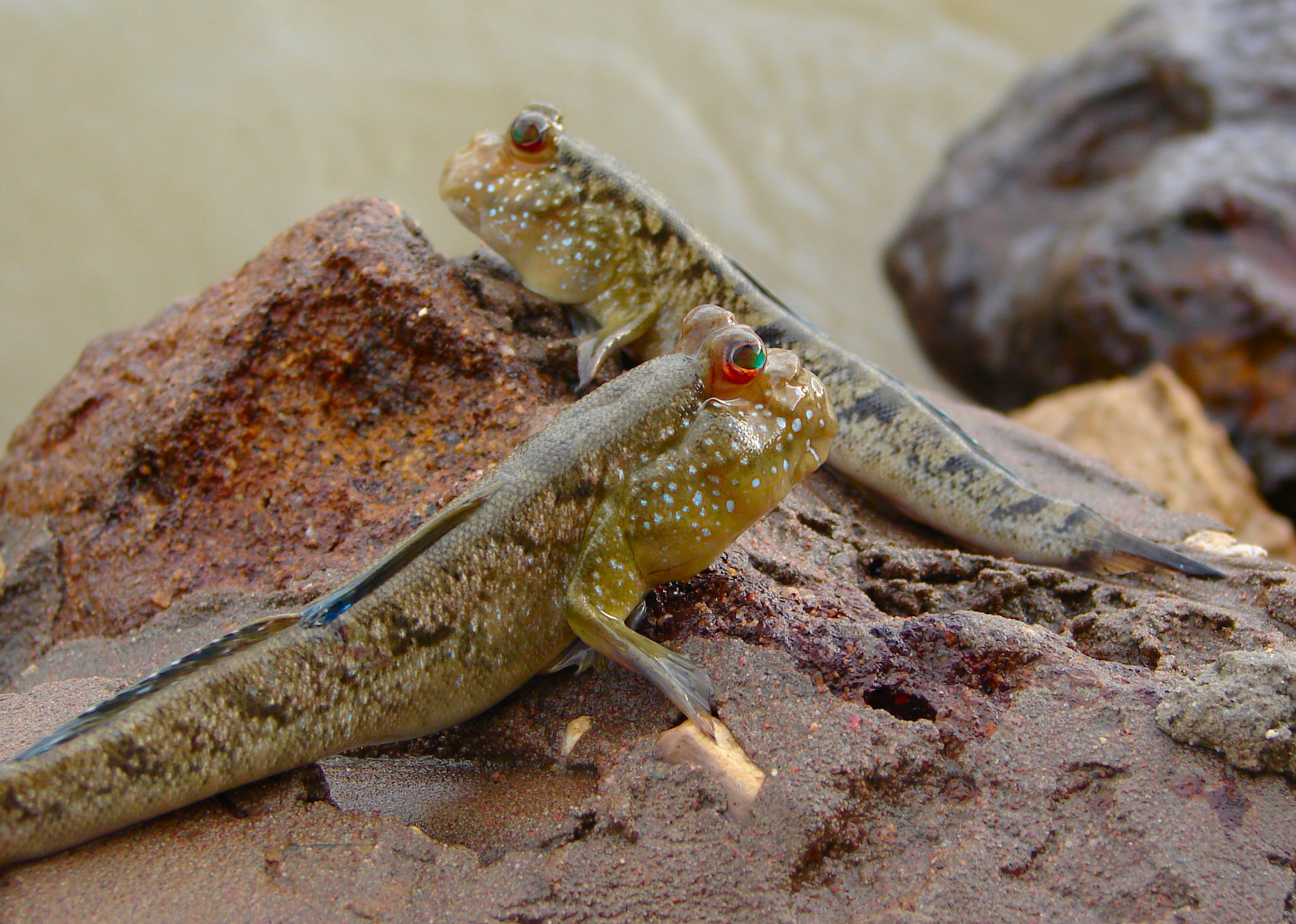
The Atlantic mudskipper is an amphibious brackish-water goby that spends much of its time out of water, breathing through its skin and gill chambers and 'walking' on muscular pectoral fins. It needs a custom paludarium-style setup with both brackish water and dry land, making it a charming but specialized aquarium subject.
ℹ️
Educational only. KinStation content is reviewed by licensed veterinarians but cannot replace an in-person exam. Always consult a licensed veterinarian or board-certified specialist for diagnosis, treatment, or any decision affecting your pet's health.
🩺 Need expert help with your atlantic mudskipper?
Connect with a specialist near you or ask a licensed vet — never substitute online guidance for hands-on care in an emergency.
Small; commonly 10-15 cm (4-6 in), occasionally to about 25 cm (10 in).
Lifespan
5–8 years
Social needs
group
Native region
Coastal West and Central Africa (eastern Atlantic); intertidal mudflats, mangroves, and estuaries.
Origin
Old World
Climate
🌴 Tropical
Water type
🌫️ Brackish
Family
Oxudercidae
Genus
Periophthalmus
Part of the Gobies
Small, mostly bottom-dwelling marine and brackish fish prized in aquaria for their hardiness, interesting behaviors, and roles such as sand-sifting, burrowing, or pairing with pistol shrimp. This grouping also includes goby-like specialty species sold under goby names.
From the minimum an animal needs to be kept humanely, up to the ideal setup. Bigger is almost always better — minimums are floors, not targets.
Photo coming soon
Minimum
Brackish paludarium
30 gal / 114 L paludarium, half land
Periophthalmus barbarus is amphibious — needs more land than water. A 30-gallon paludarium with ~60% land area, shallow brackish water (SG 1.005–1.015), basking heat to 30 °C, and humid air. Tight lid; they climb.
Photo coming soon
Recommended
Mangrove paludarium
55 gal / 208 L mangrove setup
Mangrove-style paludarium with mud/sand banks, driftwood roots, brackish pools, basking spots, and live mangroves if possible. Each adult is territorial; give multiple visual barriers if keeping more than one.
Photo coming soon
Ideal
Custom mangrove biotope
75+ gal / 284 L+ custom build
Purpose-built mangrove biotope with tidal-style varied water depth, real mangroves rooted in mud substrate, UVB, and heated land. Closest to the intertidal flats this fish actually lives on.
Life & growth stages
How this animal changes through its life — each stage often has its own care, diet and space needs.
Photo coming soon
Egg
Fish eggs are small, translucent spheres, often laid in clutches on plants, substrate, or in a nest — or carried/brooded by a parent in livebearing and mouth-brooding species. A dark eye spot and the curled embryo become visible inside as development progresses.
Photo coming soon
Fry
Newly hatched fry are tiny and semi-transparent, frequently still carrying a yolk sac that fuels them before they feed freely. They lack full fin structure and adult coloration, staying near cover until they can swim and forage on their own.
Photo coming soon
Juvenile
Juveniles look like miniature adults but with developing fins and muted or different markings; many species shift pattern and color as they mature. Growth is rapid at this stage given clean water and steady feeding.
Adult
Adults show the species' full size, finnage, and mature coloration, and are sexually mature. Many fish develop sex-specific differences in size, color, or fin shape, which can intensify during breeding.
Habitat & enclosure
Requires a paludarium (part-water, part-land) of at least 75-115 L (20-30 gallons) for a small group, with a large land area and only shallow brackish water. Build a sloping muddy or sandy 'beach' so the fish can haul fully out, since it spends most of its time on land. Keep the water shallow (a few centimeters to ~15 cm) and brackish: specific gravity around 1.005-1.015 (roughly 5-20 ppt), temperature 25-30 C (77-86 F), pH 7.5-8.5. Critically, maintain very high humidity and a warm, humid air layer above the water, plus a tight cover, because the fish breathes air and its skin must stay moist. Provide a temperature gradient with a warm basking spot.
Substrate
Use a soft sand or fine sand-and-mud substrate that the fish can move across and burrow into; some individuals dig burrows. Build the land portion from sloped sand or aquarium-safe mud held in place with rocks, driftwood, or mangrove roots to create gentle haul-out beaches. Avoid sharp gravel that can abrade the delicate skin.
Equipment & setup
Needs a sealed, high-humidity enclosure: a tight, escape-proof lid is mandatory because mudskippers climb glass and jump. Provide a heater (kept fully submerged or guarded in the shallow water), gentle filtration sized for the small water volume, and a basking lamp or heat source to create a warm spot over the land. Maintain marine salt mixed to brackish strength and monitor salinity with a hydrometer or refractometer. A spray bar, misting, or a humid air layer keeps skin and land moist. Decorate with sturdy hardscape and aquarium-safe wood or mangrove props for climbing.
Diet
Carnivore and active hunter. In the wild it ambushes small crustaceans, insects, worms, and tiny fish across the mudflats. In captivity offer live and frozen meaty foods: bloodworms, brine shrimp, mysis, small crickets, mealworms, blackworms, and chopped seafood. It will often take food off the land as well as from the water. Many learn to accept frozen and even some prepared foods, but live prey is excellent for encouraging natural hunting behavior. Feed daily, removing uneaten food to protect water quality in the shallow volume.
Behavior & temperament
Amphibious, alert, and highly entertaining, using its pectoral fins to crutch-walk and even skip across land and its pelvic fins to perch. It is social but territorial: males display by raising their colorful dorsal fins and may spar over territory, so provide a larger land area with visual barriers and keep a small group rather than a single pair to spread out aggression. It is not a fish for a community tank with fully aquatic species. Not meant to be handled; its skin must stay moist and handling stresses it. Mudskippers are escape artists and will climb and jump out of any gap.
Health
Generally hardy when its specialized needs are met, but most health problems stem from incorrect setup: fully aquatic tanks with no land cause stress and drowning-like exhaustion, while a dry environment leads to skin desiccation and death. Because it absorbs oxygen through moist skin, low humidity is directly harmful. Brackish salinity supports its osmoregulation and disease resistance; keeping it in pure freshwater long-term weakens it. Watch for skin lesions, fungus, and bacterial infections, often secondary to poor humidity, dirty substrate, or unstable salinity. Quarantine new fish and keep the shallow water pristine.
Tips, DIY & hacks
Set up the tank as a paludarium with mostly land and only shallow brackish water before buying fish. Keep salinity in the brackish range with marine salt, not freshwater or full marine. Seal every gap, since mudskippers escape readily. House a small group with ample land and barriers to diffuse male territorial sparring, and feed live insects and worms to bring out natural hunting. Keep the air warm and humid with a secure lid, and never keep them permanently submerged or in a standard fish tank without land.