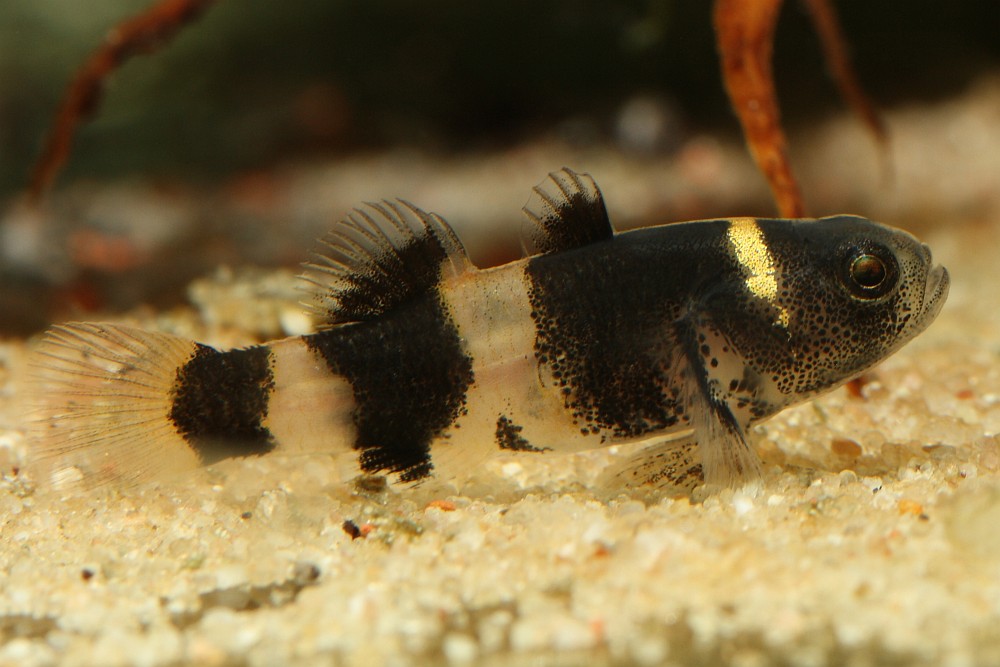
A tiny, boldly black-and-yellow striped goby that perches on surfaces with its fused pelvic-fin sucker. Best kept in groups in a dedicated nano tank of hard, slightly brackish water with live or frozen meaty foods.
ℹ️
Educational only. KinStation content is reviewed by licensed veterinarians but cannot replace an in-person exam. Always consult a licensed veterinarian or board-certified specialist for diagnosis, treatment, or any decision affecting your pet's health.
🩺 Need expert help with your bumblebee goby?
Connect with a specialist near you or ask a licensed vet — never substitute online guidance for hands-on care in an emergency.
Tiny; adults reach only about 3.5-4 cm (1.4-1.6 in).
Lifespan
3–5 years
Social needs
group
Native region
Southeast Asia (Indonesia, Borneo, Brunei, Malaysia, Singapore, Thailand, Cambodia, Vietnam)
Origin
Old World
Climate
🌴 Tropical
Water type
🌫️ Brackish
Family
Oxudercidae
Genus
Brachygobius
Part of the Gobies
Small, mostly bottom-dwelling marine and brackish fish prized in aquaria for their hardiness, interesting behaviors, and roles such as sand-sifting, burrowing, or pairing with pistol shrimp. This grouping also includes goby-like specialty species sold under goby names.
From the minimum an animal needs to be kept humanely, up to the ideal setup. Bigger is almost always better — minimums are floors, not targets.
Photo coming soon
Minimum
Brackish group nano
15 gal / 57 L brackish
Brachygobius spp. are tiny brackish bottom-dwellers (1–1.5 in). Keep in groups of 6+. Minimum 15 gallons with low-end brackish water (SG 1.005), sand substrate, lots of small caves, and live or frozen food only.
Photo coming soon
Recommended
Brackish shoal tank
20 gal / 76 L long brackish
20-gal long brackish with a shoal of 8–10, sand, smooth pebble caves, and shrimp/bloodworm feeding. Pure freshwater long-term is a common cause of decline.
Photo coming soon
Ideal
Brackish biotope
29 gal+ / 110 L+ biotope
Brackish biotope with mangrove roots, sand, and dense cave structure, with peaceful brackish tankmates (small mollies, knight goby). Each goby claims a small territory.
Life & growth stages
How this animal changes through its life — each stage often has its own care, diet and space needs.
Photo coming soon
Egg
Fish eggs are small, translucent spheres, often laid in clutches on plants, substrate, or in a nest — or carried/brooded by a parent in livebearing and mouth-brooding species. A dark eye spot and the curled embryo become visible inside as development progresses.
Photo coming soon
Fry
Newly hatched fry are tiny and semi-transparent, frequently still carrying a yolk sac that fuels them before they feed freely. They lack full fin structure and adult coloration, staying near cover until they can swim and forage on their own.
Photo coming soon
Juvenile
Juveniles look like miniature adults but with developing fins and muted or different markings; many species shift pattern and color as they mature. Growth is rapid at this stage given clean water and steady feeding.
Adult
Adults show the species' full size, finnage, and mature coloration, and are sexually mature. Many fish develop sex-specific differences in size, color, or fin shape, which can intensify during breeding.
Habitat & enclosure
Keep bumblebee gobies in groups of 5-6 or more in a fully cycled tank of around 40 L (10 US gal); a small group can be maintained in a 20 L (5.5 gal) species tank. Provide a soft sand or fine gravel substrate, plus many caves, flowerpots, rockwork, and broad leaves or decor that give each fish a perch and territory, since males are territorial over small home ranges. Gentle filtration suits these weak swimmers, and a lid helps reduce evaporation that would swing salinity.
Unlike some of its relatives, Brachygobius doriae does well in hard freshwater or slightly brackish water, so salt is beneficial but not strictly mandatory; many keepers find it more robust with a little salt. Aim for a specific gravity around 1.002-1.006 using marine salt, temperature 22-28 C (72-82 F), and stable, hard, alkaline water (pH about 7.0-8.5). Maintain pristine conditions with regular small water changes; their small size makes them sensitive to ammonia and nitrite spikes.
Substrate
Fine sand or smooth fine gravel suits these tiny bottom-dwellers; a sand bed mixed with a little crushed coral helps maintain the light brackish, hard water they do best in.
Equipment & setup
A small dedicated tank (10+ gallons) with gentle sponge filtration, a heater at 76-82F, and light brackish salinity around 1.002-1.006 specific gravity. They are sensitive to poor water quality, so stable, well-filtered conditions are key.
Diet
Bumblebee gobies are micro-predators that strongly prefer live and frozen meaty foods and frequently refuse dry flakes or pellets. Offer live or frozen brine shrimp, daphnia, bloodworms, tubifex, cyclops, and microworms; live baby brine shrimp is excellent for conditioning and tempting fussy or newly imported fish.
Because they feed slowly and near the bottom, ensure food reaches them rather than being intercepted by faster tankmates - another reason a dedicated species tank is ideal. Feed small amounts once or twice daily and watch that every fish is eating, since starvation is a leading cause of loss in this species.
Behavior & temperament
These are shy, slow-moving, bottom-perching gobies that spend much of their time clinging to surfaces with the suction disc formed by their fused pelvic fins. Males establish and defend small territories around caves and will display and spar at boundaries, but they are not dangerous to similarly sized peaceful tankmates. They are too small and timid for boisterous communities and do best alone or with calm tankmates.
Provide enrichment through plenty of caves, perches, sightline breaks, and live prey to hunt. Keeping them in a group encourages natural territorial and breeding displays and makes for a more active, secure-feeling colony.
Health
The most common cause of decline is improper diet and water quality. Long-term keeping in soft, acidic, or unstable water stresses these hard-water fish and opens the door to bacterial, fungal, and parasitic infections; a varied live/frozen diet and stable, hard, alkaline (ideally lightly brackish) water are the core preventives.
Starvation, whitespot (ich), and skin/fin infections are also frequent, especially in wild-caught and newly imported stock that may arrive thin or parasitized. Quarantine new arrivals, feed nutritious live foods to rebuild condition, and dose any medications cautiously given their small body size and sensitivity.
Tips, DIY & hacks
Scatter many small caves, PVC offcuts, snail shells, and rockwork to create individual territories since males are territorial in their tiny patches. They often ignore dry food, so feed live or frozen foods like brine shrimp, daphnia, and bloodworms, and keep them in a species tank to ensure they get enough to eat.