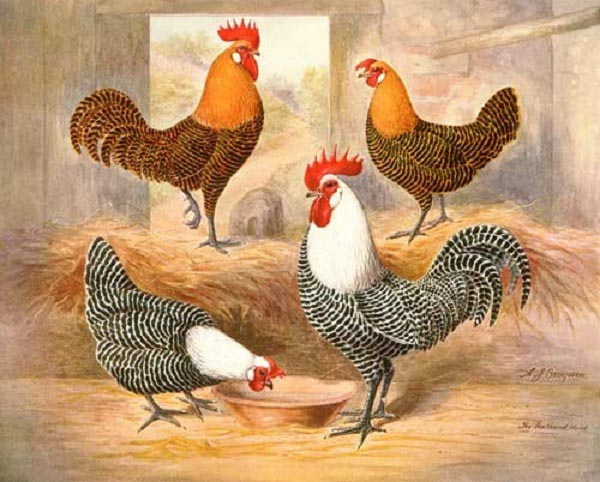
An old, strikingly barred light breed from the Campine (Kempen) region of Belgium, kept primarily for white eggs. Notable for 'hen-feathering' in cocks, which lack the usual pointed sex feathers.
ℹ️
Educational only. KinStation content is reviewed by licensed veterinarians but cannot replace an in-person exam. Always consult a licensed veterinarian or board-certified specialist for diagnosis, treatment, or any decision affecting your pet's health.
🩺 Need expert help with your campine?
Connect with a specialist near you or ask a licensed vet — never substitute online guidance for hands-on care in an emergency.
From the minimum an animal needs to be kept humanely, up to the ideal setup. Bigger is almost always better — minimums are floors, not targets.
Photo coming soon
Minimum
Coop + tall secure run
4 sq ft coop + 10 sq ft run per bird, 5 ft fence
Campines (4–5 lb) are flighty, active Belgian landrace layers. 4 sq ft coop, 10 sq ft run, tall fencing or netting, 4 ft roost — they fly well and roost high. Single comb is frost-sensitive; provide draft-free winter coop.
Photo coming soon
Recommended
Covered run + tall roosts
5 sq ft coop + 15 sq ft covered run per bird
Covered run with branch perches and clutter, deep-litter coop, sand dust bath. Campines hate confinement; covered run prevents flyaways. Their barred plumage hides them from raptors decently.
Photo coming soon
Ideal
Free-range landrace flock
Free-range + 6 sq ft coop per bird, hedgerows for cover
Free-range a yard with hedge cover and trees, locked in a predator-proof coop at dusk. Campines are tireless foragers; landrace welfare = forage, cover, and minimal confinement.
Life & growth stages
How this animal changes through its life — each stage often has its own care, diet and space needs.
Photo coming soon
Egg
Birds develop inside a hard-shelled egg incubated by the parent(s). Egg size, shell color, and clutch size vary by species; the embryo develops over days to weeks before hatching.
Photo coming soon
Hatchling / Chick
Hatchlings are either altricial — naked, blind, and dependent on parents (typical of parrots and songbirds) — or precocial — downy, mobile, and self-feeding soon after hatching (typical of poultry and waterfowl). Down gives way to the first feathers.
Photo coming soon
Juvenile / Fledgling
Fledglings grow in their juvenile plumage and begin to fly and feed themselves, though they may still beg from parents at first. Juvenile feathering is often duller than the adult and is replaced as the bird matures.
Adult
Adults attain full body size and mature plumage, and are capable of breeding. Many species show distinct adult coloration, and in sexually dimorphic birds males and females differ in plumage, size, or markings.
(c) D. N., some rights reserved (CC BY-NC) via iNaturalist — https://www.inaturalist.org/observations/312084723
Color & pattern variants
Natural variants occur in the wild; selectively bred (man-made) variants were developed in captivity.
Provide a dry, airy coop with a spacious covered run or free range; Campines are active, alert foragers that thrive on pasture and dislike tight confinement. Give roughly 0.3-0.4 m² per bird indoors plus generous run space, high perches, and predator-proof fencing — they are light, agile and can fly well, so a covered run or tall fence is advisable. The single comb is large and frostbite-prone, so ensure draught-free yet well-ventilated winter housing.
Diet
A standard balanced layer feed (16-17% protein) with grit, oyster-shell and fresh water meets their needs. As enthusiastic foragers they make good use of range, supplementing their diet with insects, seeds and greens, which can reduce feed costs. Keep them lean and active; avoid excessive grain treats that depress laying. Ensure adequate calcium for shell quality in this productive layer.
Behavior & temperament
Light egg-laying breed producing around 150-200 white eggs per year. Temperament is lively, alert, inquisitive and somewhat flighty — bright and active rather than placid, though birds handled young can become reasonably friendly. A distinctive trait is the 'hen-feathered' cock, whose plumage resembles the hen's (rounded rather than pointed hackle and saddle feathers). Hens rarely go broody, so artificial incubation or a foster broody is usually needed to reproduce the breed.
Health
A hardy, naturally vigorous breed with few inherent health problems, but now globally rare and maintained by a small gene pool, so sourcing unrelated breeding stock matters to avoid inbreeding depression. The prominent single comb is susceptible to frostbite in cold climates. Otherwise standard poultry care — parasite control, clean dry housing and good ventilation against respiratory disease — keeps them healthy.
Tips, DIY & hacks
Handle chicks frequently from an early age to temper their natural flightiness. Because the breed is rare, buy from a reputable breeder and keep careful records to maintain genetic diversity. Protect combs with petroleum jelly in hard frosts. Offer dust baths and varied forage to keep these busy birds occupied and reduce stress in runs. Plan to incubate eggs or use a broody hen of another breed, as Campine hens seldom sit.