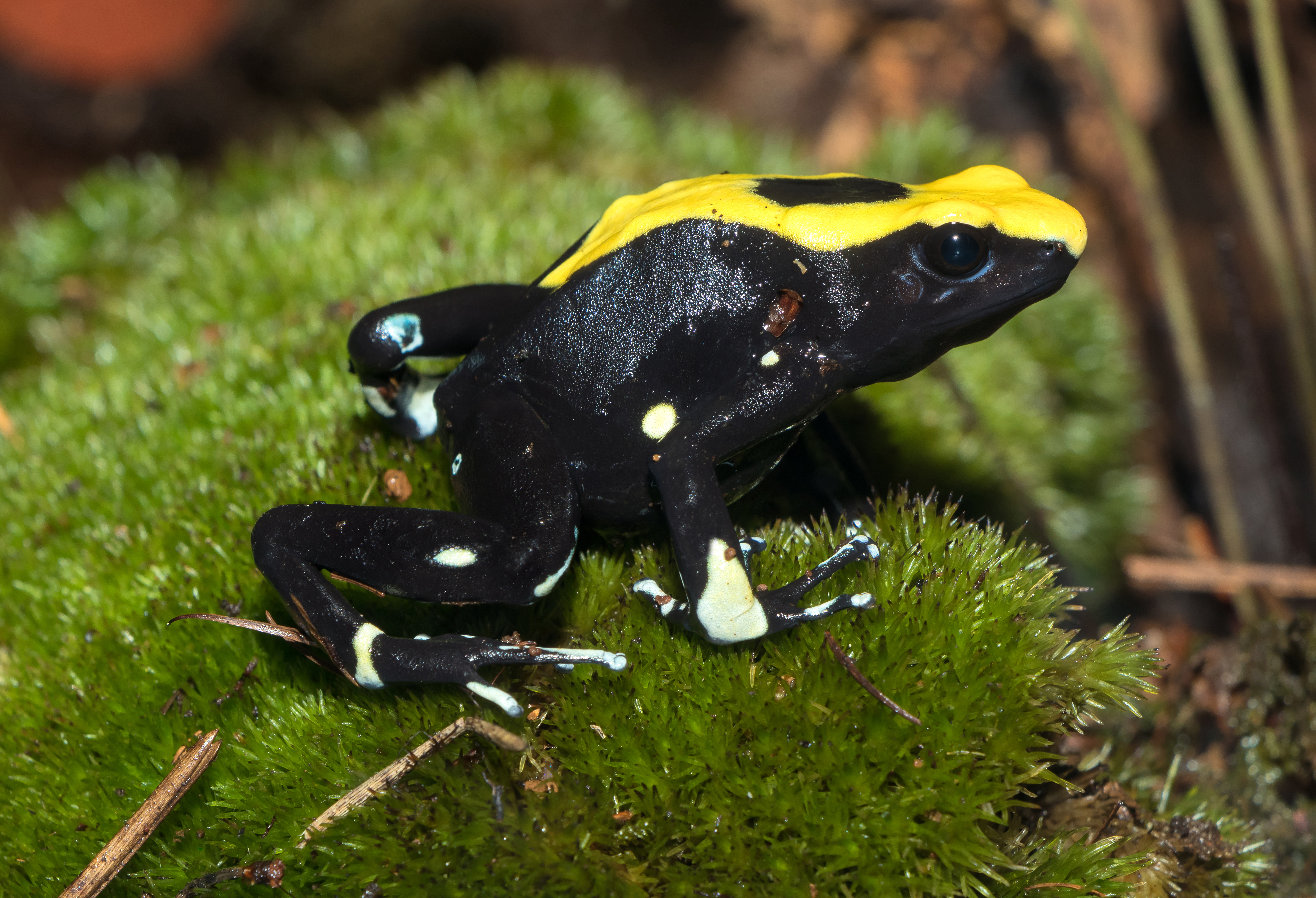
Blue dart frogs are a vividly colored color morph of the dyeing poison frog from northern South America. Captive-bred individuals raised on a controlled feeder-insect diet are non-toxic but should still be regarded as a display species — handling is discouraged.
ℹ️
Educational only. KinStation content is reviewed by licensed veterinarians but cannot replace an in-person exam. Always consult a licensed veterinarian or board-certified specialist for diagnosis, treatment, or any decision affecting your pet's health.
🩺 Need expert help with your blue dart frog?
Connect with a specialist near you or ask a licensed vet — never substitute online guidance for hands-on care in an emergency.
South America (Sipaliwini savanna, southern Suriname; adjacent northern Brazil)
Origin
New World
Climate
🌴 Tropical
Family
Dendrobatidae
Genus
Dendrobates
Part of the Poison Dart Frogs
Small, brilliantly colored diurnal frogs of the family Dendrobatidae from Central and South America. Captive-bred individuals are non-toxic because their alkaloid defenses come from wild ant- and mite-based diets. They thrive in planted, high-humidity bioactive vivaria and are display-only animals that should not be handled.
From the minimum an animal needs to be kept humanely, up to the ideal setup. Bigger is almost always better — minimums are floors, not targets.
Photo coming soon
Minimum
Planted group vivarium
18 × 18 × 18 in (≈ 25 gal)
Azureus dart frogs are social and do best in a group, so an 18 × 18 × 18 in planted vivarium is the welfare floor for two to four, with a drainage layer, leaf litter, broms, and many hides to diffuse aggression. Maintain 21–26 °C (never let it overheat past ~27 °C), 80–100% humidity via misting, and a springtail/isopod culture as live cover and food.
Photo coming soon
Recommended
Bioactive rainforest vivarium
24 × 18 × 18 in bioactive for 3–5
A 24 × 18 × 18 in bioactive vivarium gives a group of three to five room to establish territories among bromeliads, cork, dense leaf litter, and a film of clean water. Hold 21–26 °C and 80–100% humidity with an automatic mister and a thriving microfauna clean-up crew, exceeding the minimum by reducing stress and supporting tadpole-rearing.
Photo coming soon
Ideal
Large naturalistic vivarium
36 × 18 × 24 in+ bioactive
A 36 × 18 × 24 in or larger naturalistic vivarium with a water feature, mist system, deep planting, and abundant leaf litter lets a small group thrive with natural territories and calling. Stable 21–26 °C, near-saturated humidity, and a mature springtail and isopod ecosystem deliver the richest enrichment and most natural breeding behaviour.
Life & growth stages
How this animal changes through its life — each stage often has its own care, diet and space needs.
Photo coming soon
Egg
Amphibian eggs are soft, jelly-coated spheres laid in or near water — in floating clutches, strings, or foam nests depending on the species. The dark embryo is visible within the clear gel as it develops.
Photo coming soon
Tadpole / Larva
The aquatic larva (a tadpole in frogs/toads, a gilled larva in salamanders and newts) breathes through gills and feeds and grows in water. Frog/toad tadpoles are limbless at first, then sprout hind then front legs as metamorphosis nears.
Photo coming soon
Juvenile (froglet / eft)
At metamorphosis the animal develops legs and lungs and typically leaves the water as a froglet or, in many newts, a terrestrial eft. It resembles a small adult but is not yet sexually mature and its coloration may still be changing.
Adult
Adults reach full size and breeding condition, with the species' mature skin coloration and pattern. Many amphibians return to water to breed and can show seasonal or sex-specific changes such as nuptial coloration or crests.
Color & pattern variants
Natural variants occur in the wild; selectively bred (man-made) variants were developed in captivity.
Blue dart frogs are tiny, terrestrial rainforest-floor amphibians kept in densely planted bioactive vivariums. A small group typically lives in something like an 18×18×18 inch (or larger) enclosure built up in layers: a drainage layer at the bottom, a moisture-retaining substrate (an ABG-style mix is standard), live mosses and broadleaf plants, leaf litter for cover and microfauna, and shallow water features. The leaf litter and plants are not just decoration — they host the springtails and other tiny invertebrates that complete a bioactive system.
Conditions are warm and very humid, with daily misting maintaining humidity in a high band while good ventilation prevents stagnation. Temperatures sit in a moderate tropical range with a slight nighttime drop; dart frogs are sensitive to heat, and overheating is dangerous. Low-output UVB is increasingly used by keepers.
Water is dechlorinated, and the closed, planted environment is kept clean and stable. The whole approach mirrors the humid, shaded, leaf-littered forest floor these frogs inhabit, where they move among plants and water-filled leaf axils rather than across open ground.
Substrate
Use a bioactive drainage-layer setup: a false bottom or LECA/hydroball base, mesh divider, then a deep ABG-style mix (tree fern fiber, peat/coir, sphagnum, charcoal, bark) topped with leaf litter. Springtails and isopods seed the bioactive layer to break down waste and supplement the frogs' diet.
Equipment & setup
Keep a tall planted vivarium at 70-78F (never above 80F, as heat is dangerous) with 80-100% humidity, maintained by a misting system or daily hand-misting plus a screen-and-glass top for airflow. Low-output LED or T5 plant lighting is sufficient; supplemental UVB at low levels (e.g. 2.0) is beneficial but not strictly required.
Diet
Blue dart frogs are micro-predators that eat very small, moving prey. The staple in captivity is flightless fruit flies (Drosophila melanogaster and the larger D. hydei), supplemented with springtails, pinhead crickets, and bean weevils for variety. A self-sustaining springtail and isopod population in a bioactive vivarium provides constant foraging opportunities, especially valuable for froglets.
Feeders are dusted with calcium plus vitamin supplements (including vitamin A and D3 components) on a schedule appropriate for dart frogs, because these tiny frugivore-insectivores are prone to deficiencies if their feeders aren't fortified. Supplement specifics should be confirmed with a vet experienced in amphibians rather than estimated.
A crucial point about diet ties directly to toxicity (covered below): dart frogs do not manufacture their poisons; they acquire them from a wild diet of specific ants, mites, and other arthropods. Captive feeder insects lack those precursor compounds, which is why captive-bred dart frogs raised on fruit flies and crickets are not poisonous. Good supplementation and varied micro-prey are the diet priorities.
Behavior & temperament
Blue dart frogs are diurnal and, for amphibians, remarkably bold and active — they forage in the open during the day, which (along with their color) makes them excellent display animals. Small groups of females, or carefully selected mixed groups, often coexist; males call and can compete or become territorial, so group composition is chosen with care and monitored.
Despite being non-toxic when captive-bred, dart frogs are strictly look-don't-touch animals. Their thin, permeable skin makes them acutely sensitive to the oils, soaps, salts, and lotions on human hands, so handling is strongly discouraged regardless of toxicity. Interaction is observational: watching them patrol the leaf litter, call, and interact within the group.
The combination of daytime activity, bright color, and complex social behavior in a planted vivarium gives blue dart frogs an outsized presence for such small animals, and a well-balanced group can show courtship, calling, and parental behaviors that are fascinating to observe.
Health
Common blue dart frog health concerns include chytrid fungal infection, ranavirus, and bacterial skin infections — the same skin- and water-mediated diseases that affect amphibians broadly. Nutritional issues can also arise if feeders aren't properly supplemented. These are general patterns to address with an amphibian-experienced veterinarian.
Because dart frogs are kept in closed bioactive systems and are extremely sensitive, prevention is dominated by biosecurity and stability: strict quarantine of new animals, separate tools per enclosure, clean dechlorinated water, stable temperatures (avoiding heat), and careful supplementation. Cross-contamination between collections is a real risk for spreading chytrid and ranavirus.
Signs that warrant veterinary attention include skin abnormalities, lethargy, bloating, loss of the righting reflex, weight loss, and refusal to eat. Given how small and delicate these frogs are, early consultation with a vet familiar with dart frogs is important.
Tips, DIY & hacks
Culture your own flightless fruit flies and springtails to feed cheaply, and dust every feeding with calcium plus vitamin D3 and a separate vitamin A supplement to prevent spindly-leg and edema. Keep azureus in same-morph groups, quarantine new frogs separately, and use only reverse-osmosis or dechlorinated water for misting since darts absorb everything through their skin.
Origin & history
The blue "azureus" frog is a striking blue form of Dendrobates tinctorius, the dyeing poison frog, occurring in isolated forest-fragment populations associated with the highlands of southern Suriname and adjacent Brazil. Long treated as its own species (D. azureus) and still widely sold under that name, it is now generally regarded as a color morph within the variable D. tinctorius complex.
In the wild, D. tinctorius is a poison frog whose skin carries lipophilic alkaloid toxins sequestered from its diet of particular ants, mites, and other small arthropods. The brilliant blue coloration is aposematic — a warning to predators. In the pet trade, virtually all available animals are captive-bred and are raised on fruit flies and crickets that lack the dietary precursors for those toxins, so captive-bred dart frogs do not develop the wild toxicity. This contrast — genuinely toxic in the wild, harmless when captive-raised — is the single most important fact to understand about the species.
Anecdotes & owner lore
Community experience and cultural notes — not veterinary advice. Every animal is an individual; treat these as colour, not care instructions.
The blue dart frog sits at the intersection of beauty and danger in the public imagination, and the real story is more interesting than the myth. In the wild, poison frogs are famously toxic — Indigenous peoples of the Americas are documented using the secretions of certain dart-frog species to poison blowgun darts, which is where the whole family gets its name. But the toxicity is borrowed, not built: the frogs accumulate their alkaloids from specific wild prey, so a frog raised in a vivarium on fruit flies grows up completely harmless. Keepers love correcting the inevitable "isn't that thing deadly?" question with "only if it grew up eating the right ants."
The electric-blue color earns the species its nickname "okopipi" and a permanent spot on aquarium-store wish lists, even though dart-frog keeping is its own deep, plant-nerd rabbit hole of bioactive vivariums, springtail cultures, and fruit-fly farming. Hobbyists trade morphs and bloodlines with collector zeal, and there's a quiet pride in maintaining a self-sustaining slice of rainforest in a glass cube where jewel-bright frogs hunt among living moss.
Common ailments
Chytrid fungus (chytridiomycosis) — common — A primary biosecurity concern for dart-frog collections; quarantine and dedicated tools per enclosure are standard.
Bacterial skin infection (incl. 'red leg') — common
Ranavirus — rare — Less commonly seen than chytrid but devastating; reinforces the need for quarantine and biosecurity.
Reviewed and signed off by: KinStation Editorial - pre-launch draft (pending DVM review)