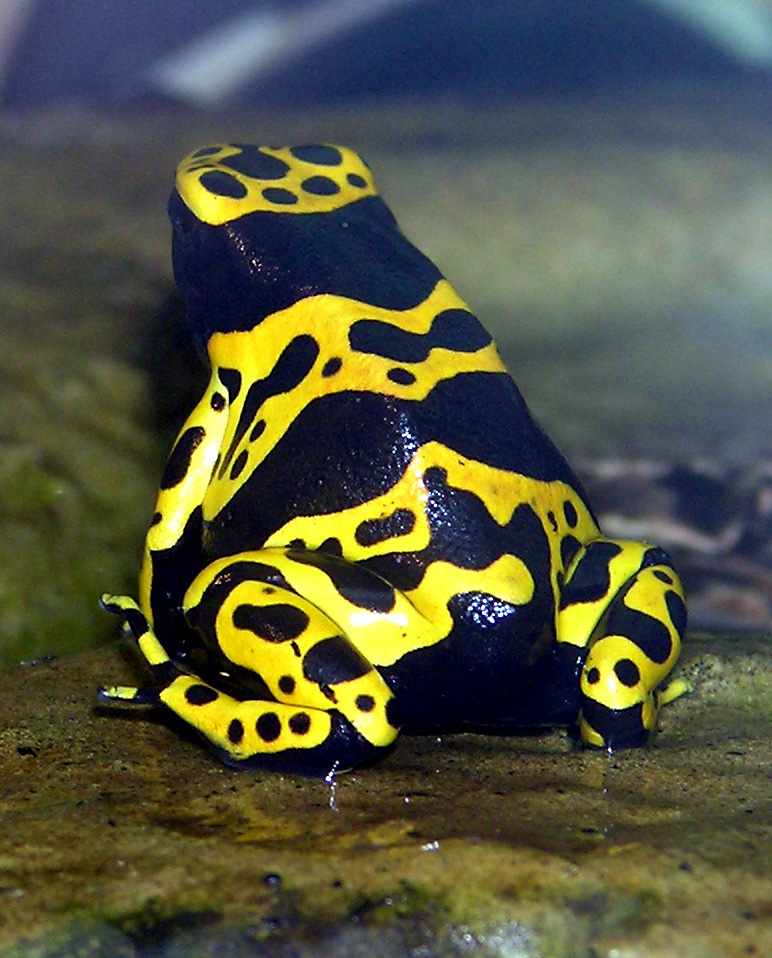
A boldly banded black-and-yellow dart frog often called the bumblebee frog, prized as one of the hardiest and most beginner-friendly poison dart frogs. Captive-bred animals are non-toxic and make a striking, active display species.
ℹ️
Educational only. KinStation content is reviewed by licensed veterinarians but cannot replace an in-person exam. Always consult a licensed veterinarian or board-certified specialist for diagnosis, treatment, or any decision affecting your pet's health.
🩺 Need expert help with your yellow-banded poison dart frog?
Connect with a specialist near you or ask a licensed vet — never substitute online guidance for hands-on care in an emergency.
Northern South America: Venezuela, Guyana, and adjacent Brazil and Colombia
Origin
New World
Climate
🌴 Tropical
Family
Dendrobatidae
Genus
Dendrobates
Part of the Poison Dart Frogs
Small, brilliantly colored diurnal frogs of the family Dendrobatidae from Central and South America. Captive-bred individuals are non-toxic because their alkaloid defenses come from wild ant- and mite-based diets. They thrive in planted, high-humidity bioactive vivaria and are display-only animals that should not be handled.
From the minimum an animal needs to be kept humanely, up to the ideal setup. Bigger is almost always better — minimums are floors, not targets.
Photo coming soon
Minimum
Bioactive vertical vivarium
18 × 18 × 24 in for a pair
Dendrobates leucomelas is bold, loud, and one of the easiest darts for beginners. Bioactive 18×18×24 with ABG, leaf litter, broms, and 75–85% humidity at 72–80 °F (tolerates a slight dry-season simulation).
Photo coming soon
Recommended
Larger planted bioactive
24 × 18 × 24 in for a group
Yellow-bands tolerate group housing well (1.3 or 2.3). Wider vivarium with dense planting, multiple brom cups, a shallow water feature, and a thriving springtail + fruit fly culture lets a group cycle through breeding.
Photo coming soon
Ideal
Planted bioactive 30+ gal
30+ gal display vivarium
Heavily planted 30+ gallon bioactive with a working waterfall, deep leaf litter, multiple brom cups, and a thriving isopod + springtail crew. One of the most rewarding display darts in a larger vivarium.
Life & growth stages
How this animal changes through its life — each stage often has its own care, diet and space needs.
Photo coming soon
Egg
Amphibian eggs are soft, jelly-coated spheres laid in or near water — in floating clutches, strings, or foam nests depending on the species. The dark embryo is visible within the clear gel as it develops.
Photo coming soon
Tadpole / Larva
The aquatic larva (a tadpole in frogs/toads, a gilled larva in salamanders and newts) breathes through gills and feeds and grows in water. Frog/toad tadpoles are limbless at first, then sprout hind then front legs as metamorphosis nears.
Photo coming soon
Juvenile (froglet / eft)
At metamorphosis the animal develops legs and lungs and typically leaves the water as a froglet or, in many newts, a terrestrial eft. It resembles a small adult but is not yet sexually mature and its coloration may still be changing.
Adult
Adults reach full size and breeding condition, with the species' mature skin coloration and pattern. Many amphibians return to water to breed and can show seasonal or sex-specific changes such as nuptial coloration or crests.
Color & pattern variants
Natural variants occur in the wild; selectively bred (man-made) variants were developed in captivity.
Natural
representative
Standard
The common form with three to four bold yellow bands across a glossy black body.
representative
Fine Spot
A locale variant in which the yellow bands break into fine spotting and speckles.
representative
British Guyana / orange-tinted
Locale forms showing more orange-toned banding rather than bright yellow.
Habitat & enclosure
House in a planted, humid glass vivarium with a tight lid. A group of three to five does well in an 18x18x18 in (45x45x45 cm) or larger enclosure with plenty of leaf litter and cover. Maintain 72 to 80 F (22 to 27 C) and humidity of 80 to 100 percent, avoiding heat above 84 F (29 C). This species tolerates a brief seasonal cooler, drier period that can help trigger breeding.
Substrate
Use a bioactive ABG-style mix over a drainage layer with a deep leaf-litter top layer. Springtails and isopods keep the vivarium clean and supplement the diet.
Equipment & setup
Full-spectrum LED plant lighting; optional low-level UVB. No basking heat usually needed in normal room conditions. Maintain humidity with misting or fogging plus a drainage layer; monitor with hygrometer and thermometer. Controlled-ventilation glass lid balances humidity and airflow.
Diet
Feed flightless fruit flies (melanogaster and hydei) as a staple, dusted with calcium plus D3 and vitamin A. Supplement with springtails, isopods, and bean beetles. Feed adults every one to two days and froglets daily. A bioactive substrate with springtails offers continuous forage.
Behavior & temperament
Diurnal, bold, and gregarious, generally doing well in groups with minimal aggression compared to more territorial darts. Males call with a pleasant bird-like trill. They are an excellent active display animal but, like all darts, should not be handled except with clean wet gloves when necessary.
Health
Very hardy with correct husbandry. Main concerns are metabolic bone disease and vitamin A deficiency from poor supplementation, overheating, and chytrid or bacterial infection. Quarantine new arrivals and buy captive-bred stock.
Tips, DIY & hacks
An ideal first dart frog. Start with a small group of captive-bred froglets and a bioactive vivarium. A short seasonal dry-down followed by heavier misting often triggers calling and breeding. Provide film canisters or coco huts as egg sites.